

Why Small Business Security Needs Physical and Digital Protection
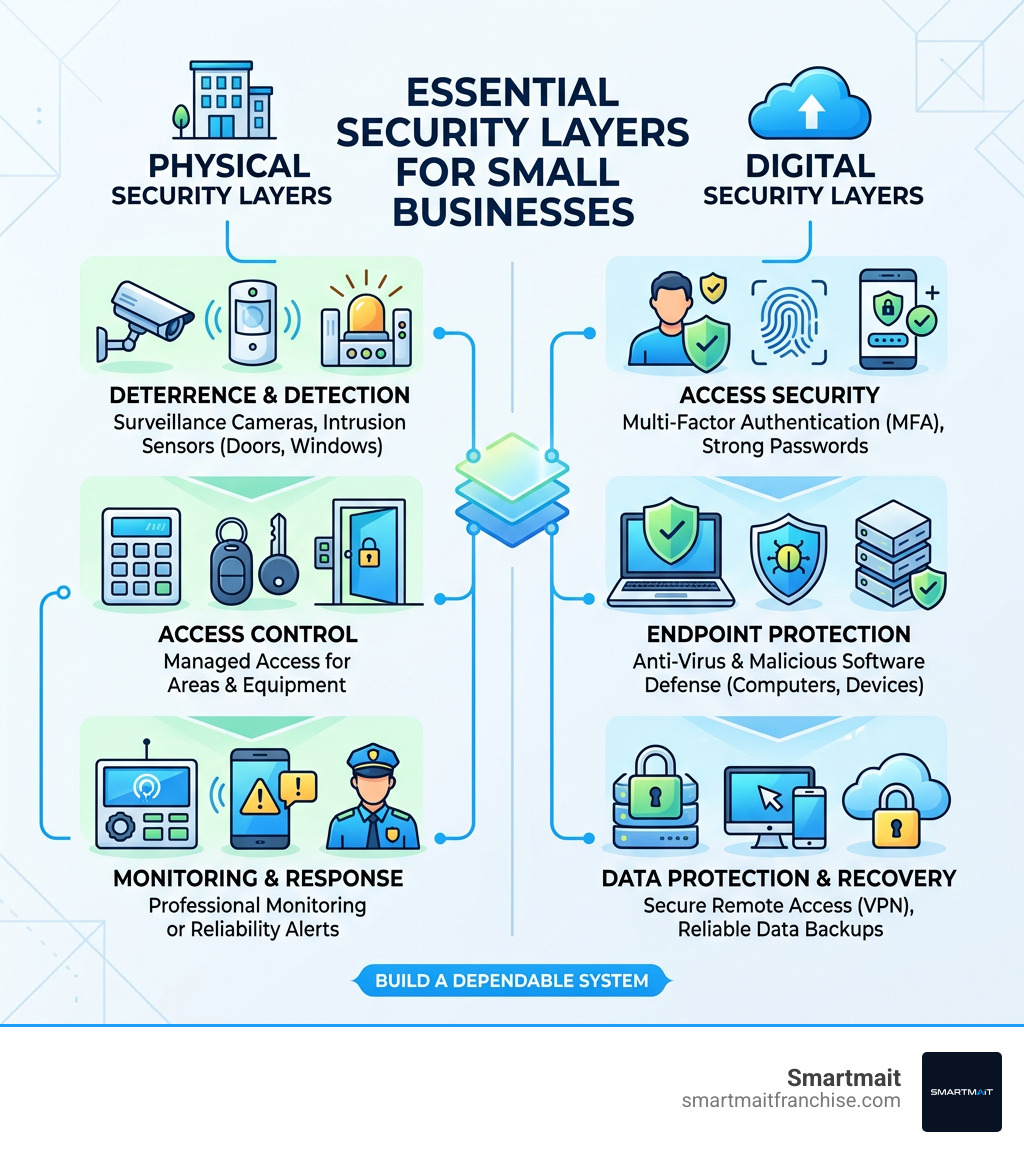
Small business security works best in layers: protect the building, devices, accounts, and data at the same time. Start with cameras and intrusion sensors at doors, windows, cash areas, and high-value equipment. Then add access control, professional monitoring or reliable alerts, multi-factor authentication, endpoint protection, secure remote access, and tested backups.
This approach matters because a break-in can stop operations just as quickly as a ransomware attack. In 2025, nearly 600,000 burglary offenses were reported nationwide, with property losses exceeding $30 billion. Small businesses also face phishing, stolen passwords, payment fraud, and ransomware that can lock critical files or point-of-sale systems.
The goal is not to buy the most technology. It is to build a dependable system that detects trouble early, limits access, preserves evidence, and helps your team recover quickly.
I am Dominic Hesano, a business operator focused on smart technology, low-voltage systems, networking, automation, and small business security for commercial spaces. In this guide, I will break down the practical security basics that help owners get expert protection without unnecessary complexity.
Assessing Common Physical and Cyber Threats
When evaluating the risk profile of an enterprise, physical vulnerabilities and digital exposure feed into one another. A burglar who walks out with an unencrypted office laptop has simultaneously orchestrated a physical theft and a massive data breach.
Understanding the financial and operational impact of these incidents highlights why leaving entryways or networks unprotected is a gamble no business can afford:
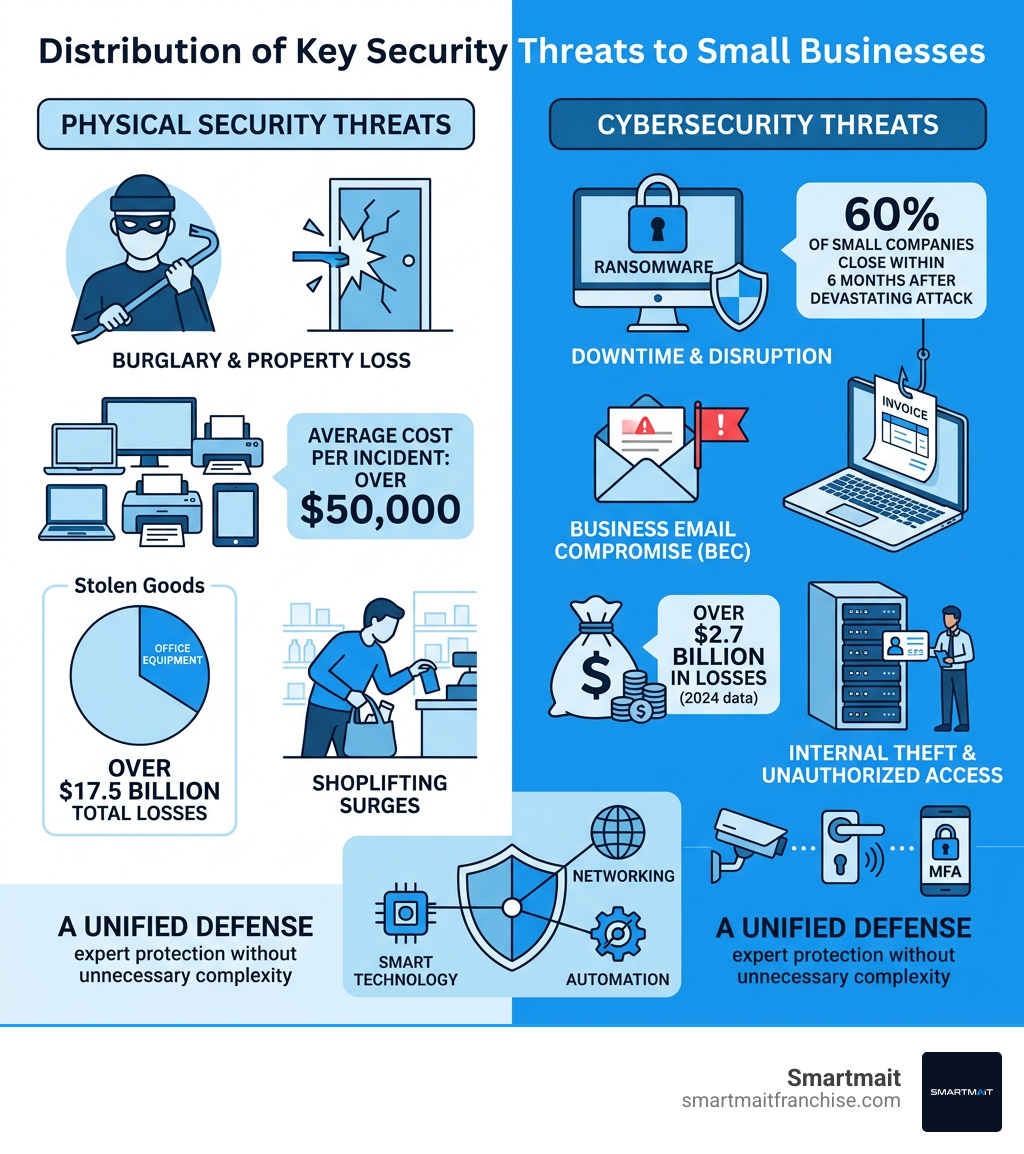
- Burglary and Property Loss: Business burglaries cost over $50,000 on average per incident. In 2025 alone, commercial property losses contributed significantly to the nationwide tally of stolen assets.
- Targeted Office Equipment: Office equipment ranked as the sixth most valuable category of stolen goods, accounting for nearly $17.5 billion worth taken in a single year. Alarmingly, only about $19 million—just over 1%—was ever recovered by law enforcement.
- Retail Shoplifting Surges: Commercial storefronts face compounding losses; shoplifting incidents cost businesses 90 percent more per year between 2019 and 2023.
- Ransomware Crippling Operations: Ransomware demands frequently range between $50,000 and $500,000. For small firms without reliable backups, the downtime alone can force doors closed permanently—roughly 60% of small companies that suffer a devastating cyber attack shutter within six months.
- Business Email Compromise (BEC): In 2024, the FBI reported over $2.7 billion in losses from BEC schemes alone, tricking employees into diverting invoices or wiring funds to fraudulent accounts.
- Internal Theft and Unauthorized Access: Unmonitored inventory rooms, shared physical keys, and uncontrolled access permissions expose organizations to employee theft and unauthorized after-hours entry.
Essential Physical Controls for Small Business Security
Deterring physical break-ins requires establishing structured defensive perimeters around your property. If an intruder attempts to force a door, smash a window, or wander into a restricted inventory room, your sensors must register the event immediately.
Key physical security hardware includes:
- Perimeter Contact Sensors: Placed on all exterior doors, delivery bays, and accessible windows to signal unauthorized opening instantly.
- Glassbreak Detectors: Tuned to the specific acoustic frequencies of breaking glass, providing instant alarm verification before an intruder even steps foot inside.
- Motion Sensors: Deployed strategically in open hallways, showrooms, and warehouses (ideally positioned in corners roughly 6 feet high with a 90-degree field of view) to catch interior movement after hours.
- Continuous High-Definition Video: Motion-only recording often misses crucial context before an alarm triggers. High-definition commercial video surveillance captures 24/7 evidentiary footage of parking lots, points of sale, and sensitive back-office storage.
To design an effective surveillance layout tailored to your commercial floor plan, explore our detailed guide on the best CCTV for small business.
Crucial Cybersecurity Defenses for Small Teams
Physical deadbolts and glassbreak sensors keep physical intruders outside, but software firewalls and authentication protocols keep cybercriminals out of your financial accounts and databases. Implementing enterprise-grade cyber defenses does not require a massive IT team.
Focus on establishing these core controls:
- Multi-Factor Authentication (MFA): Enforce app-based MFA across every email account, cloud platform, and administrative login. MFA neutralizes the vast majority of automated credential attacks.
- Password Managers: Eliminate reused or sticky-note passwords by provisioning dedicated password managers for your staff, ensuring every system uses high-entropy, distinct credentials.
- Endpoint Protection and Patching: Deploy managed endpoint security across all workstations, mobile devices, and servers to block malware and remediate ransomware attempts before they spread across your local area network.
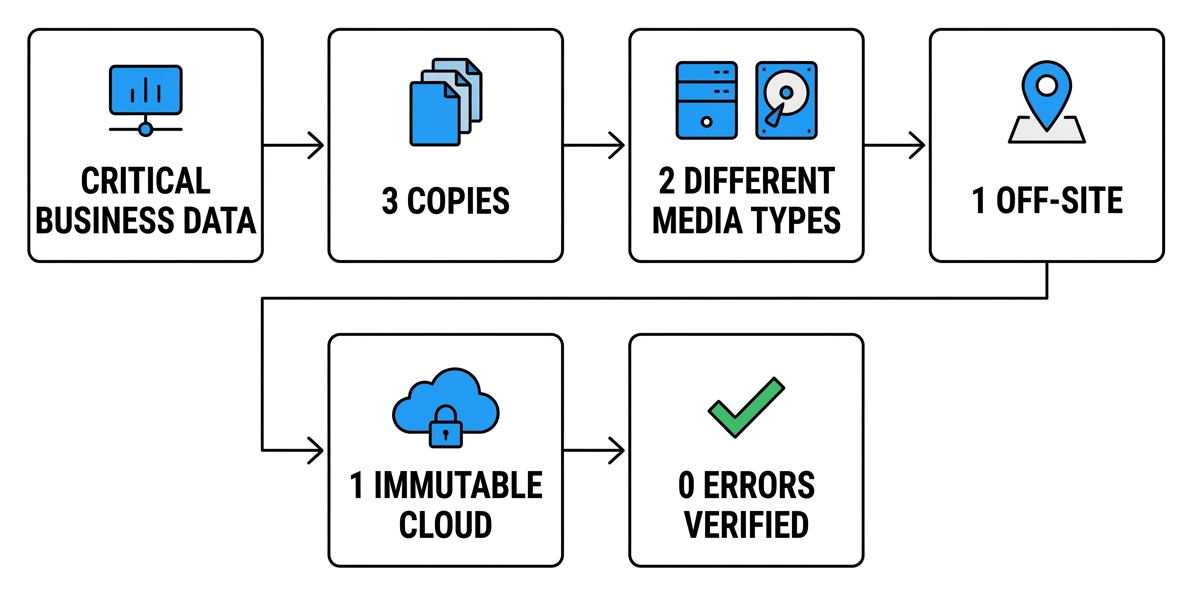
- The 3-2-1-1-0 Backup Rule: Keep three copies of your critical business data across two different storage media types, with one copy stored off-site, one copy stored in an immutable (unalterable) cloud repository, and zero errors verified via automated restoration testing.
- Secure Remote Access & Encryption: Use encrypted network tunnels and device-level drive encryption to ensure that remote workers and lost hardware never compromise proprietary data.
For a deeper dive into establishing tiered cyber defense protocols on a practical budget, review the complete guide to small business cybersecurity.
Core Pillars of Modern Small Business Security
Modern commercial security moves beyond static alarms that simply make noise. Today’s systems integrate active deterrence, environmental monitoring, and smart building management into a single operational dashboard.
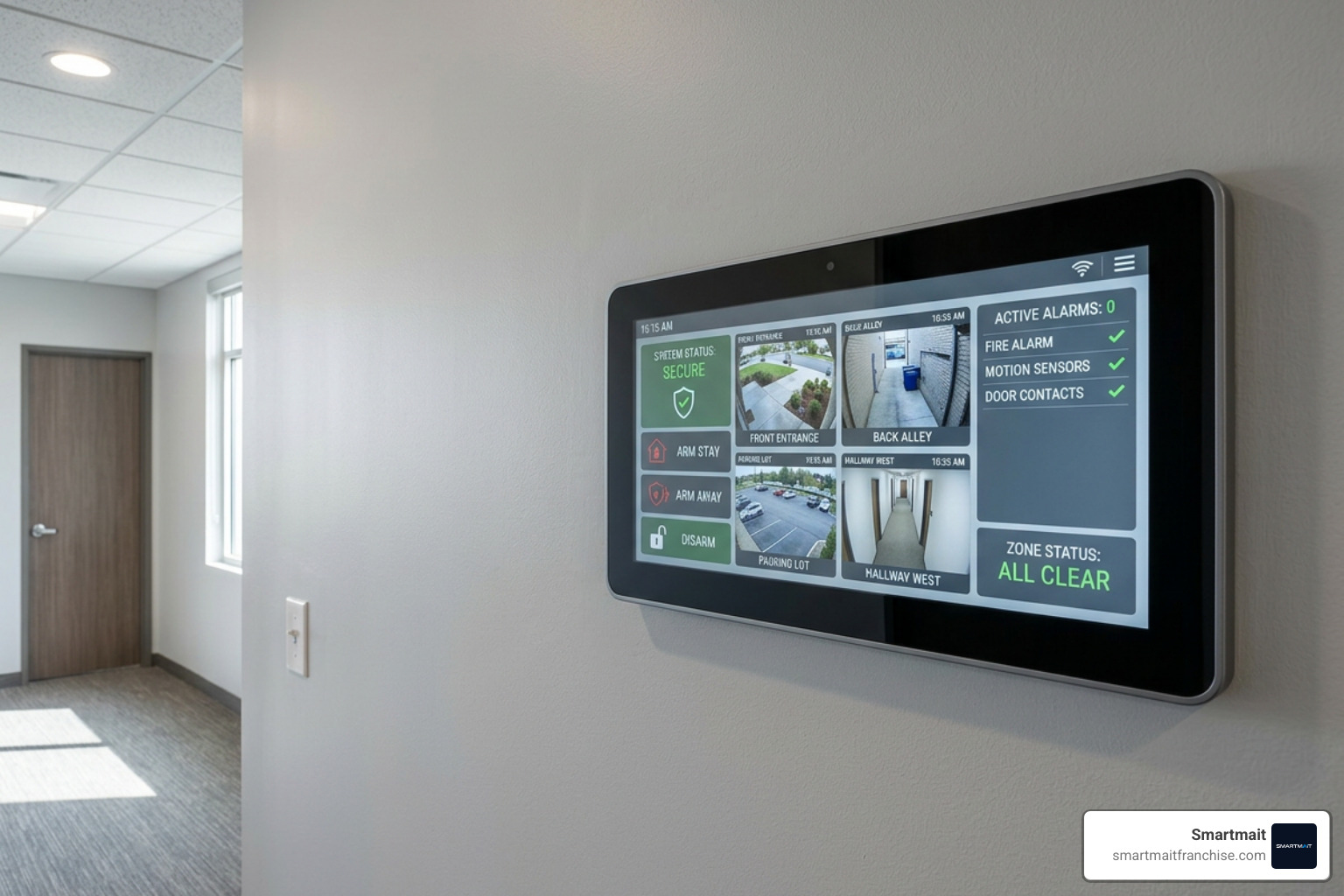
Leading installations combine multiple proactive capabilities:
- AI-Powered Video Analytics: Advanced optical sensors differentiate between vehicles, stray animals, delivery personnel, and potential intruders. This eliminates nuisance alerts while enabling real-time perimeter tracking.
- Two-Way Audio and Active Deterrence: Exterior cameras equipped with motion-activated spotlights and built-in speakers can issue automated verbal warnings to trespassers or enable live monitoring agents to intervene verbally before property damage occurs.
- Integrated Environmental Sensors: Water leaks, frozen pipes, and sudden temperature spikes in server rooms or commercial walk-in freezers can ruin inventory faster than a burglar. Unified platforms incorporate flood sensors, temperature probes, and connected smoke detectors.
- Cellular Fallback and Power Redundancy: Commercial base stations feature integrated backup batteries and dedicated cellular radios, ensuring your alarm panel continues communicating with central dispatch even if severe weather or vandalism cuts commercial power and landline internet.
Comparing DIY vs. Professionally Installed Systems
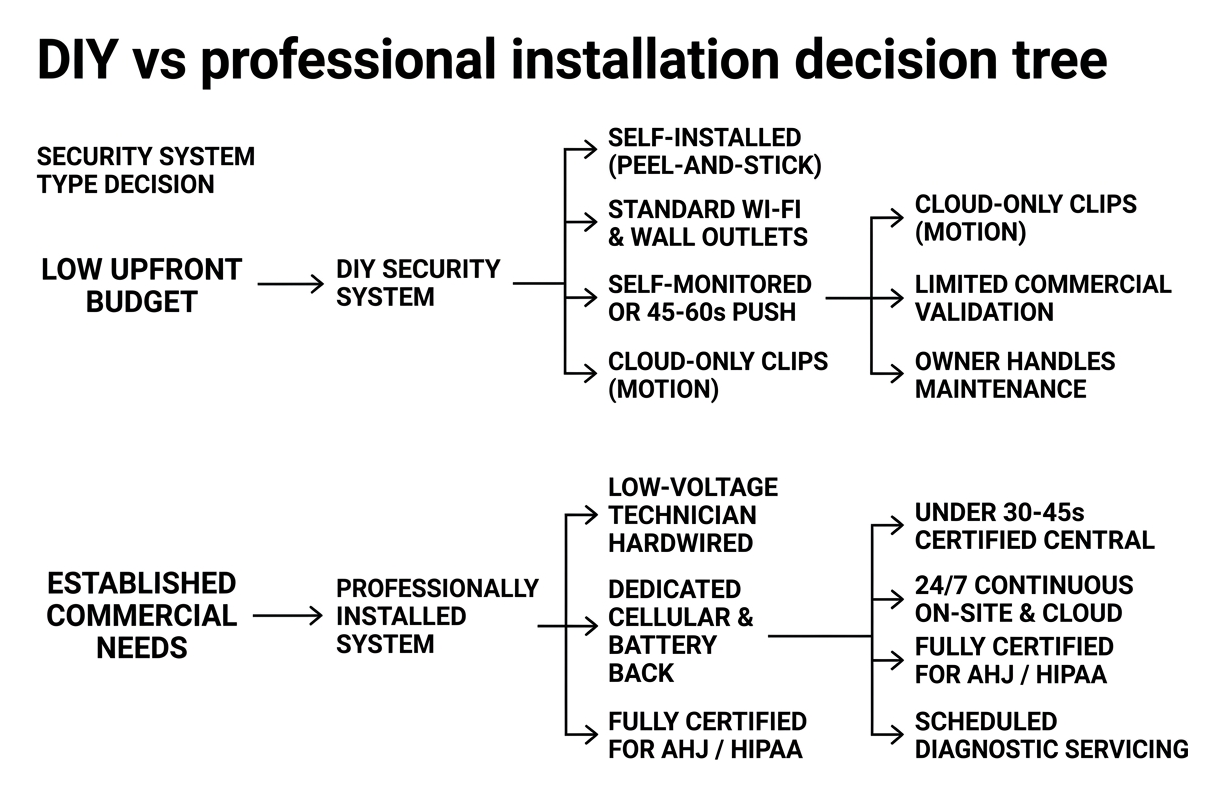
Choosing between off-the-shelf, self-installed kits and professionally engineered commercial setups is a primary decision for business operators. While DIY setups appeal to tight upfront budgets, they carry operational tradeoffs in commercial environments.
When evaluating system architectures, read our guide to comparing video surveillance systems to determine whether wireless hardware or hardwired IP equipment best suits your square footage.
Tailoring Systems for Industry Needs and Compliance
Security is never one-size-fits-all; a veterinary clinic handles physical narcotics and client records, while a retail clothing store battles inventory shrinkage and front-door grab-and-run incidents.

Tailoring Small Business Security by Industry Type
- Retail Establishments: Require wide-angle overview cameras over cash drawers, discreet panic buttons under checkout counters, and electronic article surveillance at main exits to combat retail shrinkage.
- Restaurants and Bars: Need rugged, waterproof environmental sensors in refrigeration walk-ins, wide dynamic range (WDR) cameras to handle shifting low-light dining room environments, and strict access controls on liquor and dry storage.
- Warehouses and Logistics Facilities: Require long-range motion sensors (with 35+ foot detection ranges), AI-driven vehicle tracking across loading docks, and electronic gate access controls.
- Medical and Dental Practices: Focus on strict access control permissions to keep unauthorized personnel out of drug cabinets and physical records rooms, alongside continuous video coverage of public waiting areas.
- Professional Office Suites: Prioritize keycard or mobile-credential access readers on server closets and suite entrances, paired with managed firewall protection to safeguard client data.
To see how professional monitoring ties these industry setups together, consult our guide to security system monitoring.
Insurance Discounts and Regulatory Compliance Benefits
Investing in certified commercial security provides direct bottom-line benefits through reduced insurance overhead and streamlined compliance audits:
- Commercial Property Insurance Discounts: Underwriters frequently offer policy premium discounts between 5% and 20% for commercial properties protected by UL-listed, 24/7 professionally monitored alarm systems and tamper-resistant camera networks.
- PCI DSS Compliance: Retailers processing credit card payments must restrict physical access to cardholder data environments, maintaining strict access logs and video surveillance at transaction points.
- HIPAA Physical Safeguards: Healthcare facilities must implement physical access controls (45 CFR § 164.310) to prevent unauthorized entry into areas housing protected health information (PHI).
- Evidentiary Documentation: When disputes, slip-and-fall claims, or property damage incidents occur, continuous 24/7 high-definition footage provides indisputable evidence that shields businesses from fraudulent liability payouts.
To understand proper camera placement and mounting techniques that satisfy insurer and legal standards, reference our complete walkthrough on video surveillance system installation.
Budgeting and Cost Breakdown for Commercial Protection
Designing an effective security budget involves balancing initial capital expenditures against ongoing operational costs. A well-planned security deployment pays for itself by preventing catastrophic losses, avoiding municipal false alarm fines, and keeping insurance rates low.
Projected Commercial Security Costs (Estimated 2026 Rates)
- Hardware and Initial Setup:
- Basic Starter Package (1-5 sensors, base station, smart lock): $300 – $700
- Mid-Tier Commercial Installation (Hardwired cameras, access panels, full intrusion detection): $1,200 – $3,500
- Comprehensive Commercial Buildout (Multi-door access, AI analytics, continuous NVR storage): $4,000 – $10,000+
- Monthly Monitoring & Platform Subscriptions:
- Basic Cellular Alarm Monitoring: $25 – $45 / month
- Video Verification & Live Guard Deterrence: $50 – $120 / month
- Cybersecurity Software Subscriptions:
- Managed Endpoint Protection & Anti-Phishing: $3 – $8 / user / month
- Enterprise Password Management & MFA Tools: $3 – $6 / user / month
- Immutable Cloud Backup Licensing: $50 – $200 / month (depending on data volume)
Preventing False Alarms and System Failures
Municipalities often levy steep fines—sometimes exceeding $250 per occurrence—when police respond to false alarms caused by poor sensor placement or user error.
Regular maintenance, routine battery replacements, and proper user training ensure your system remains an asset rather than an administrative headache. To optimize sensor sensitivity and train your staff effectively, consult our guide to alarm system set up and false alarm prevention.
Frequently Asked Questions
How much should a company spend annually on protection?
A typical small business with 5 to 25 employees should plan to allocate between $1,500 and $5,000 annually for comprehensive security. This covers amortized hardware installation, 24/7 professional alarm monitoring, endpoint antivirus licenses, password manager seats, and cloud backup storage. Businesses in high-risk retail sectors or regulated industries (like healthcare or financial services) may scale this budget to $10,000–$15,000 annually to cover advanced access control and compliance-grade audit logging.
Can small commercial spaces rely on residential alarm hardware?
While residential hardware can function in very small, single-room offices (under 1,000 square feet), commercial spaces generally outgrow them quickly. Residential systems typically lack continuous 24/7 video recording, offer limited sensor capacity, cannot integrate with commercial door-strike access hardware, and may fail to satisfy local commercial building codes or insurer underwriting mandates for UL-certified central station dispatch.
How do alarm systems reduce commercial insurance premiums?
Insurance carriers calculate property coverage premiums based on risk. When a business installs a professionally monitored security system with cellular backup and continuous video surveillance, the statistical likelihood of an unresolved burglary, undetected fire, or major water leak drops substantially. Providing your insurance underwriter with an official Certificate of Installation from a certified provider typically yields an annual policy discount between 5% and 20%.
Conclusion
Securing a growing business requires an integrated mindset. Leaving your digital perimeter unguarded makes physical door locks meaningless against ransomware, just as neglecting physical access controls exposes your most critical server hardware to anyone walking through an unlocked back door.
By layering robust intrusion sensors, continuous video surveillance, smart access control, and proactive cyber hygiene, you build a resilient operational environment that protects your revenue and your team.
At Smartmait, we specialize in bridging this gap for business owners. As a national franchise leader in smart-building technology, low-voltage infrastructure, and commercial automation, we provide end-to-end design, expert installation, and ongoing maintenance to keep your facilities protected 24/7.
To explore the ideal camera configurations, lens choices, and storage architectures for your commercial facilities, read The Ultimate Guide to Cameras for Business Security and build your customized protection strategy today.