
Why a 12 Channel Security Camera System Creates a Strong Service Opportunity
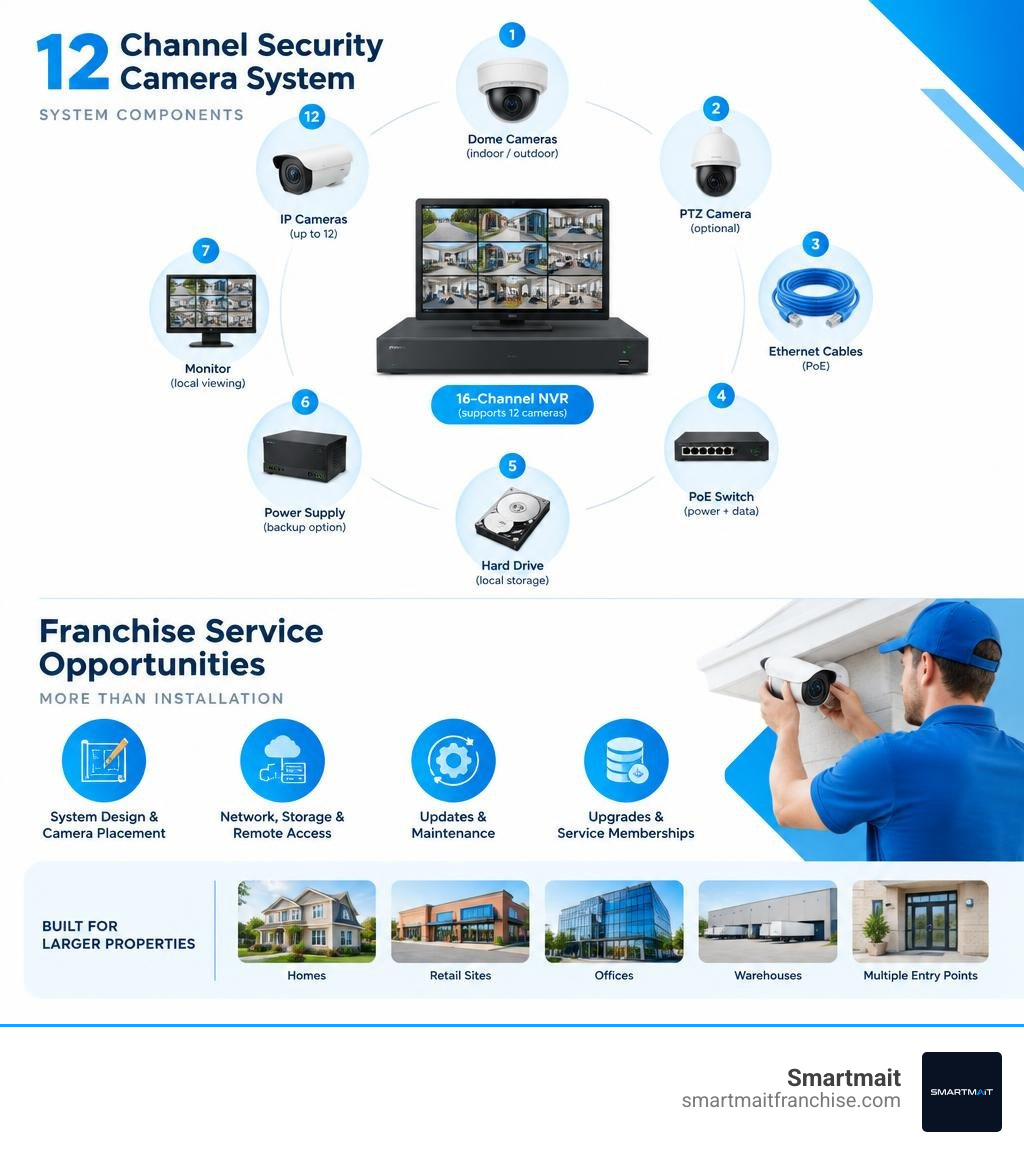
A 12 channel security camera system supports up to 12 cameras from one central recorder. For low-voltage franchise operators, it is a practical service package for larger homes, retail sites, offices, warehouses, and properties with several entry points. The best opportunity is usually a wired IP camera system with a 16-channel NVR and Power over Ethernet (PoE), leaving room for future camera additions while providing stable video, local recording, and remote access.
For a franchise buyer or established integrator, this type of project can create revenue beyond the initial installation through:
- System design and camera placement planning
- Network, storage, and remote-viewing setup
- Firmware updates and ongoing maintenance
- Storage upgrades, camera additions, and service memberships
A 12-camera setup is not simply a larger camera kit. It requires clear planning around bandwidth, hard-drive retention, camera style, AI detection, and long-term support. That makes it a useful example of how smart-building operators can package reliable technology with recurring customer care. Industry resources such as closed-circuit television explain the broader surveillance infrastructure that franchise operators support.
I am Dominic Hesano, a franchise development professional and business operator building Smartmait around low-voltage, smart-building, security, networking, and automation services. My work focuses on helping future operators understand how a 12 channel security camera system can fit into a scalable installation, support, and recurring-service business.
Quick 12 channel security camera system definitions:
Evaluating a 12 Channel Security Camera System Service Offering: Core Architecture and Business Use Cases

When evaluating a franchise territory in the low-voltage integration sector, prospective owners must examine the density of mid-market commercial and high-end residential real estate. A 12-camera configuration represents a sweet spot in the security landscape: it moves beyond basic DIY setups while remaining nimble enough for standardized execution across residential estates, retail storefronts, light industrial facilities, and regional branch offices.
For entrepreneurs looking into smart-home and commercial integration franchise models, understanding these surveillance architectures is essential for establishing structured operations. Offering standardized multi-camera deployments allows operators to build clear operating procedures for technical staff, maintain predictable supply chain relationships, and create structured service packages. By addressing properties that require comprehensive visibility across loading bays, sales floors, perimeters, and access points, integration franchises can anchor their service catalogs with high-demand installations.
Understanding this balance is central to establishing the ultimate guide to best CCTV for small business clients, who regularly seek professional-grade coverage without the operational friction of enterprise-scale data centers.
When to Offer a 12 Channel Security Camera System Instead of Smaller Setups
Small 4-channel or 8-channel packages often leave blind spots on properties exceeding 3,000 square feet or those featuring detached structures, multiple entrances, and delivery docks. Deploying a comprehensive 12-camera package allows an integration business to provide full perimeter defense, entry point tracking, inventory monitoring, and parking lot oversight under a single unified platform.
In commercial environments—such as multi-bay auto repair shops, independent hardware stores, and medical clinics—a 12-camera setup eliminates the gaps where inventory loss, workplace incidents, or property damage frequently go unrecorded. For an integration franchise, these mid-tier commercial projects represent ideal targets for routine maintenance contracts, regular lens cleaning, angle adjustments, and system audits.
IP NVR vs. Analog DVR Architectures
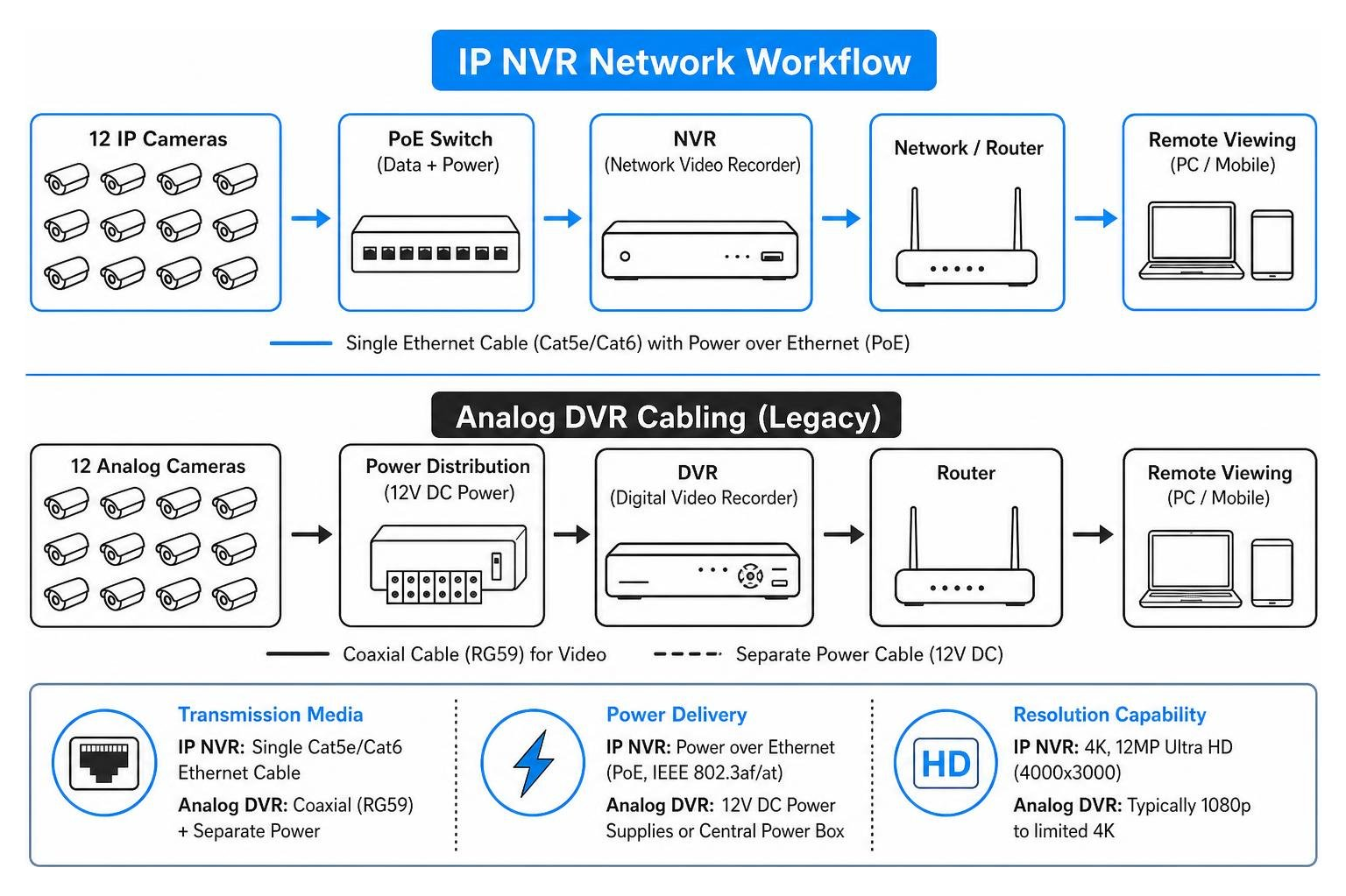
One of the fundamental operational choices for any low-voltage integration business involves selecting the underlying transmission architecture: modern Network Video Recorders (NVR) utilizing Internet Protocol (IP) versus legacy Digital Video Recorders (DVR) reliant on coaxial cables.
| System Parameter | IP Camera + NVR Architecture | Analog Camera + DVR Architecture | Franchise Operational & Training Impact |
|---|---|---|---|
| Transmission Media | Single Category (Cat5e/Cat6) Ethernet Cable | Coaxial Cable (RG59) + Separate Power Wiring | Ethernet standardizes inventory and speeds up technician wire pulls. |
| Power Delivery | Power over Ethernet (PoE, IEEE 802.3af/at) | Individual 12V DC power supplies or central power box | PoE simplifies field termination and reduces failure points. |
| Resolution Capability | High-definition (4K, 12MP Ultra HD at 4000×3000) | Limited scaling (typically 1080p to limited 4K) | High resolution offers superior detail for commercial clients. |
| Edge Intelligence | On-camera AI processing (People, Vehicle, Pet detection) | Centralized processing on the DVR (higher latency) | IP reduces false alarms and service-call callouts. |
| System Expansion | Easily scaled using managed network switches | Hardwired physical port limits on the back of the DVR | NVRs allow flexible additions as a client’s property expands. |
From a franchise operations standpoint, standardizing on IP NVR systems streamlines technician onboarding. Technicians only need to master standard Ethernet termination, network addressing, and PoE power budgets, avoiding the troubleshooting headaches of legacy Siamese coaxial cabling. For operators reviewing how to modernize their service vehicle inventory, mastering CCTV systems installation wired and wireless setup made easy principles is a vital baseline for team training.
Essential Technical Features for Modern 12-Camera Service Packages

Commercial and high-end residential clients expect modern video infrastructure to provide actionable intelligence rather than merely passive recording. As a low-voltage business operator, building a standardized service catalog requires understanding the technical capabilities of modern camera hardware to ensure systems deliver consistent performance across diverse environments.
Standardizing service offerings around advanced image sensors, intelligent edge processing, and deterrence features positions an integration business to deliver comprehensive solutions that require minimal reactive troubleshooting.
Resolution, Image Sensors, and Night Vision Capabilities
Resolution is not just a marketing figure; it dictates the pixel density required to identify faces, verify license plates, and assess incidents at specific distances. Standard 1080p systems provide roughly 2 million pixels per frame, whereas modern 4K sensors deliver 8 million pixels, and 12MP Ultra HD sensors capture at 4000×3000 pixels.
High-performance cameras utilize larger image sensors (such as 1/1.8″ or 1/2.8″ CMOS sensors) paired with Wide Dynamic Range (WDR, typically 120dB) to balance difficult lighting conditions, such as bright glass vestibules or sun-drenched parking lots. Furthermore, modern night vision solutions utilize two distinct technologies:
- Infrared (IR) Illumination: Discreet, invisible 850nm lighting providing crisp monochrome footage up to 100 feet in complete darkness.
- Smart Dual-Light & Color Night Vision: Integrated warm-white LED spotlights (typically 400 to 600 lumens) that activate automatically upon person or vehicle detection, shifting monochrome recording into full color to preserve critical clothing and vehicle color details.
Equipping technicians to evaluate and align hardware with property geometry is a key component of the ultimate guide to cameras for business security.
Audio Recording, Deterrence, and Weatherproofing Standards
Comprehensive commercial packages integrate active deterrence and robust environmental protection. Active deterrence cameras combine flashing red-and-blue or white strobe lights with localized audible sirens to interrupt unauthorized entry before property damage occurs. Integrated microphones and two-way audio provide listen-in audio and interactive communication, though service teams must guide clients on regional audio recording compliance and wiretap regulations.
For outdoor reliability, hardware must meet rigid environmental standards:
- IP66 Rating: Protection against heavy dust storms and strong water jets.
- IP67 Rating: Complete protection against dust ingress and immersion in water up to 1 meter for 30 minutes, vital for exposed rooflines and marine environments.
- IK10 Vandal Resistance: Impact-resistant dome housings engineered to withstand blunt force trauma in public spaces.
Technicians applying an ultimate checklist for security camera installation can audit these physical enclosures during regular quarterly service reviews.
Storage Sizing and Network Bandwidth Planning for a Service Business
A surveillance system is only as reliable as its recorded data. When delivering a 12-camera high-definition system, calculating local hard drive storage and internal network bandwidth is critical. Miscalculating these parameters leads to dropped frames, premature drive failure, and unexpected gaps in video history.
For a low-voltage service provider, designing and maintaining storage infrastructure provides a clear path for recurring service agreements, proactive drive replacement schedules, and remote system health checks.
Designing Storage for a 12 Channel Security Camera System
Calculating surveillance storage requires evaluating camera resolution, frame rates (FPS), operational encoding, and recording modes (24/7 continuous versus intelligent AI-event triggers). Modern deployments utilize advanced H.265 or H.265+ video encoding, which reduces storage consumption and bandwidth demands by approximately 40% to 50% compared to legacy H.264 compression without sacrificing video fidelity.
For 12-camera commercial installations, multi-bay NVR platforms supporting two to four SATA bays (holding 8TB, 12TB, or 16TB surveillance-grade hard drives) are standard. Unlike desktop drives, enterprise surveillance drives are engineered for 24/7 continuous write cycles and feature rotational vibration sensors. Designing these configurations ensures that clients requiring 30 or 60 days of retention meet their insurance mandates without storage bottlenecks.
Selecting Camera Housing Styles: Bullet, Turret, Dome, and PTZ
Standardizing on the right camera form factors ensures straightforward field maintenance and long-term customer satisfaction:
- Turret (Eyeball) Cameras: The industry favorite for versatile outdoor and indoor deployments. Their flat glass face separates the lens from the IR LEDs, eliminating the IR reflection and spider-web attraction common to dome covers.
- Bullet Cameras: Highly visible deterrents featuring long-range lenses and robust sunshields. Best deployed on exterior walls, parking lot light poles, and building perimeters.
- Dome Cameras: Enclosed in impact-resistant bubbles (IK10 rated), making them ideal for high-traffic commercial hallways, schools, and spaces vulnerable to tampering.
- Pan-Tilt-Zoom (PTZ) Cameras: Motorized units featuring optical zoom (10x to 30x) and auto-tracking capabilities, suited for expansive industrial yards and loading docks.
For business owners evaluating operational standards, selecting the best indoor CCTV cameras survival guide metrics helps match hardware selections directly to property architecture.
Wired PoE Installation vs. Wi-Fi Deployment Considerations for Franchise Operators
A primary operational question for prospective franchise owners is whether to deploy wired or wireless surveillance systems. While consumer smart-home markets frequently advertise battery-powered or Wi-Fi devices, a commercial-grade 12-camera deployment requires the stability of a structured wired infrastructure.
Wired Power over Ethernet (PoE, IEEE 802.3af/at) carries several structural advantages for a low-voltage services business:
- Single Cable Runs: Category 6 Ethernet cables deliver up to 30W of power alongside gigabit data up to 300 feet (100 meters) per drop, keeping technician labor efficient.
- Bandwidth Reliability: Twelve 4K streams generate 60–100 Mbps of continuous local network traffic. Transmitting this volume over standard commercial Wi-Fi often leads to dropped packets and network congestion.
- Operational Consistency: Wired drops avoid the client callbacks associated with dead batteries, Wi-Fi router reboots, and RF interference from neighboring businesses.
Structuring field operations around certified wired installations ensures clean wire management, documented patch panels, and organized equipment racks. It also forms the foundation for reliable integration when following frameworks like stop thief a complete guide to video surveillance system installation.
Frequently Asked Questions About 12-Channel Security System Service Opportunities
How much hard drive storage is required for 12 cameras recording continuously?
Storage depends on the camera resolution, frame rate, and compression protocol. For a 12-camera system recording 24/7 in 4K resolution (8MP) at 15 FPS using H.265 compression, the system requires approximately 640 GB of storage per day. To provide a standard 30-day retention window, the NVR requires at least 20 TB of usable surveillance-grade storage, typically configured across two 10TB or 12TB hard drives.
Can a 12-camera security system operate without an internet connection?
Yes. Professional IP NVR systems record video directly to local hard drives via the internal Local Area Network (LAN) without requiring an active internet connection. An internet connection is only needed if the property owner wishes to view live feeds remotely via a mobile app, receive push notifications for AI events, or back up critical clips to off-site cloud storage.
Why are most 12-camera systems wired rather than wireless?
Twelve high-definition cameras streaming continuous video generate substantial data traffic that can easily overwhelm commercial Wi-Fi networks, leading to video latency, frame drops, and battery-maintenance overhead. Wired PoE (Power over Ethernet) provides a dedicated, interference-free connection that delivers both electrical power and data over a single cable up to 300 feet, ensuring round-the-clock reliability.
Conclusion and Next Steps for Building a Smart-Building Services Franchise
The demand for integrated, commercial-grade security systems continues to expand across both residential estates and growing businesses. A 12-channel surveillance installation represents far more than an initial hardware deployment; it is a long-term operational relationship encompassing system design, network optimization, routine camera maintenance, firmware management, and storage lifecycle planning.
For existing low-voltage integrators, home service professionals, and prospective franchise owners, building a business around standardized security and smart-building systems provides an opportunity to move past transactional one-off jobs. By establishing structured service processes and ongoing maintenance memberships, operators can build sustainable businesses serving commercial and luxury residential clients across protected territories.
Smartmait provides comprehensive operational frameworks, vendor-neutral technical training paths, and structured business systems designed to help operators deliver high-value smart-building integration services.
If you are an established low-voltage contractor seeking to scale beyond day-to-day field operations, or an entrepreneur evaluating franchise ownership in the growing smart-technology and commercial services sector, explore how a Smartmait franchise territory can fit your business goals.
Request Franchise Information Today to Learn More About Available Opportunities