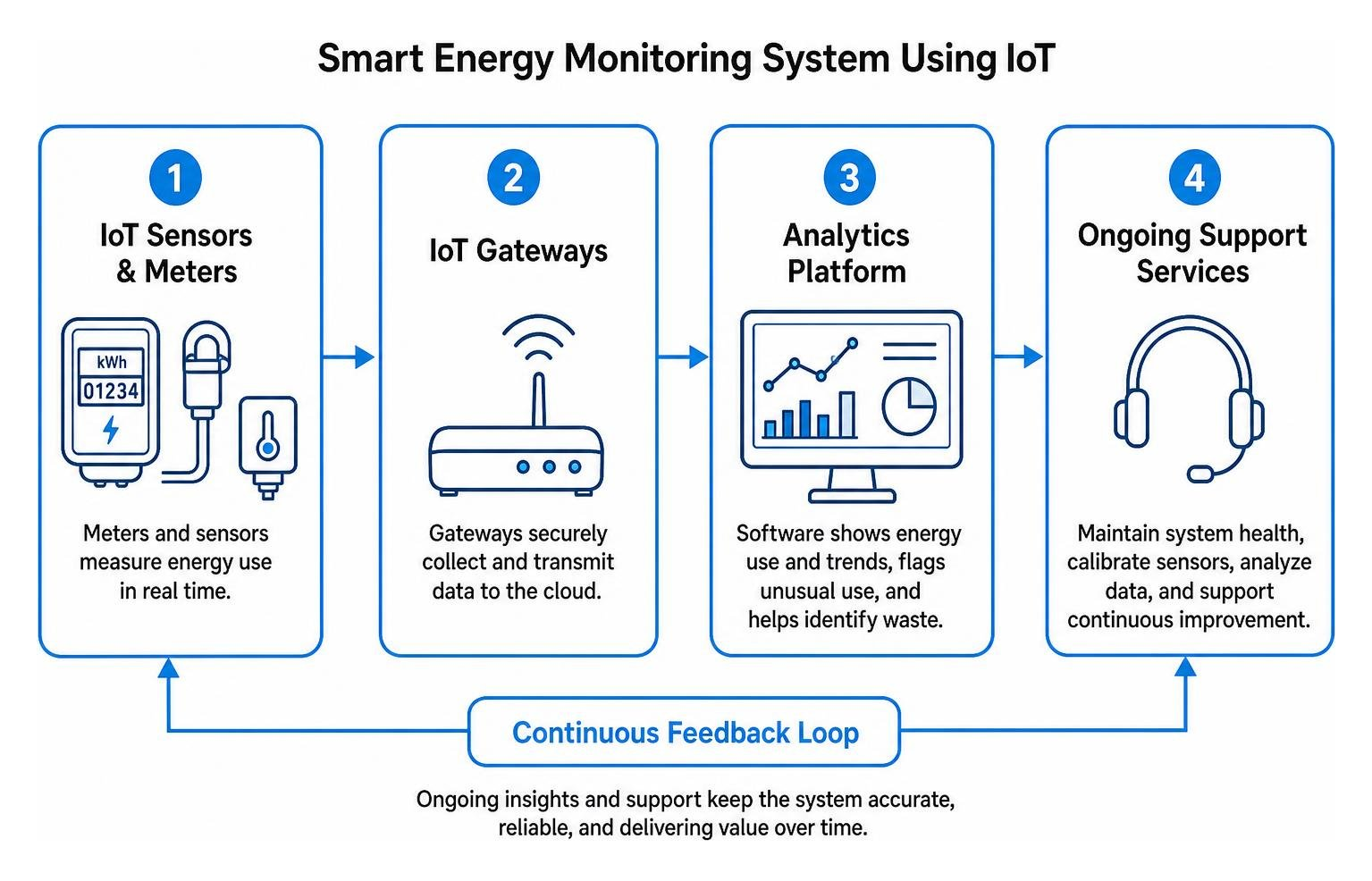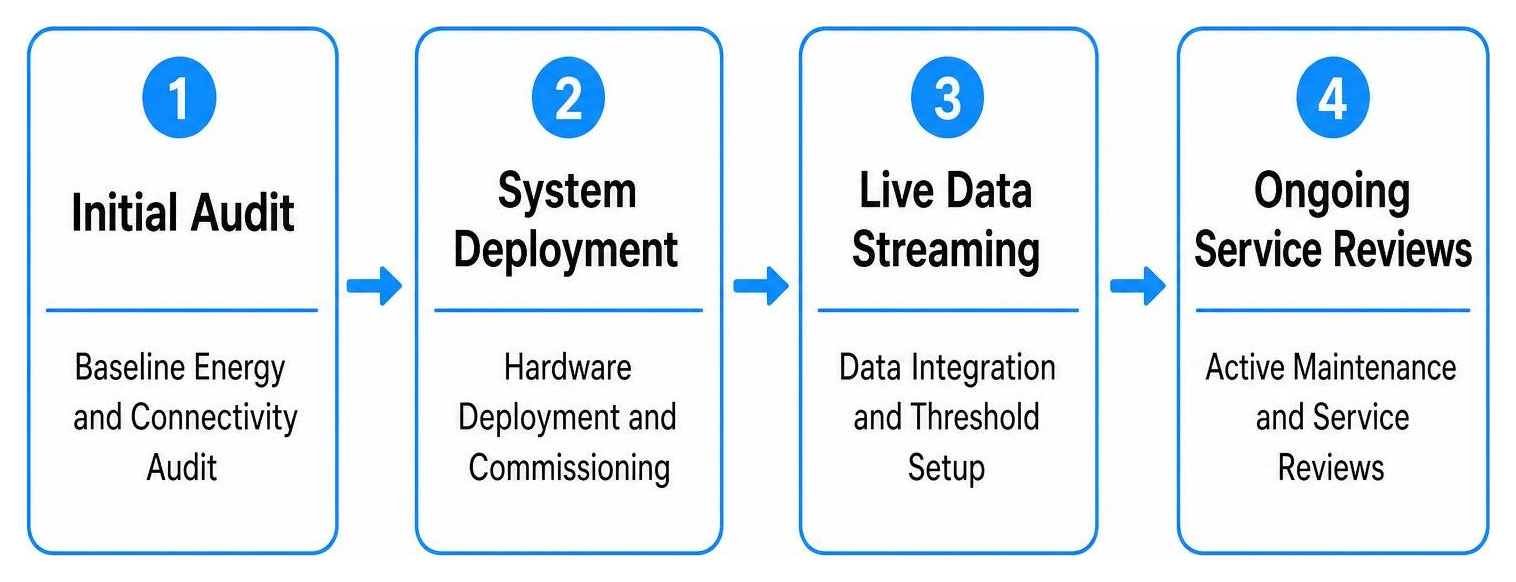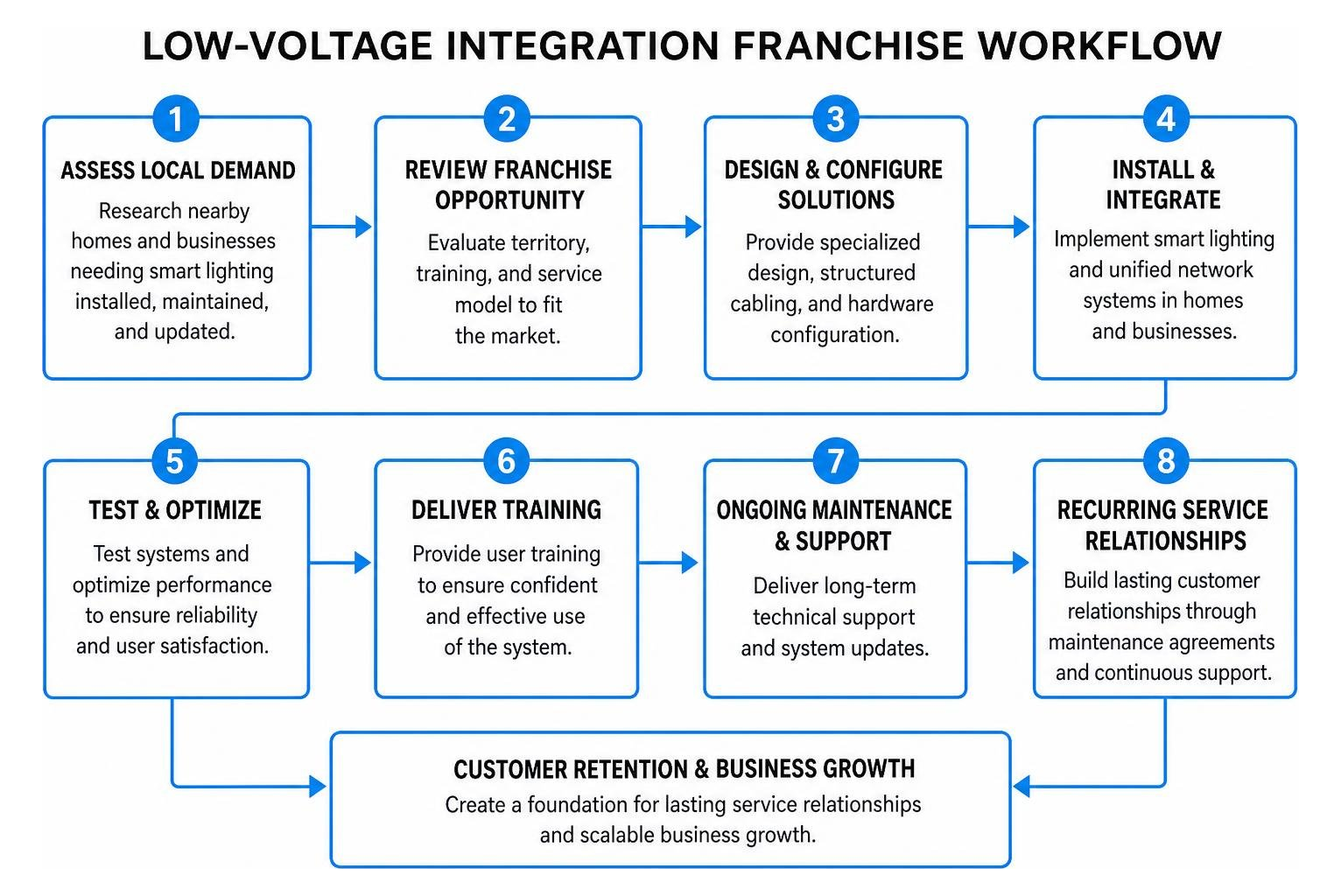
CCTV Installation for Condo Markets: A Franchise Planning Guide

CCTV Installation for Condo Properties as a Franchise Opportunity

If you’re evaluating cctv installation for condo properties as a franchise market, start with three checks: how many condo communities are in your target territory, who approves work in their shared spaces, and whether their systems need ongoing service. A project may cover entrances, parking, elevators, and package rooms, but the business opportunity extends beyond installation to maintenance and system upgrades.

For a prospective Smartmait franchise buyer, the key question is whether local demand can support repeatable low-voltage work and long-term service relationships. Condo boards may need help planning projects, while privacy rules and building access can make the work more complex than a single-home job. According to the U.S. Census Bureau’s American Housing Survey, condominiums and other multifamily structures represent a substantial share of the U.S. housing stock, which underscores the scale of the service market for integration businesses.

I’m Dominic Hesano, a franchise development professional and business operator building Smartmait around smart-building installation and ongoing service. My work in franchising and connected technology shapes how I assess cctv installation for condo properties as a potential service market.
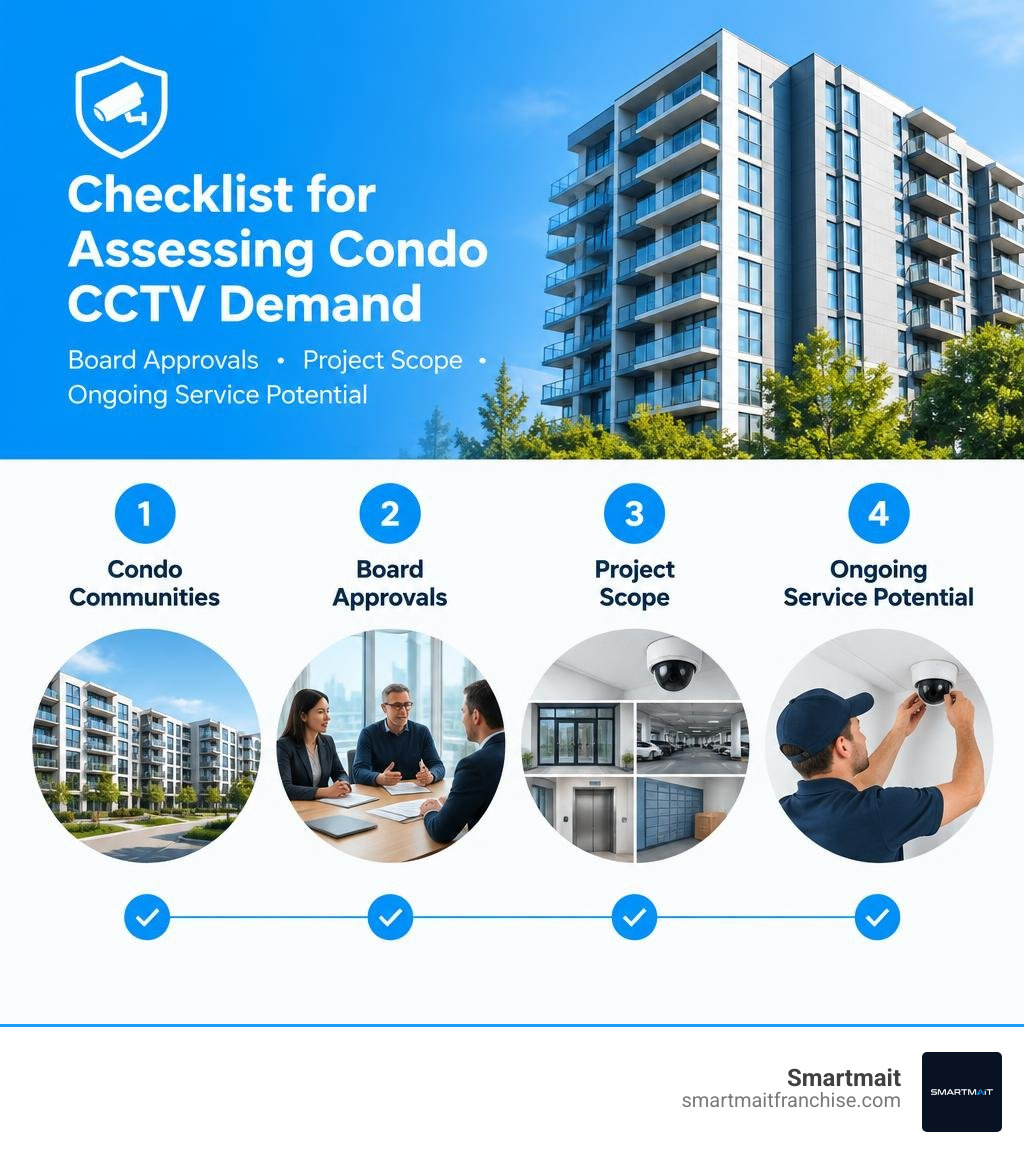
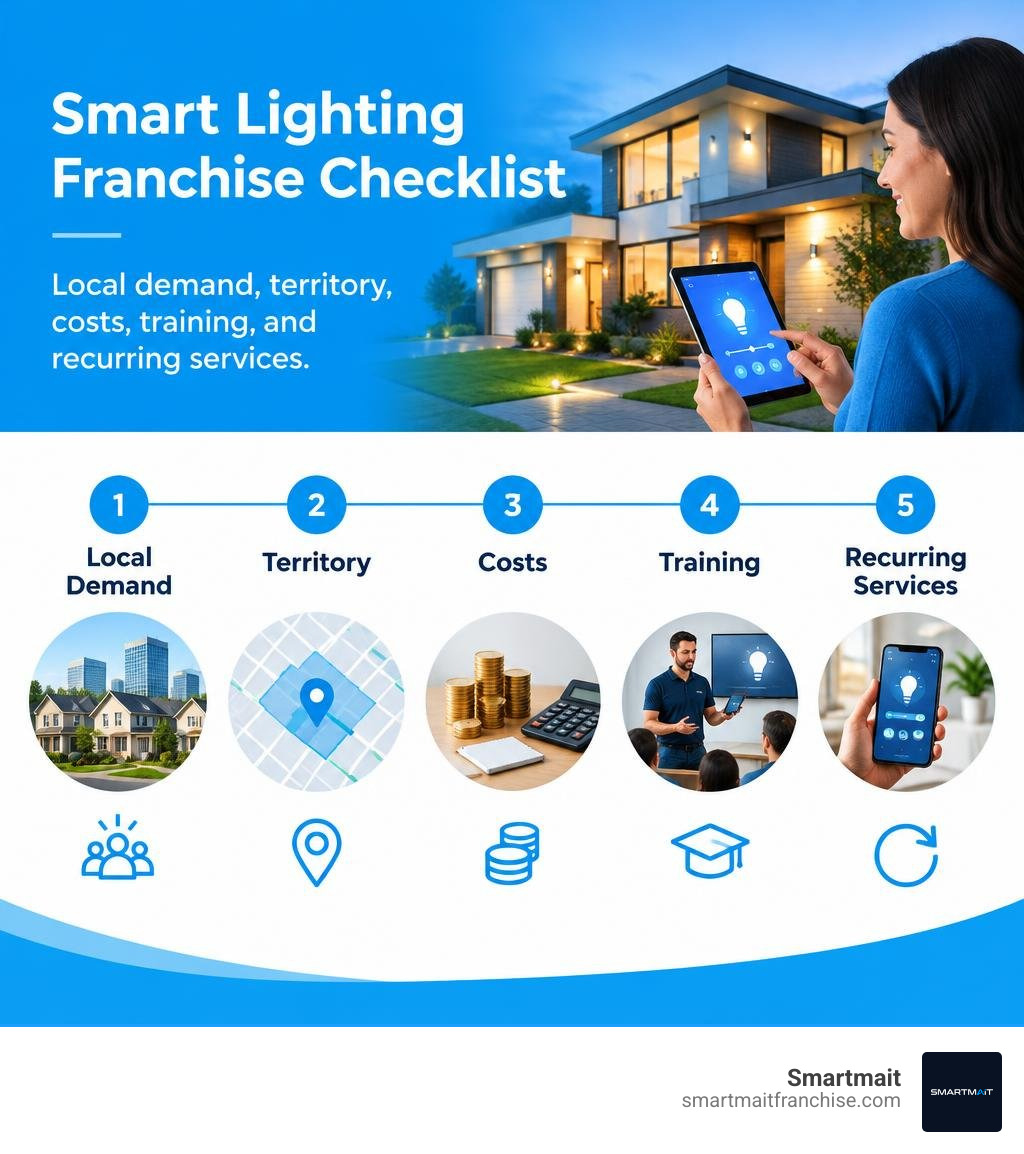
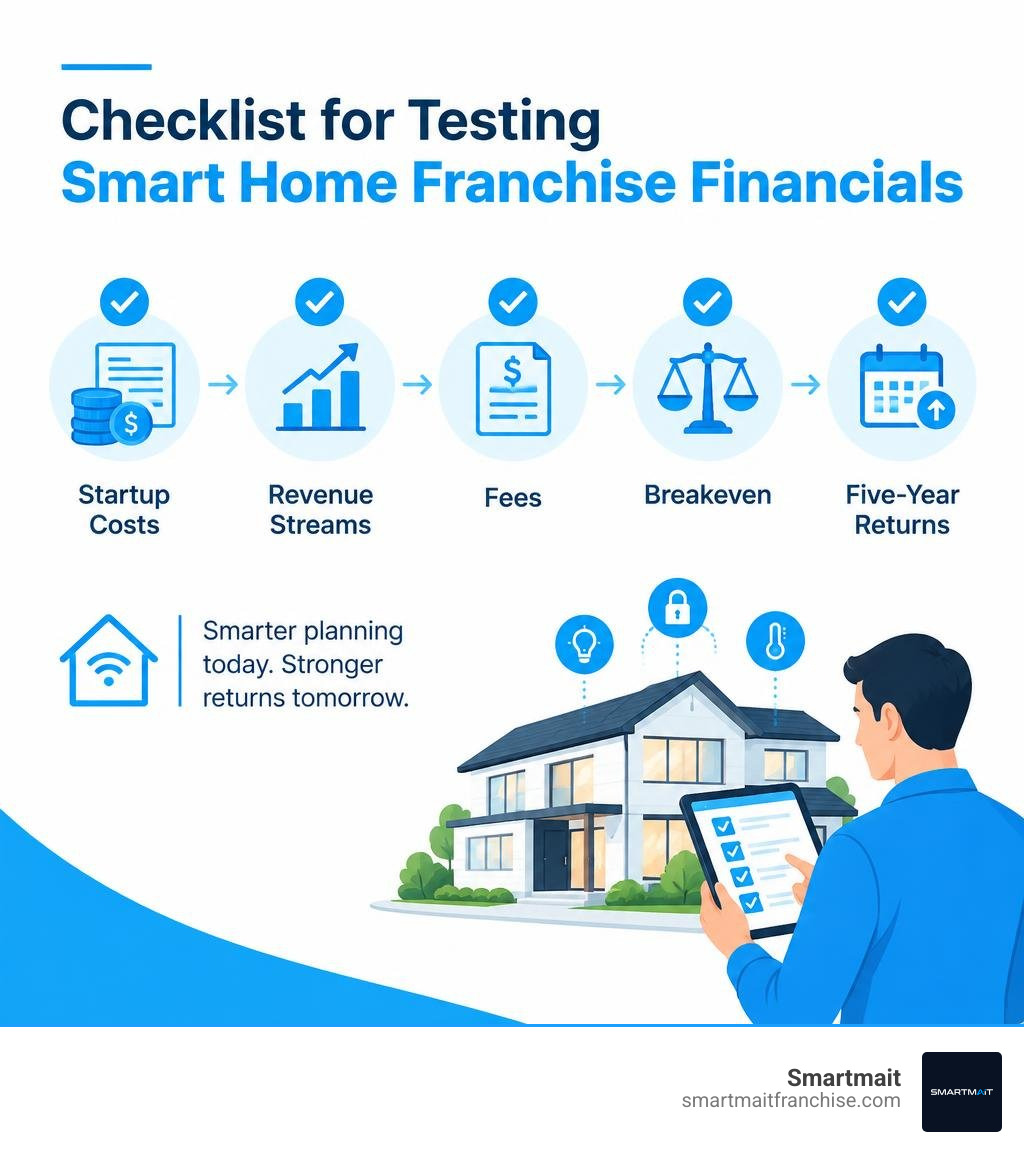
Checklist for assessing condo CCTV demand, board approvals, project scope, and ongoing service potential infographic

Quick cctv installation for condo definitions:

Evaluating Condo Surveillance Projects as Franchise Service Opportunities

The multifamily sector represents a distinct growth vertical for commercial low-voltage contractors and smart-building integration operators across the United States. Unlike standalone residential jobs that end when the last wire is tucked away, multifamily residential communities operate as complex shared-risk ecosystems. For entrepreneurs evaluating franchise ownership or established integration business owners considering a franchise conversion, condominium developments provide a balance of upfront deployment and long-term service relationships.
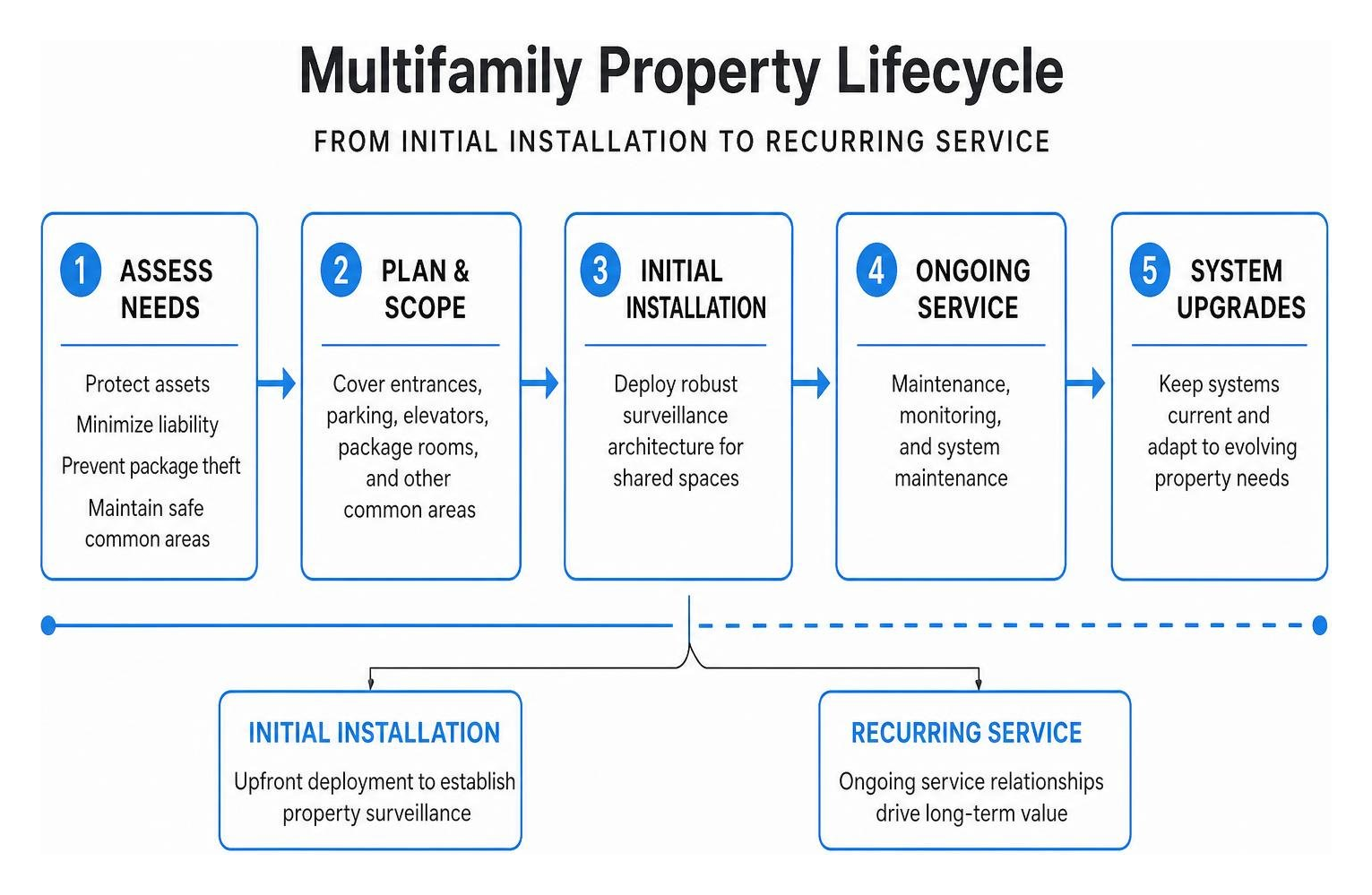
Multifamily property lifecycle showing initial installation transitioning to recurring service

Condominium communities and Homeowners Associations (HOAs) are tasked with protecting physical assets, minimizing liability, preventing package theft in mailrooms, and maintaining safe common areas. These responsibilities require robust surveillance architecture that cannot be satisfied by basic retail hardware. Independent integrators often face challenges scaling their operations in this sector due to owner-dependence, fluctuating project pipelines, and the lack of standardized service packaging.

When operators build their pipeline around structured low-voltage services, comprehensive video surveillance system installation becomes the gateway to ongoing property service contracts. These contracts help establish reliable operational cadence and higher customer retention rates compared to one-off residential work.

Assessing Common-Area Needs and Project Scope

Condo lobby and elevator surveillance cameras

Evaluating a condominium property requires understanding how shared spaces function. Common areas experience heavy daily foot traffic, frequent vendor access, and varying environmental conditions that dictate camera hardware selection and mounting strategies.

Key operational zones across multifamily properties include:

  • Primary Ingress and Egress: Lobbies, vestibules, and turnstiles require high-resolution imaging to verify visitors and cross-reference access control logs.
  • Mail and Package Delivery Hubs: Secure package rooms and mail kiosks experience high rates of misplacement and theft. High-definition coverage with clear field-of-view design eliminates visual blind spots.
  • Elevator Cabs and Vertical Transit: Elevators present mechanical movement challenges, requiring specialized traveling cables or dedicated wireless bridge units to transmit video data from the cab to the core network without physical cable fatigue.
  • Parking Garages and Outer Perimeters: Garages present poor ambient lighting, vehicle movement, and reflective glare. These zones demand dynamic range capabilities, infrared illumination, and outdoor bullet or PTZ cameras for perimeter tracking.
  • Amenity Spaces: Fitness centers, clubhouses, swimming pools, and rooftop decks require discreet indoor domes or weather-resistant units that secure the assets while respecting the recreational nature of the space.

When planning project deployment across these zones, technicians must select optimal hardware locations to provide overlapping coverage without capturing private residential doorways or windows. Following the definitive guide to best places to mount security cameras ensures that fields of view remain unobstructed, legal, and vandal-resistant.

Infrastructure Considerations for Condo Projects

Multifamily buildings demand commercial-grade network topologies and structured low-voltage wiring. While single-family residences often utilize simplified layouts, multi-story buildings require coordinated network planning to support high-bandwidth video streams without packet loss.

Understanding infrastructure begins with deciding between wired and wireless security camera systems. In multi-unit properties, high-density Wi-Fi environments often face RF interference, thick concrete floors, and steel structural members. Commercial integration businesses rely primarily on hardwired Power over Ethernet (PoE) architectures.

PoE infrastructure delivers power and high-speed data across a single Cat6 run, simplifying cable management and centralizing backup power through Uninterruptible Power Supplies (UPS) located in telecommunications closets. For large commercial facilities or expansive condominium mid-rises, technicians deploy intermediate distribution frames (IDFs) on alternating floors connected via fiber-optic uplinks to the main distribution frame (MDF).

Strategic Planning for Franchise Operators Serving Condo Communities

To build an efficient business model in the multifamily security sector, franchise operators must align their market selection, workforce capabilities, and customer agreements. Condominium associations do not operate on spontaneous impulse buys; they plan work through annual budgeting cycles, reserve studies, and formal board review meetings.

Successfully navigating this market requires positioning your integration business not merely as a cabling subcontractor, but as a long-term technology and maintenance partner. Professional management companies and HOA boards prioritize contractors who offer documented quality standards, reliable technician response times, and predictable maintenance programs.

Defining Service Offerings and Recurring-Revenue Models

A primary operational advantage of commercial smart-building integration is transforming initial project work into predictable recurring maintenance agreements. Without recurring contracts, independent low-voltage businesses remain trapped in an unpredictable cycle of hunting for new project revenue each month.

For mid-sized developments or community clubhouses, configuring structured multi-channel hardware is common. Deploying a centralized 12-channel security camera system allows property managers to cover critical common areas while preserving expansion capacity for future access points or perimeter gates.

By wrapping these hardware deployments into structured service-level agreements (SLAs), franchise operators secure recurring revenue while providing boards with dependable system uptime.

Regulatory and Privacy Considerations for Condo Projects

Navigating condominium projects requires strict adherence to property governance and privacy laws. HOA boards operate under defined bylaws and Declaration of Covenants, Conditions, and Restrictions (CC&Rs). Before running a single cable, operators must ensure that all proposed camera placements comply with both local building codes and association guidelines.

Key governance and privacy principles include:

  1. Strict Avoidance of Private Zones: Cameras must never be angled toward private unit interiors, residential windows, balconies, or restrooms where individuals have a legal expectation of privacy.
  2. Clear Public Signage: Conspicuous, professional signage must be posted at all pedestrian and vehicular entrances, notifying residents, guests, and delivery staff that video recording is active.
  3. Footage Access and Retention Protocols: Condo associations must establish formal retention guidelines (typically 14 to 30 days) and define strict data governance rules. Board members should not distribute video feeds indiscriminately; instead, access should be restricted to authorized property management personnel or exported solely for formal law enforcement investigations.
  4. Board Presentation and Approval: Integrators must supply detailed camera layout maps, field-of-view simulations, and spec sheets to help board members explain project plans clearly during community meetings.

Operational Execution: Building a Scalable Integration Business

For independent integration business owners considering a franchise conversion, scaling beyond owner-dependence represents the single biggest operational milestone. When an owner is personally responsible for bidding, pulling cable, terminating jacks, and answering support calls, business growth naturally hits a ceiling.
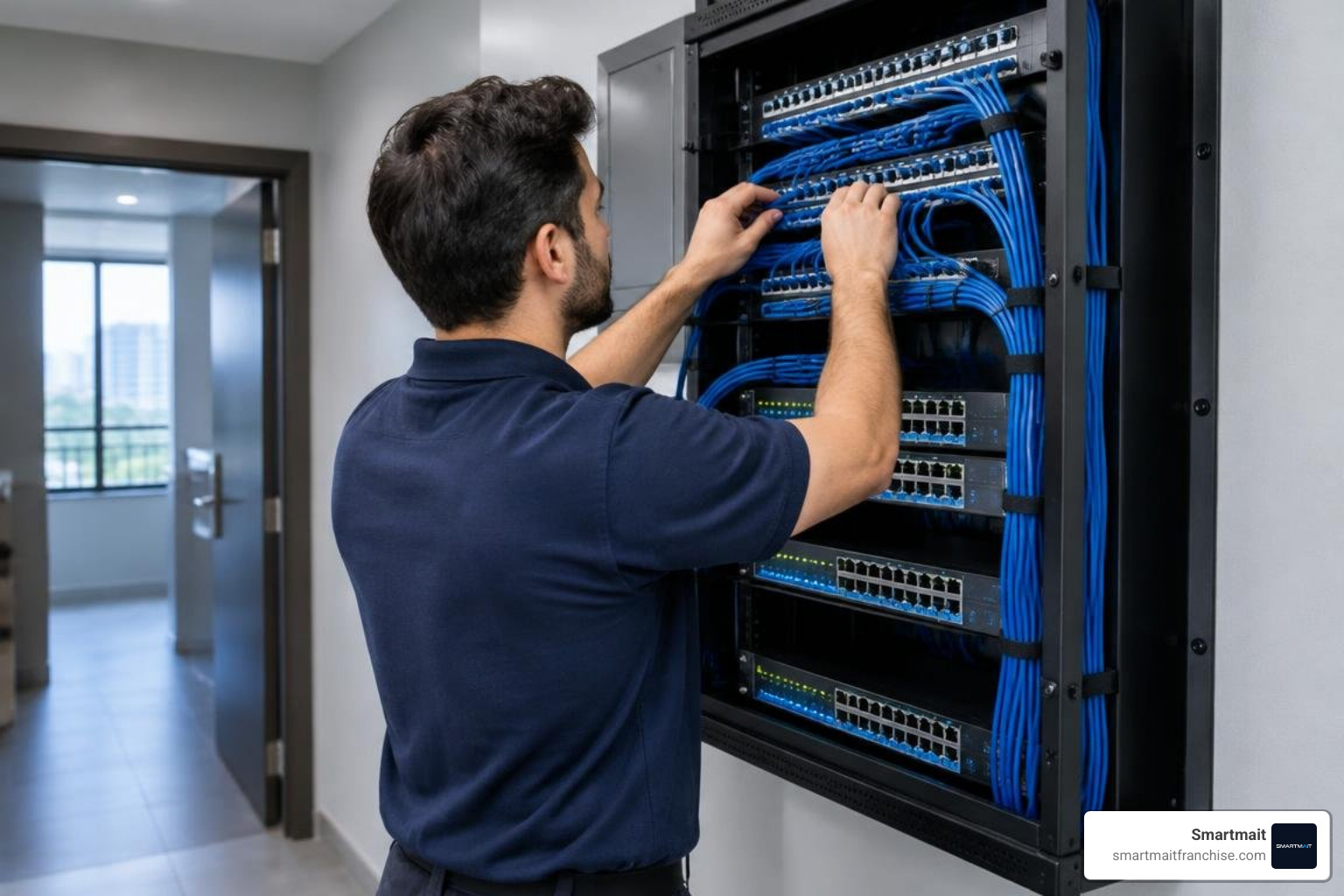
Structured cabling and rack installation in a multi-story building

Scaling a smart-building service company requires operational frameworks that allow non-owner field technicians to execute complex installations with consistent precision. Establishing structured training paths, clear job-site protocols, and standardized inventory controls ensures projects finish on time and within scope.

Planning for Multi-Story Project Complexity

Multi-story residential towers introduce architectural and logistical hurdles that single-family residential installers rarely encounter. Planning for vertical complexity demands robust project management and strict low-voltage trade standards.

  • Riser and Pathway Management: Utilizing designated low-voltage vertical risers and fire-rated pathways ensures compliance with commercial firestop codes whenever cabling breaches structural floors.
  • Network Cable Distance Limitations: Standard Ethernet runs are constrained by the 100-meter (328-foot) structural limit. Projects spanning multiple stories or expansive properties require strategic placement of PoE network switches and fiber uplinks.
  • Elevator Shaft Coordination: Working within elevator hoistways requires close coordination with licensed elevator maintenance contractors to integrate traveling cables or configure high-frequency wireless bridge transmitters safely.
  • Power Redundancy and Environmental Protection: IT closets require adequate thermal ventilation and battery backup capacity to maintain continuous recording during localized power interruptions.

Technicians must master the foundational methods outlined in our guide on how to install a security system, ensuring every termination, patch panel, and equipment rack meets professional commercial standards.

Scaling Through Established Service Standards

Standardization turns custom, chaotic low-voltage jobs into repeatable commercial services. When field technicians follow uniform checklists for mounting heights, cable labeling, weatherproofing, and network configuration, operational overhead decreases and service calls become predictable.

Our ultimate checklist for security camera installation serves as an operational baseline across all customer sites, ensuring field teams execute every step correctly the first time.

By pairing rigorous quality assurance with structured recurring maintenance plans, franchise owners create long-term equity in their business. This organized framework simplifies technician recruitment, accelerates onboarding, and supports exit and succession planning when an owner eventually prepares to step back from daily operations.

Frequently Asked Questions About Condo-Market Opportunities

How can a franchise operator evaluate demand for condo surveillance services?

Evaluating local demand involves analyzing municipal property data, regional construction trends, and local HOA density. Operators should assess:

  • The total volume of multifamily developments and aging condominium complexes in the territory requiring technology modernizations.
  • Property management firms overseeing multiple associations across the region.
  • Local crime statistics and package delivery density, which often drive community board agendas toward security investments.

How can maintenance agreements support recurring revenue?

Commercial surveillance systems require routine care to perform reliably over years of continuous operation. Maintenance agreements bridge the gap between initial installation and long-term customer retention by offering:

  • Routine physical inspections, lens cleanings, and housing seal checks.
  • Scheduled firmware updates, password rotations, and cybersecurity patches.
  • Storage drive health assessments and automated error-alert monitoring.
  • Priority diagnostic response, reducing downtime for the community.

These ongoing service agreements provide property managers with budget predictability while generating stable, recurring service cash flow for the integration business.

What training and operational capabilities may condo projects require?

Multifamily commercial projects require broader low-voltage skills than basic consumer device setups. Field teams need training in:

  • Structured cabling pathways, conduit installation, and commercial firestopping.
  • Advanced IP networking, subnetting, VLAN configuration, and bandwidth calculation.
  • Power over Ethernet load management and UPS backup design.
  • Safe commercial job-site practices, lift operation, and working in shared tenant environments.

Conclusion

Condominium communities and multifamily developments represent a resilient, high-demand market sector within the commercial smart-building integration industry. As communities prioritize perimeter protection, package security, and liability reduction, their need for professional, commercial-grade surveillance infrastructure continues to expand across the country.

For prospective business owners and established low-voltage integrators seeking a path toward scalable growth, Smartmait provides the operational systems, technical training paths, and service-membership frameworks required to build an enduring enterprise. Moving away from one-time installations toward recurring maintenance agreements helps business owners scale beyond owner-dependence and build real equity.

If you are an experienced technician, low-voltage contractor, or entrepreneur ready to build a scalable smart-building integration and maintenance business in your market, explore franchise opportunities with Smartmait today. Request your comprehensive franchise information package to review our business model, training infrastructure, and territory development plans.
Smart Home Wiring Essentials for Smart-Home Franchise Operators

Why Smart Home Electrical Installation Matters to Franchise Operators

Smart home electrical installation starts with a scope check: identify the devices a project must support, review the existing wiring and network, and flag panel capacity or new-circuit work for a qualified electrician. For a prospective franchise operator, that check helps separate a simple device setup from a larger integration project—and shows where ongoing maintenance may be needed.

In 2026, connected homes may combine wired data, wireless devices, and energy controls. Operators who understand how those layers fit together can plan work more clearly, coordinate the right trades, and build service relationships beyond the first installation.

I’m Dominic Hesano. My background in franchise development and service-business operations informs my work building Smartmait, where smart home electrical installation is part of a broader integration and ongoing-support opportunity.

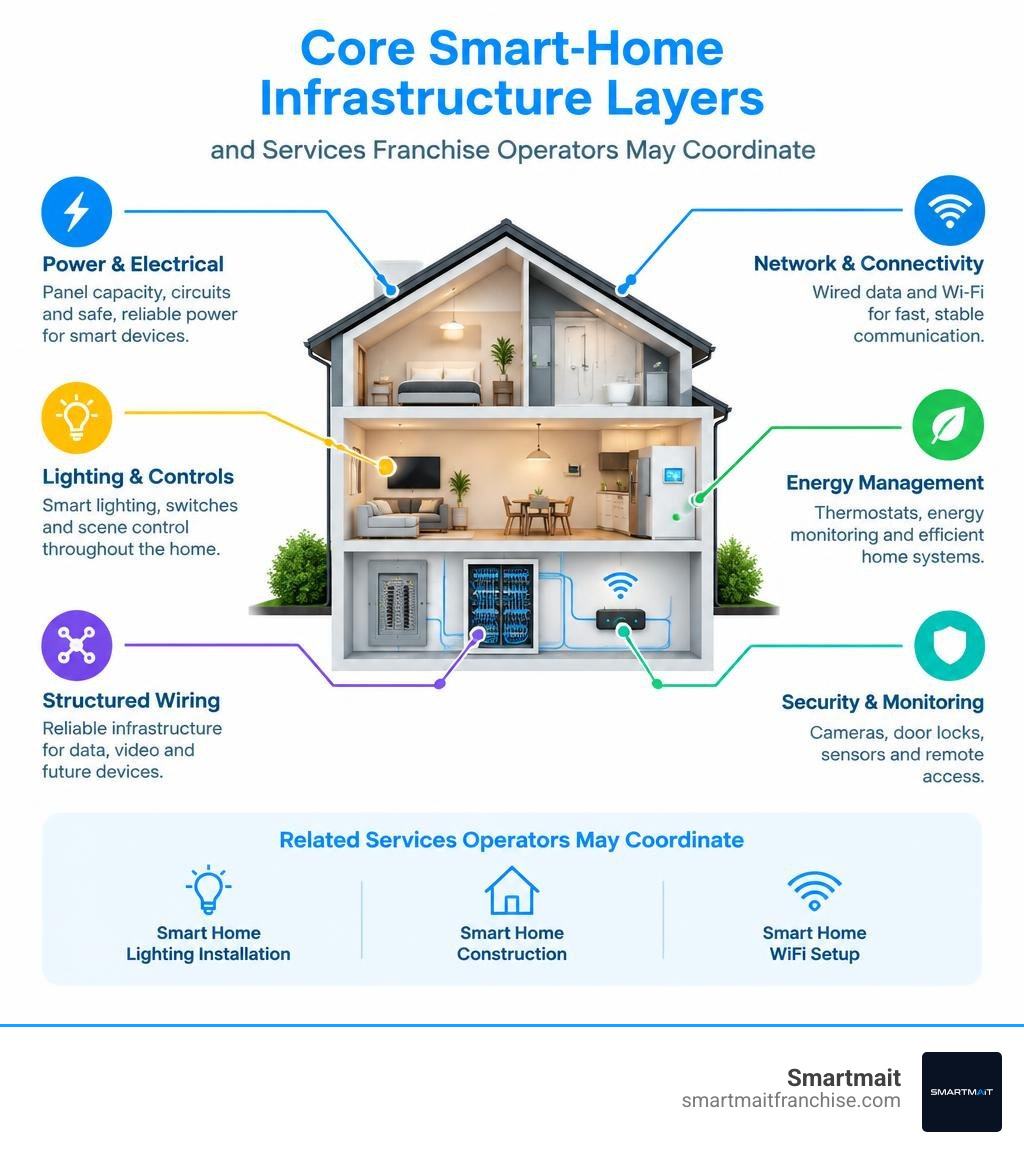
Core smart-home infrastructure layers and services franchise operators may coordinate infographic

Essential smart home electrical installation terms:

Core Infrastructure and Wiring Services in a Smart-Home Franchise

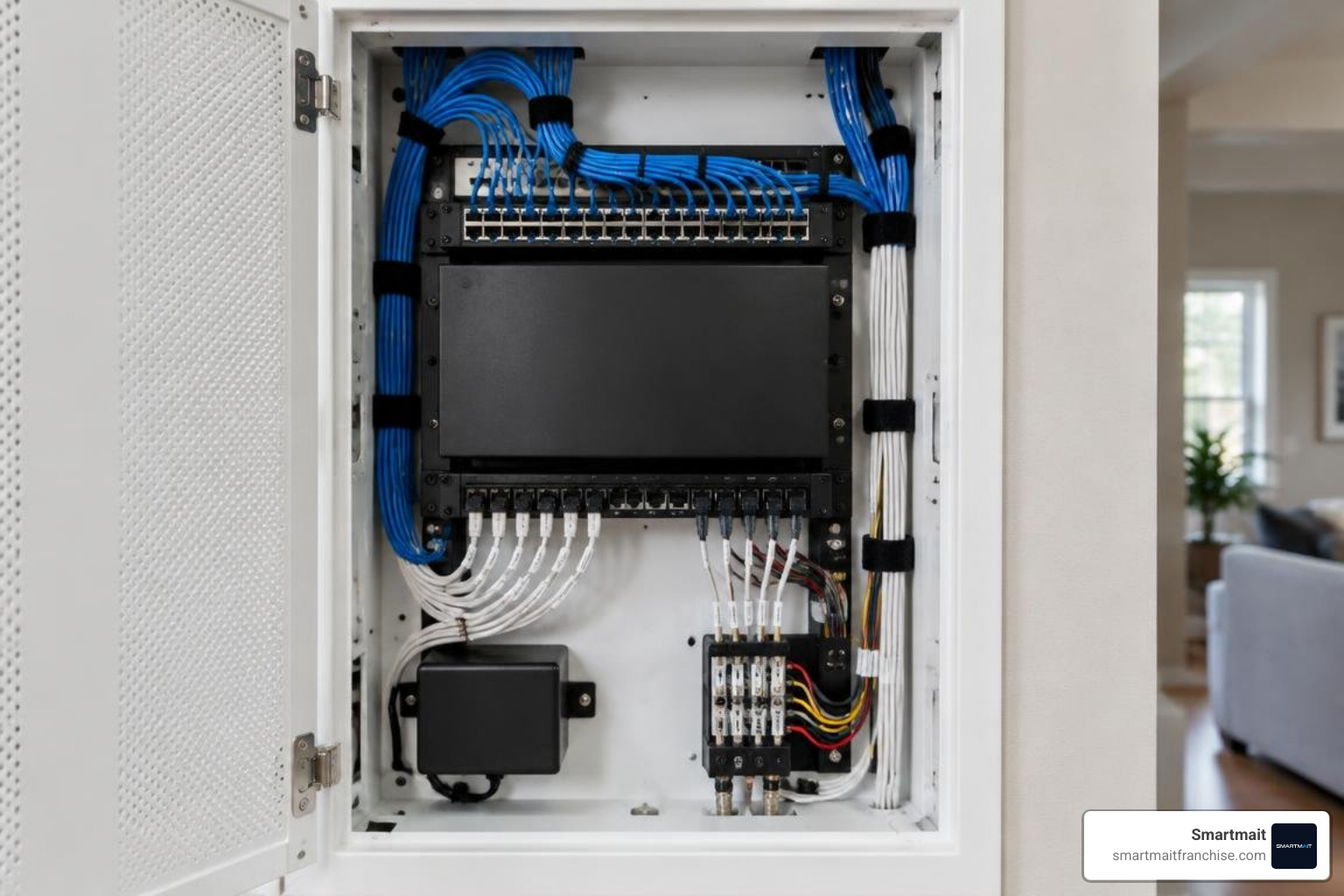
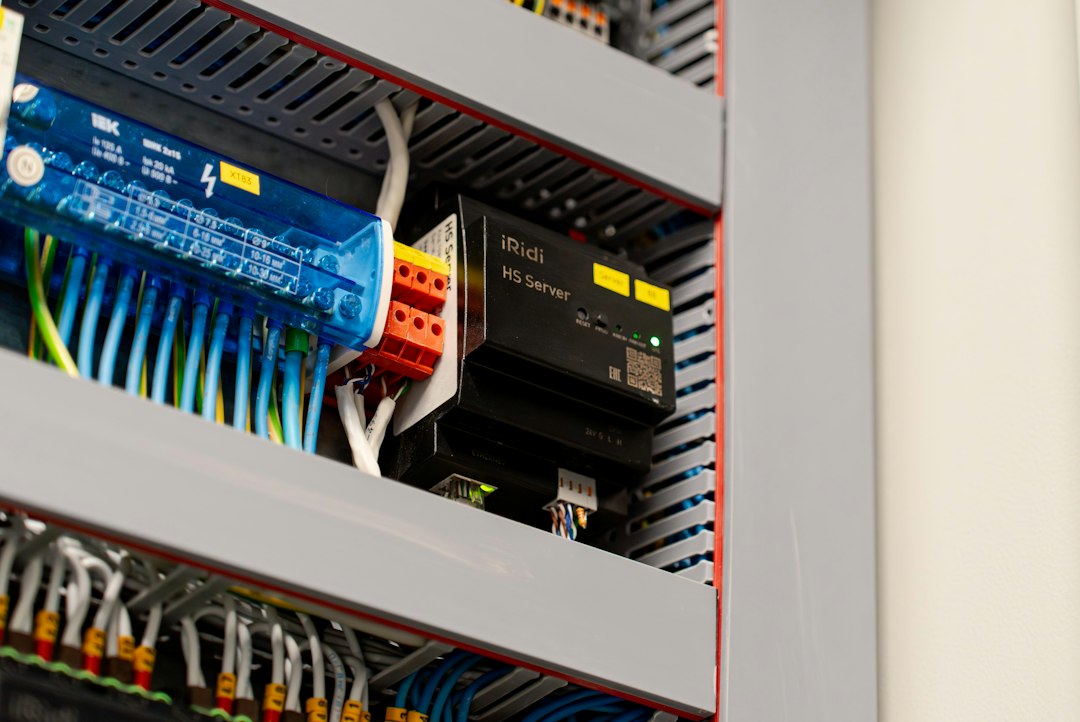
structured media enclosure with labeled data and low-voltage control lines

For integration business owners and prospective franchisees evaluating the smart-building sector, understanding low-voltage infrastructure versus line-voltage power is critical for scoping projects accurately. A successful installation business relies on standardized scoping processes to evaluate client sites, organize technician workflows, and establish ongoing service agreements.

When scoping a project, operators encounter two distinct electrical tiers:

  1. Line-Voltage Systems (120V/240V AC): These supply power to primary appliances, branch circuits, outlets, and lighting loads. Line-voltage modifications—such as panel additions, new branch circuits, and line-voltage terminations—require coordination with licensed electrical subcontractors or qualified internal electricians depending on state licensing requirements.
  2. Low-Voltage and Communications Infrastructure (≤50V DC/AC): This encompasses the central data backbone, including structured cabling, Power over Ethernet (PoE) runs, sensor buses, and control wiring. These systems represent the primary domain of low-voltage systems integration and form the core of long-term system optimization and maintenance services.

A frequent technical hurdle in residential retrofits involves neutral-wire availability. Most modern connected light switches and smart dimmers require a dedicated neutral conductor in the switch box to maintain continuous standby power for their internal radios and microcontrollers. While properties built after the mid-1980s generally include neutral wires in switch boxes, older homes often route switch loops with only hot and switched-leg conductors. Identifying this during the initial assessment prevents scheduling delays and helps determine whether to run new cabling or deploy specialized solutions.

Central structured media enclosures organize these complex networks. By consolidating modems, routers, patch panels, PoE switches, network-attached storage (NAS), and smart hubs into a single ventilated, power-backed cabinet, our field technicians can cleanly troubleshoot, update, and optimize systems over time.

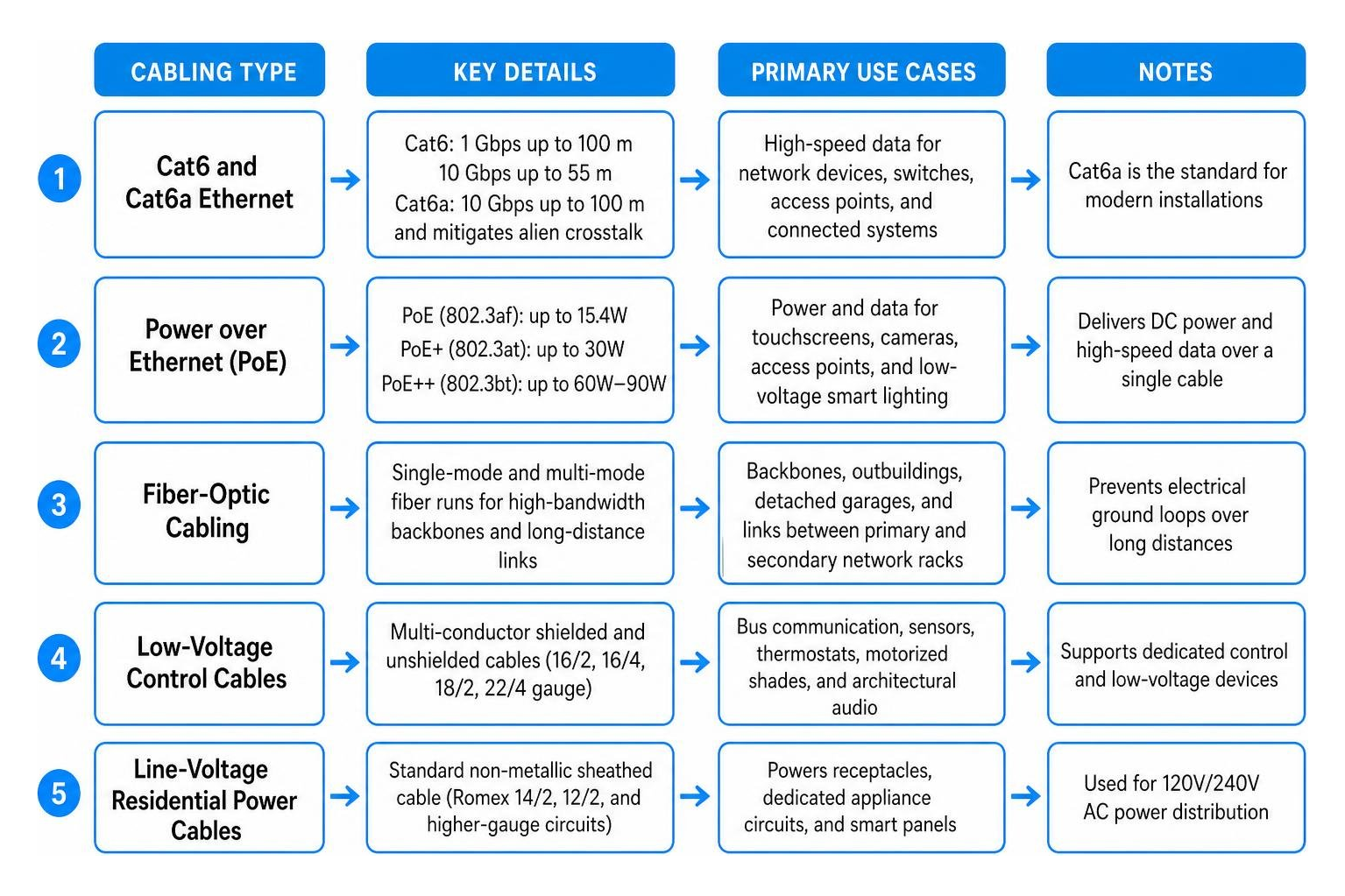
Cabling Categories Franchise Operators Should Recognize

To scope projects effectively, operators must ensure their field teams recognize standard cabling categories and their specific deployment environments:

  • Cat6 and Cat6a Ethernet: Cat6 supports 1 Gbps up to 100 meters and 10 Gbps up to 55 meters. Cat6a is the standard for modern installations, supporting 10 Gbps data rates across full 100-meter runs while mitigating alien crosstalk.
  • Power over Ethernet (PoE) Standards: Standards ranging from standard PoE (802.3af, up to 15.4W) and PoE+ (802.3at, up to 30W) to PoE++ (802.3bt, delivering up to 60W–90W) allow single-cable delivery of high-speed data and DC power to touchscreens, pan-tilt-zoom cameras, access points, and low-voltage smart lighting fixtures.
  • Fiber-Optic Cabling: Single-mode and multi-mode fiber runs are utilized for high-bandwidth backbones, outbuildings, detached garages, and links between primary and secondary network racks to prevent electrical ground loops over long distances.
  • Low-Voltage Control Cables: Multi-conductor shielded and unshielded cables (such as 16/2, 16/4, 18/2, and 22/4 gauge) support dedicated bus communication, hardwired sensors, smart thermostats, motorized shades, and architectural audio.
  • Line-Voltage Residential Power Cables: Standard non-metallic sheathed cable (such as Romex 14/2, 12/2, and higher-gauge circuits) powers receptacles, dedicated appliance circuits, and smart panels.

Comparison of common cabling types and their primary use cases in smart integration

Understanding these cabling formats enables operators to design reliable client solutions that support long-term service agreements, regular network audits, and structured firmware maintenance plans.
Scoping New-Build and Retrofit Opportunities

Project scoping differs significantly between new construction and existing-home retrofits. In new builds, rough-in scheduling allows integration teams to pull structured cabling, install dedicated conduits, and set deep back-boxes before insulation and drywall are placed. Integrators can plan dedicated home runs to a central media closet, position wireless access points in ceiling locations, and pre-wire all exterior entry points.

Retrofit environments require non-invasive diagnostic techniques. Technicians must evaluate wall cavities, accessible attic spaces, crawlspaces, and existing conduit runs. When retrofitting properties where pulling new wiring through finished walls would require costly drywall repairs, operators must balance hardwired drops for bandwidth-heavy equipment with reliable wireless protocols for distributed endpoints. Mastering both environments allows a franchise operator to capture diverse residential and light-commercial territory demand.

Understanding Wired and Wireless Smart-Home Systems

Franchise operators must guide clients through the structural differences between hardwired automation architectures and wireless mesh protocols. Both approaches provide unique operational advantages depending on project scope, property age, and client budget.

System Characteristic Wired Bus Systems (e.g., KNX, Proprietary Bus) Wireless Mesh Networks (Matter, Thread, Zigbee, Z-Wave)
Physical Infrastructure Dedicated low-voltage bus cabling alongside line-voltage power runs. Relies on local AC power or battery endpoints; no extra control cabling.
Deployment Fit New builds, extensive architectural renovations, luxury estates. Retrofits, modular expansions, standard residential properties.
System Latency Near-zero latency with deterministic command execution. Low latency; depends on mesh density and local hub processing.
Interference Risk Immune to radio frequency (RF) congestion and structural barriers. Susceptible to RF interference, dense masonry, and metal framing.
Scalability High; scales to hundreds of addressable nodes via line couplers. Scales via repeaters; self-healing mesh improves with device density.
Maintenance Profile Centralized panel testing, hardware diagnostics, long lifespan. Periodic battery replacements, RF mapping, and firmware updates.

Wired bus topologies connect physical sensors, keypads, and actuators directly to central control panels over dedicated communication wiring. This delivers exceptional reliability and deterministic response times, making it a staple of high-end architectural projects.

Conversely, modern wireless standards provide rapid deployment flexibility. Wireless protocols like Zigbee and Z-Wave create self-healing meshes where mains-powered devices act as signal repeaters. Thread introduces an IP-addressable, low-power mesh architecture that operates alongside Wi-Fi to form the wireless foundation for Matter.

Matter standardizes cross-platform device commissioning across major ecosystems, eliminating closed vendor silos. By understanding how these protocols route data, operators can deliver reliable smart home integration and design managed service packages that monitor network health, resolve RF dead zones, and optimize wireless traffic.

Electrical Capacity, Dedicated Circuits, and Smart-Energy Service Opportunities

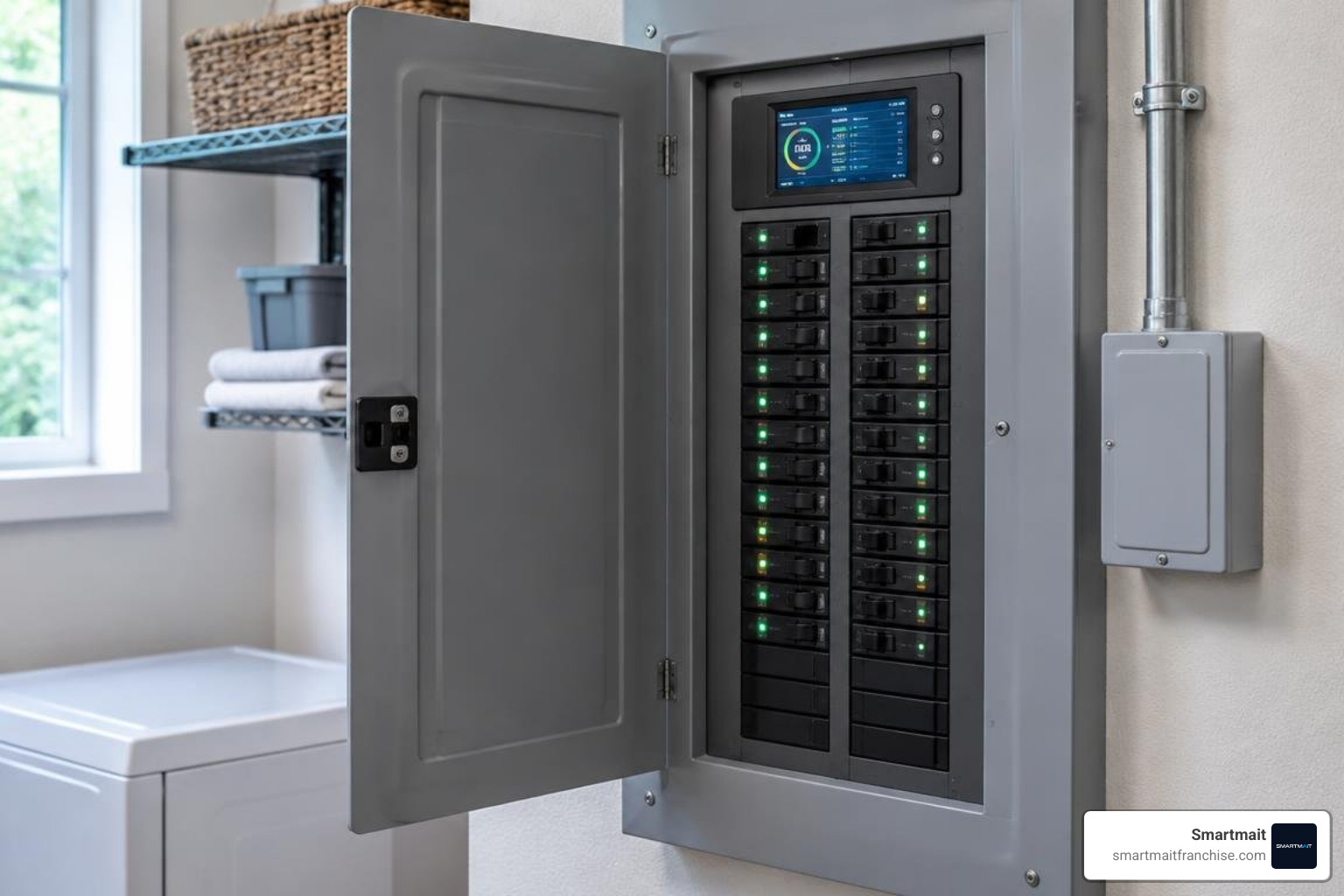
smart electrical panel with circuit-level monitoring

Modern residential properties are transitioning toward full electrification, creating demand for intelligent energy orchestration. Integration businesses frequently encounter properties where smart infrastructure overlaps with high-draw electrical additions, including Level 2 electric vehicle (EV) supply equipment, heat pumps, solar photovoltaic (PV) inverters, and battery storage.

A 200-amp service panel is standard for modern homes, but heavily electrified residences often require 320-amp or 400-amp service to manage simultaneous high-draw loads. When main service upgrades face utility lead times or physical constraints, smart electrical panels and dynamic load-shedding modules provide an effective alternative. These intelligent panels continuously monitor circuit-level consumption and automatically shed or throttle non-critical loads (like water heaters or EV chargers) when household demand approaches main breaker thresholds.

To ensure stability, connected homes require dedicated circuits for sensitive electronics:

  • Central Network Enclosure: A dedicated 15-amp or 20-amp circuit powering the primary router, network switches, and security recording hardware, protected by an uninterruptible power supply (UPS).
  • Automation Control Processors: Dedicated power to isolate central controllers from inductive motor noise generated by appliances or HVAC systems.
  • Smart EV Supply Equipment: Dedicated 240V circuits configured for automated scheduling and off-peak utility rate optimization.

By offering comprehensive power audits and ongoing energy monitoring services, franchise operators turn one-time panel setups into lasting service relationships focused on system optimization and smart home power management.

Code Awareness, Surge Protection, and Safety Coordination

Operating a professional smart-home and smart-building franchise requires a thorough understanding of safety regulations and electrical codes. Integration operators must ensure their field teams maintain clear boundaries between low-voltage technical work and tasks requiring a licensed trade partner.

In the United States, installations must comply with the National Electrical Code (NEC):

  • Arc-Fault Circuit-Interrupter (AFCI) and Ground-Fault Circuit-Interrupter (GFCI) Protection: NEC standards mandate AFCI protection for branch circuits supplying living areas to detect hazardous electrical arcing, along with expanded GFCI requirements for locations exposed to moisture.
  • Low-Voltage and Communications Standards: NEC Article 725 governs Class 1, Class 2, and Class 3 remote-control and signaling circuits, while Article 800 governs communications circuits. Field teams must maintain required physical separation between low-voltage data cables and line-voltage conductors inside enclosures and wall cavities (typically keeping at least 2 inches of separation or running conductors across 90-degree angles) to prevent electromagnetic interference and dangerous voltage crossover.
  • Whole-House Surge Protection: A single transient overvoltage event from utility grid switching or lightning can destroy sensitive connected microprocessors throughout a property. National codes mandate Type 1 or Type 2 surge protective devices (SPDs) compliant with UL 1449 at the main service panel, complemented by Type 3 point-of-use surge protection at sensitive equipment racks.

For integration operators, tracking safety compliance and industry technical requirements—such as those detailed in the National Electrical Contractors Association resources on Technology’s Impact on Electrical Codes and Standards—protects both the client’s property and the franchisee’s business reputation.

Frequently Asked Questions About Smart-Home Franchise Operations

How much wiring knowledge does a smart-home franchise operator need?

Franchise owners do not need to be master electricians to build a successful integration business. Operators need a clear conceptual understanding of system architectures, low-voltage cabling types, and project scoping rules so they can quote work accurately, manage technician teams, and coordinate with licensed electrical subcontractors when high-voltage modifications arise. Franchise training programs bridge technical gaps by providing structured field manuals, standard operating procedures, and ongoing operational support for complex integration challenges.

What kinds of projects can create recurring service opportunities?

System deployments create natural pathways to ongoing service and maintenance agreements. High-value recurring revenue services include:

  • Managed network monitoring, remote device reboots, and automated bandwidth optimization.
  • Proactive firmware updates, Matter ecosystem patch management, and cybersecurity audits.
  • Smart energy management monitoring, load-shedding calibration, and seasonal automation adjustments.
  • Routine battery replacement cycles, camera lens cleaning, sensor recalibration, and physical rack maintenance.

These service-membership programs improve customer retention, smooth out seasonal revenue fluctuations, and transition an integration company from a volatile project-to-project cycle into a predictable service business.

Can an existing integration or home-service business convert to a franchise model?

Independent integration businesses and home-service contractors frequently face operational hurdles, including owner-dependent workflows, technician recruitment challenges, and inconsistent project pipelines. Converting an established business to a franchise model allows owners to implement standardized operating software, take advantage of national brand equity, access enterprise training platforms, and implement proven client retention frameworks. This structured approach helps owners scale their field teams, transition out of daily field work, and build long-term enterprise value across exclusive operating territories.

Conclusion

Understanding smart-home electrical infrastructure and low-voltage cabling is essential for building a thriving, professional integration business. As connected environments become more sophisticated, clients require experienced teams that can plan, execute, and maintain their systems over the long term.

Smartmait offers prospective franchise owners and converting independent operators a proven path to scale in the growing U.S. smart-building and integration market. By combining professional installation standards with recurring service agreements, our franchise model helps business owners build stable operations that deliver lasting value to clients.

Ready to take the next step in business ownership? Explore smart home franchise and integration opportunities to connect with our franchise development team and request your comprehensive franchise information package today.

Smarter Apartments Made Simple for Multi Family Communities

Smart Homes in Multifamily Communities: An Opportunity for Integrators

For a low-voltage integrator, multifamily smart homes are more than a device sale. Property managers need connected access, climate controls, leak detection, and reliable networking across many units. They also need someone to keep those systems working. If you are weighing a new territory or a move to a franchise model, assess both the installation work and the potential for ongoing service contracts.

The opportunity starts with a simple question: can your business support an entire property, not just one apartment? That means planning for shared infrastructure, repeatable work across units, and maintenance after residents move in. This guide looks at the technologies driving demand and the business systems needed to serve multifamily properties at scale.

I’m Dominic Hesano, a franchise development professional helping build Smartmait around smart technology installation and long-term service. My work in sales, operations, and service businesses shapes how I look at the smart home multi family market: as an opportunity that depends on dependable support as much as the initial installation.

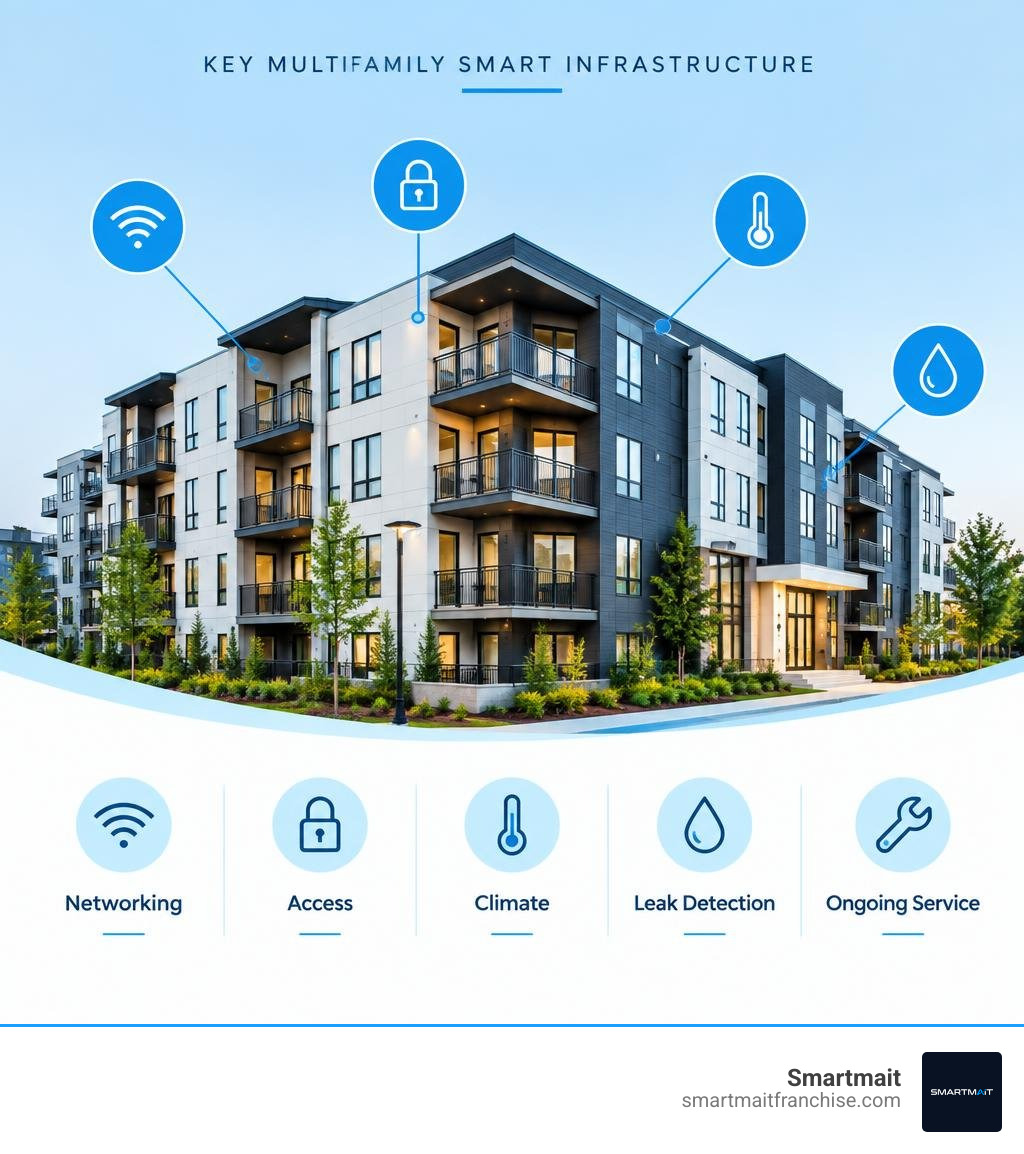
Key multifamily smart infrastructure: networking, access, climate, leak detection, and ongoing service infographic

Glossary for smart home multi family:

Capturing the Smart Home Multi Family Market: Growth Drivers for Integrators

The multi-dwelling unit (MDU) sector represents a major shift in how real estate developers and property managers view technology. Connected properties have moved from novelty to standard operating practice. In 2026, real estate operators increasingly recognize that smart building systems directly protect asset value, lower maintenance overhead, and enhance tenant retention. For prospective franchise owners and established low-voltage integrators, understanding these market drivers is vital when evaluating commercial expansion.

Developers see smart properties as a powerful market differentiator. Industry data shows that 74% of operators believe connected property technology is the direction of the future, while 72% note that competitors lacking connected systems create a distinct advantage for early adopters. Modern property managers rely on these technologies to keep operating margins healthy and streamline day-to-day operations.

Understanding smart building IoT opportunities allows integrators to position their businesses for large-scale multi-unit contracts. Commercial real estate developers are also navigating aggressive municipal building electrification mandates and utility incentive programs. Whole-building electrification initiatives make connected energy management systems indispensable, unlocking massive commercial demand for certified low-voltage integration specialists.

Why Developers Are Prioritizing Connected Properties

Modern residents actively seek out connected apartments. Industry surveys indicate that 68% of current and prospective tenants express a strong desire for connected living amenities, and 60% of prospective occupants state they would pay higher monthly rates for integrated systems. For operators, properties equipped with cohesive connected ecosystems regularly command rental premiums of 3% to 7% above comparable traditional units.

Connected amenities also directly improve operational throughput:

  • Keyless Access Management: 77% of multi-family operators have adopted or are actively deploying connected locks, virtually eliminating lock re-keying expenses and physical key tracking overhead.
  • Automated Vacancy Control: Property managers can automate temperature setpoints in vacant units to prevent utility waste without requiring on-site staff visits.
  • Rapid Maintenance Response: Automated alerts from connected sensors allow facility teams to address mechanical issues before major property damage occurs.
  • Tenant Accessibility: 70% of operators agree that connected building features significantly improve accessibility for residents with physical limitations or disabilities.

Essential Infrastructure for Smart Home Multi Family Deployments

Delivering a dependable experience across hundreds of units requires comprehensive infrastructure planning during pre-construction phases. A single network bottleneck or weak wireless zone can compromise access control, security monitoring, and climate management across an entire building.

Integrators must specify robust connectivity solutions capable of handling enterprise-grade traffic, device isolation, and multi-tenant security policies. Structured low-voltage cabling, strategic placement of high-density wireless access points, dedicated low-voltage equipment closets, and compatibility with open protocols like Matter and Thread form the operational backbone of any scalable installation.

commercial low-voltage wiring panel and networking rack

Core Technologies Reshaping Multi-Family Smart Building Systems

Building-wide automation brings together multiple sub-systems into unified management platforms. Integrators who understand enterprise architecture can transition from simple hardware installers to essential technology advisors for commercial developers.

Access Control and Environmental Management

Access management represents the most urgent operational priority for multi-family operators. Transitioning from physical brass keys to cloud-managed credentials reduces administrative staffing needs and streamlines vendor management.

Integrating perimeter intercoms, common-area doors, and in-unit locks into an open-architecture platform allows property staff to issue temporary, time-bound digital keys for maintenance contractors, package delivery carriers, and self-guided prospective resident tours. At the same time, environmental sensing safeguards physical infrastructure. Water leak detectors deployed in high-risk locations—such as water heaters, washing machines, and under-sink plumbing—provide instantaneous alerts and trigger automated shutoff valves, preventing catastrophic structural repairs.

Energy Optimization and Operational Efficiency

Energy management delivers clear environmental and financial returns. Building-wide deployments of smart thermostats and automated lighting control systems consistently reduce overall energy consumption by 15% to 25% across properties.

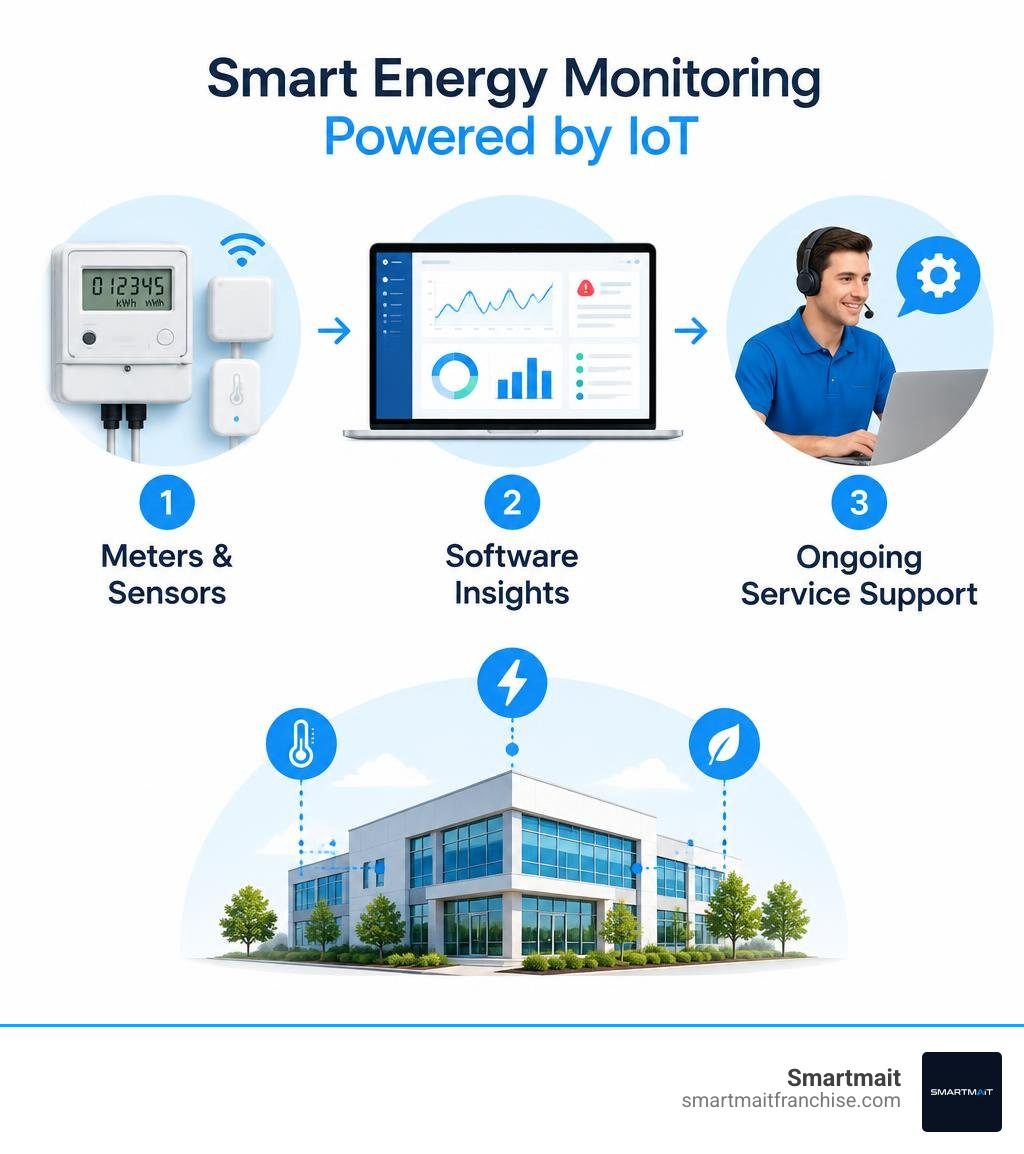
Property operators leverage integrated energy platforms to automate setpoints in vacant units, adjust common-area heating and cooling based on real-time occupancy data, and participate in utility demand-response events during peak grid strain. Incorporating comprehensive smart energy monitoring enables submetering and precise ESG reporting, helping projects meet LEED standards and qualify for regional electrification rebates.

Smart Building System Primary Function Operational Impact Key Hardware Protocols
Connected Access Control Cloud credentials, perimeter & unit access 40% drop in key-management overhead; self-guided unit tours IP-based, Bluetooth, NFC, Z-Wave
Intelligent Climate Controls Occupancy-based setback, centralized scheduling 15–25% reduction in whole-building energy consumption Matter, Thread, Wi-Fi, Zigbee
Active Leak Mitigation Point-of-use sensing, automated water shutoff Elimination of severe water damage events; insurance risk reductions Sub-GHz, LoRaWAN, Zigbee
Automated Lighting Common area scheduling, daylight harvesting Lower electrical demand, improved common area security DALI, 0-10V, Zigbee, Bluetooth Mesh
Submetering & Monitoring Unit-level electrical & mechanical tracking Streamlined utility billing, rapid equipment fault detection Modbus, BACnet, Cellular/IP

Effective execution requires careful smart home new construction planning to align low-voltage designs with electrical, mechanical, and architectural construction schedules.

Building Long-Term Value Through Service and Maintenance Models

For low-voltage businesses, one-time installation projects carry operational risk. Projects conclude, construction cycles fluctuate, and business owners are often forced back into customer acquisition mode. Transitioning to a model built around recurring service agreements changes this dynamic completely.

technician servicing commercial smart building controller

Recurring Service Contracts in Smart Home Multi Family Communities

A modern multi-family property represents hundreds of connected endpoints operating continuously. Commercial property managers rarely have the technical staff required to maintain these environments. Integrators who offer comprehensive service-level agreements (SLAs) build steady, predictable operational value.

Core components of ongoing commercial service retainers include:

  • Fleet Health Monitoring: Real-time diagnostics of network uptime, gateway stability, and endpoint connectivity across the entire property.
  • Proactive Maintenance: Scheduled battery replacements for door locks, environmental sensors, and submetering hardware before failures occur.
  • Firmware & Security Management: Centralized deployment of software updates, protocol patches, and security configurations to protect against cyber vulnerabilities.
  • Rapid On-Site Support: Guaranteed dispatch response times for hardware remediation, access control failures, and emergency sensor replacements.

Scaling Technical Operations and Field Teams

Building a business capable of handling ongoing commercial service contracts requires moving away from solo operator dependency. Independent contractors frequently encounter operational bottlenecks when trying to juggle field labor, estimating, dispatching, and customer service simultaneously.

Scalable integration operations rely on structured recruiting pipelines, consistent technician onboarding programs, and standardized workflow playbooks. When field technicians execute identical troubleshooting workflows using unified operating platforms, business owners can step back from daily field troubleshooting and focus on market expansion, commercial client relationships, and multi-territory growth.

Overcoming Integration Challenges: Independent vs. Franchise Operations

Established low-voltage integrators and home-service contractors evaluating their next stage of growth face a core strategic decision: should they continue operating independently, or convert their existing business to an established franchise brand?

Operational Trade-offs for Independent Integrators

Operating as an independent integrator offers complete autonomy, but it also presents significant operational friction as project complexity grows:

  • Procurement Scale: Independent shops often lack the purchasing leverage needed to access top-tier commercial distributor pricing and direct manufacturer support lines.
  • Custom System Overhead: Building proprietary operational platforms, field dispatching workflows, and customer management tools requires heavy internal investments.
  • Recruiting and Training Friction: Designing internal training programs to keep technicians up to speed on rapidly evolving smart protocols demands extensive time and resources.
  • Owner-Centric Vulnerability: When technical knowledge, client relationships, and sales processes live solely with the founder, scaling the business or executing an exit plan becomes difficult.

Standardization, Vendor Relationships, and Brand Support

Converting an integration company to a franchise model allows operators to leverage standardized frameworks while retaining local leadership. Franchise networks provide immediate operational infrastructure, structured technician certification pathways, and centralized enterprise systems designed specifically for commercial and multi-dwelling unit markets.

By adopting proven operational playbooks and enterprise software, business owners can eliminate operational bottlenecks, secure commercial multi-family contracts with confidence, and build an enterprise with sustainable value.

Frequently Asked Questions About Multi-Family Smart Technology

How does smart building integration create ongoing business value?

Commercial smart building integration creates predictable long-term value by pairing initial hardware deployment with ongoing service retainers. Multi-family operators require proactive fleet monitoring, scheduled sensor maintenance, automated firmware patching, and rapid hardware support across large device footprints, establishing recurring commercial relationships.

What infrastructure planning is relevant to MDU integration opportunities?

MDU projects require comprehensive low-voltage planning, including enterprise network architecture, structured Category cabling, dedicated equipment enclosures, managed wireless access points, and hardware compatible with unified building protocols like Matter, Thread, and BACnet to ensure seamless property-wide connectivity.

Why are low-voltage contractors converting to a franchise model for commercial growth?

Integrators convert to a franchise model to access standardized operational systems, established technician onboarding curriculums, commercial vendor support channels, and proven recurring-revenue frameworks that allow owners to scale beyond individual field labor.

Conclusion

The multi-family housing sector is undergoing a massive shift toward connected, energy-efficient, and cloud-managed operations. As property developers and asset managers standardize on smart building systems, the demand for qualified, professional low-voltage integrators equipped to deliver both initial installation and ongoing maintenance has never been higher.

Building a successful integration business in this market requires more than technical skill—it demands scalable business systems, structured technician training, and proven recurring-revenue models. Smartmait provides the operational framework, industry relationships, and standardized playbooks that enable entrepreneurs and existing integration business owners to capture commercial market share.

Ready to scale your business in the growing low-voltage and smart-building integration sector? Request franchise information today to explore territory opportunities and learn how our platform supports long-term commercial growth.

The Definitive Guide to Best Places to Mount Security Cameras

Key Entry Points and Coverage Strategy

When we design a security layout, we always map out how an intruder would navigate the property. Securing your home isn’t about covering every square inch of grass—it’s about locking down primary access routes where people are forced to slow down or enter.

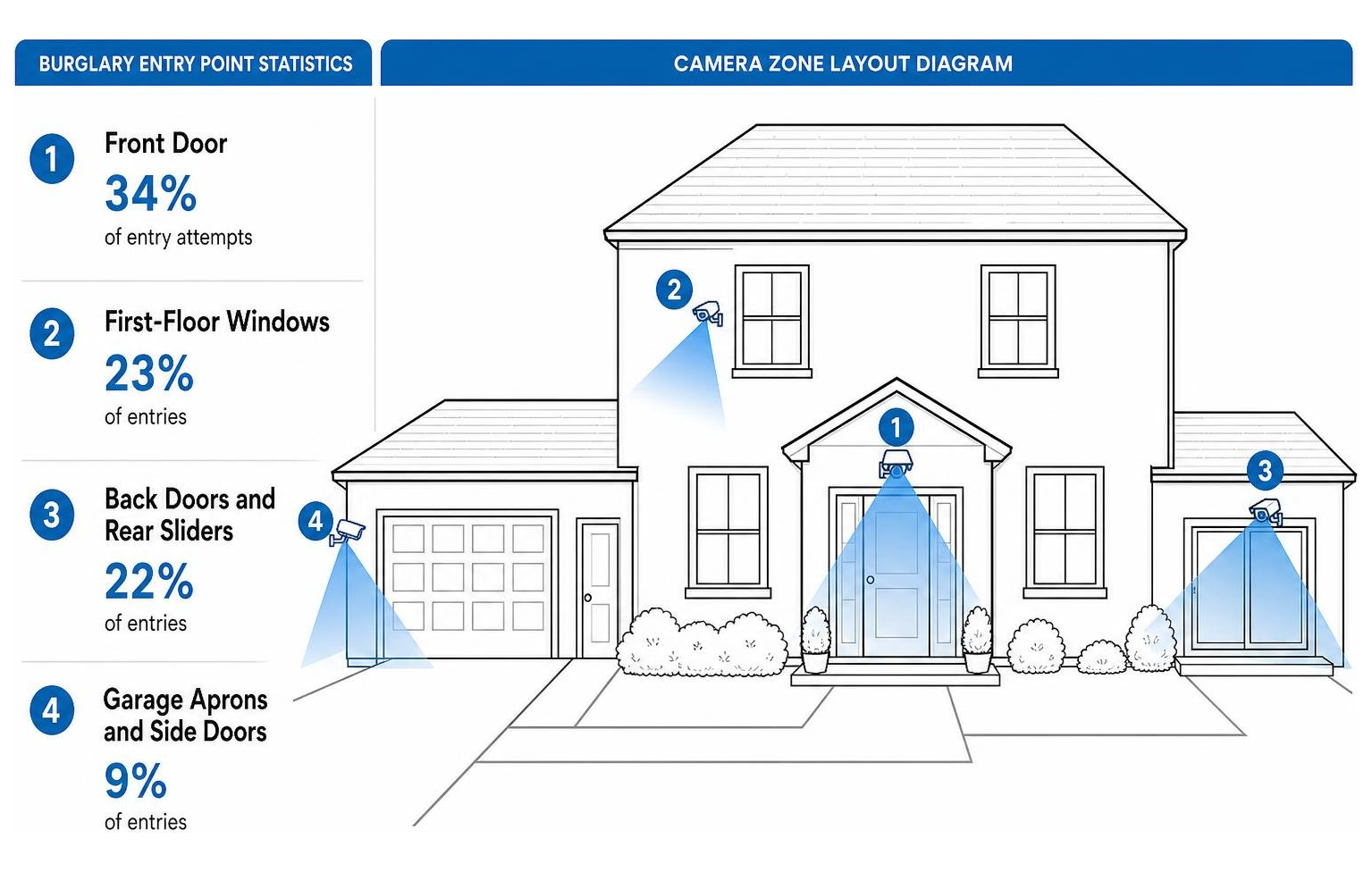
According to security research, entry points follow a predictable pattern:

  • Front Door (34% of entry attempts): This is your highest-priority zone. A camera here catches package deliveries, unwanted solicitors, and anyone attempting a forced entry through the main lock.
  • First-Floor Windows (23% of entries): Ground-level windows hidden behind bushes or located on the side of the home are prime targets.
  • Back Doors and Rear Sliders (22% of entries): Rear entrances offer privacy for intruders shielded from street view.
  • Garage Aprons and Side Doors (9% of entries): Garages hold high-value tools and vehicles, making them a common entry point into the main house.
  • Side Yards and Gates: Side paths are the ultimate blind spot. Burglars routinely use unmonitored side yards to move undetected from the street to the backyard.

To determine how many cameras you need, start with your property’s size and layout. For a small apartment or condo, two cameras (a video doorbell and one indoor overview camera) are usually sufficient.

For standard single-family homes, we recommend using this coverage scale:

  • Small Home (Under 1,500 sq ft): 4 cameras (Front door, back door, driveway, and side path).
  • Medium Home (1,500 – 2,500 sq ft): 6 to 8 cameras (Front door, garage/driveway, back patio, two side yards, and key indoor entryways).
  • Large Home (4,000+ sq ft or Fenced Lot): 10 to 16 cameras (Full perimeter cross-coverage, outbuildings, driveway gates, and interior transit hubs).

For more step-by-step detail on planning a complete system layout, explore our guide on video surveillance system installation.

Technical Placement: Mounting Heights, Angles, and Lens Selection

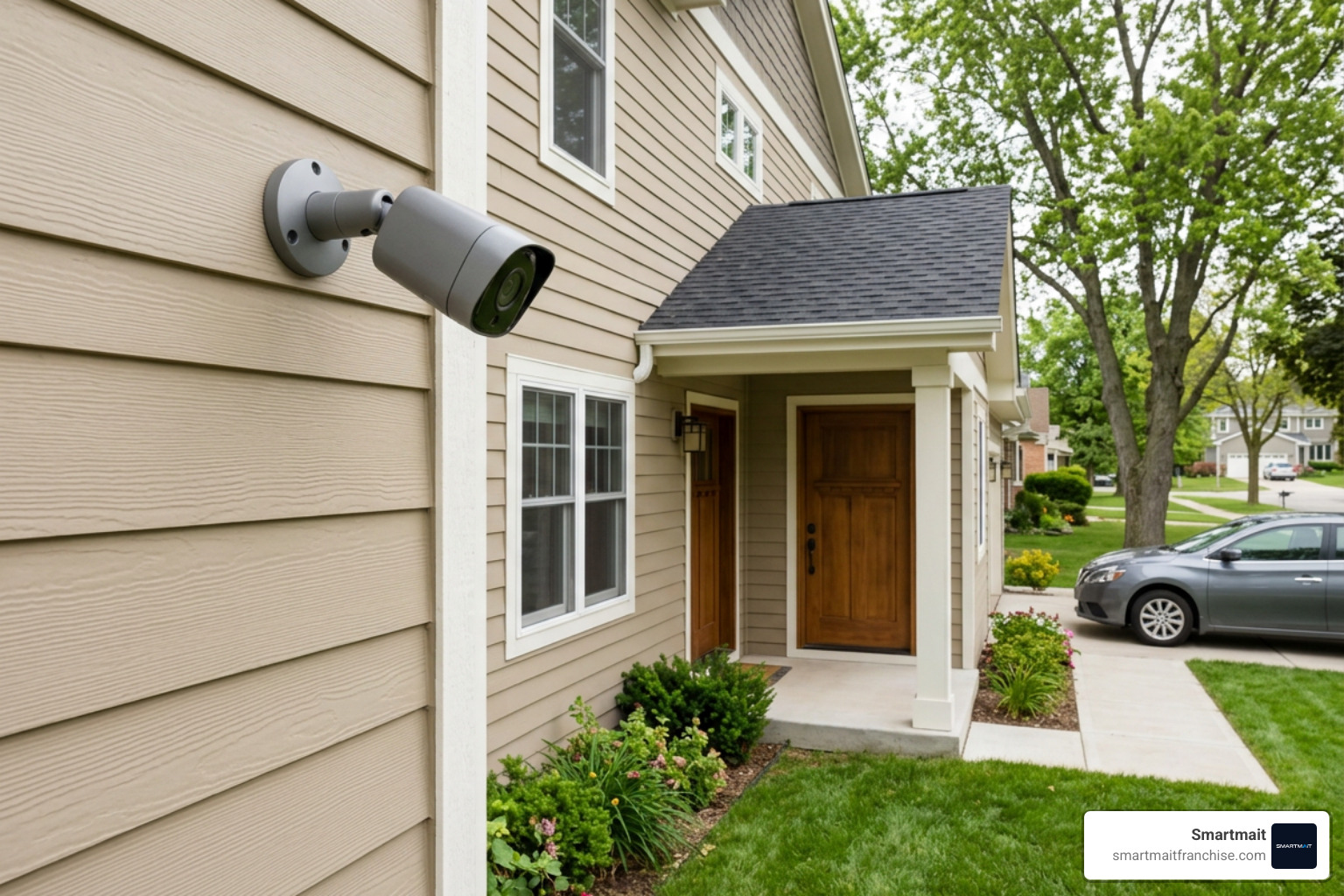
Outdoor camera mounted at proper height and downward angle

The physical positioning of your hardware determines whether you capture actionable police evidence or useless footage of the tops of people’s heads.

Follow these technical rules for physical installation:

  • The 8-to-10 Foot Height Rule: Mount outdoor cameras between 8 and 10 feet above the ground. This height keeps the camera out of reach of vandals while keeping the angle low enough to view facial features underneath hats and hoods.
  • The 15-to-30 Degree Downward Tilt: Angle the camera down at 15 to 30 degrees toward target entry points. Avoid mounting cameras completely flat, which captures too much sky and creates exposure problems during bright days.
  • Pixel Density (PPF Standards): According to industry standards from the Security Industry Association (SIA), capturing recognizable facial detail requires at least 40 Pixels Per Foot (PPF) at the target area. A standard 1080p camera reaches this threshold up to 15 feet away, while a 4K camera maintains 40 PPF out to 30 feet.
Lens Focal Length Field of View (Horizontal) Maximum Identification Distance Best Mounting Location
2.8mm ~110° (Ultra-Wide) Up to 15 feet Porches, small rooms, entryways
3.6mm ~90° (Standard) Up to 25 feet Corners, driveways, side yards
6.0mm+ ~50° or narrower (Telephoto) Up to 45+ feet Long driveways, license plate capture

Balancing Wide Scene Coverage with Facial Identification

A common mistake is expecting a single wide-angle camera to cover both broad scene context and clear facial identification. Standard 2.8mm wide lenses are fantastic for overview coverage, but they push objects into the distance, distorting facial features.

To balance coverage and identification:

  1. Establish Context Zones: Place wide-angle (2.8mm) cameras high on soffits or corners to monitor large yards and driveways.
  2. Establish Identification Choke Points: Place narrower (3.6mm or 4mm) cameras closer to eye level (7 to 8 feet) at natural choke points—such as the front porch, gate latches, or doorway paths—where individuals must pass.
  3. Use Corner Cross-Aiming: Position cameras at adjacent exterior corners facing each other. This eliminates the blind spot directly beneath each camera bracket and ensures that a person tampering with one camera is clearly captured on the second feed.

Eliminating Common Blind Spots, Glare, and IR Bounce

Environmental factors can quickly destroy image clarity if you don’t account for them during setup:

  • Soffit Glare and IR Bounce: Mounting a camera too close under a bright white soffit or eave causes its infrared (IR) night vision LEDs to bounce off the overhang back into the lens, blinding the camera with a white haze. Position cameras at least 6 to 12 inches below bright eaves, or use standoff mounting brackets.
  • Sun Washout: Avoid aiming cameras directly east or west. Low sunrise and sunset angles create harsh lens flare that completely washes out image detail. Point cameras north or south whenever possible.
  • Window Reflection Limits: Passive Infrared (PIR) motion sensors and IR illuminators do not work through glass windows. Pointing an indoor camera through a window causes severe reflection at night. If you must monitor the outdoors from inside, place the lens flat against the glass with an anti-glare silicone shade and turn off the internal IR LEDs.
  • AI Alerts and Fine-Tuning: Reduce false alarms caused by blowing leaves or passing headlights by setting up AI-based person and vehicle detection zones. You can learn how to eliminate these motion issues with our guide on alarm system set up.

Essential Locations: The Best Places to Mount Security Cameras Outside

Outdoor weather-sealed security camera mounted under eave soffit

When mapping exterior mounting locations, focus on the structures and perimeter gates where suspicious activity begins:

  • Driveways and Garage Aprons: Mount a camera above or alongside the garage door at 8 to 9 feet, angled down toward vehicle parking areas. This captures license plates and vehicle approach details before visitors reach your front door.
  • Side Gate Pathways: Side yards are the primary hidden routes for intruders. Mount a camera at 8 to 9 feet along the fence line angled toward the gate latch.
  • Backyard Fence Lines and Patio Doors: Position a wide-angle camera under the rear soffit or eave to oversee the patio door and backyard fencing. Mounting under eaves protects hardware from direct rain and reduces lens cleaning by up to 80%.
  • Detached Outbuildings and Sheds: Garages and tool sheds store valuable lawn equipment and tools that burglars use to break into main houses. Ensure these structures have dedicated camera coverage connected via outdoor-rated wiring or mesh Wi-Fi.

For tips on setting up power cables and wireless networks outdoors, read our complete guide to cctv systems installation.

Best Places to Mount Security Cameras Indoors

Indoor cameras serve a different purpose than outdoor units—they monitor critical interior transit paths while respecting family privacy.

  • Main Hallway Intersections: Place cameras high in corners where multiple rooms connect. This captures anyone moving through the home regardless of which window or door they used to enter.
  • Stairwells: Main staircases in multi-story homes are ideal choke points since intruders must use them to access upstairs bedrooms or storage.
  • Ground-Floor Entryways: Position cameras in mudrooms or foyers looking directly back toward interior entry doors.
  • Off-Limit Privacy Zones: Avoid placing cameras in bedrooms, bathrooms, or nursery rooms unless specifically setting up temporary pet or baby monitors. Keep interior cameras pointed strictly at common transit spaces to protect household privacy.

Best Places to Mount Security Cameras in Apartments and Rentals

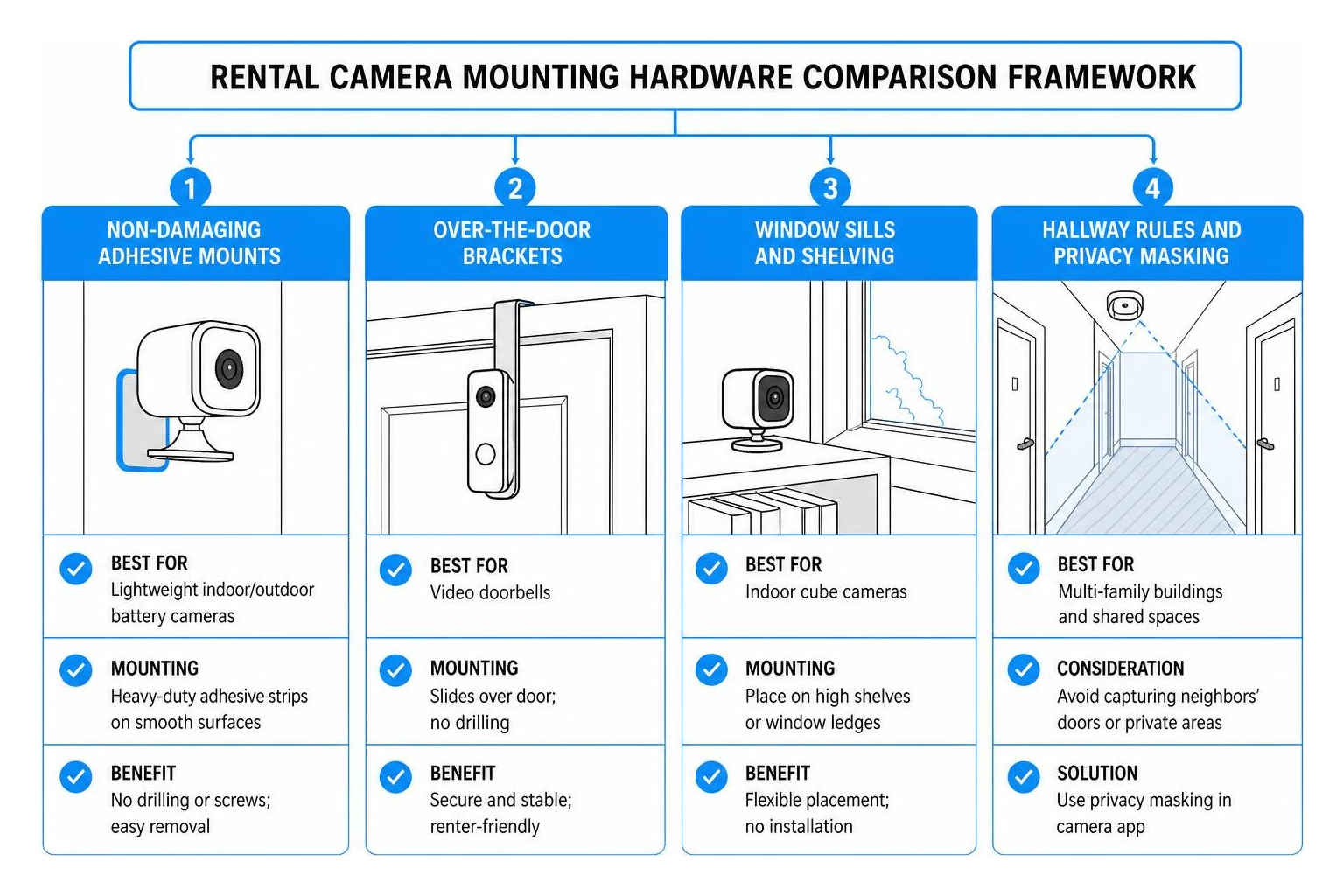
Renting doesn’t mean sacrificing security, but it does require non-permanent installation methods that won’t jeopardize your security deposit:

Rental camera mounting hardware comparison framework

  • Non-Damaging Adhesive Mounts: Lightweight battery-powered cameras can be installed using heavy-duty indoor/outdoor adhesive strips on smooth, painted trim or glass.
  • Over-the-Door Brackets: Video doorbells can be mounted onto metal over-the-door brackets that slide directly onto your apartment front door without screws or drilling.
  • Window Sills and Shelving: Place indoor cube cameras on high bookshelves or window ledges angled toward internal entry points.
  • Hallway Rules and Privacy Masking: In multi-family buildings, pointing cameras directly into a neighbor’s door across the hall can lead to legal privacy disputes. Use software privacy masking within your camera app to blackout public hallway areas or neighboring doorways from recorded footage.

Power Options, Hardware Installation, and Privacy Boundaries

PoE security camera installation and exterior cable sealing

How your camera receives power directly impacts where it can be installed:

  • Power over Ethernet (PoE): Preferred for permanent installation. Ethernet cables carry both power and video signals up to 328 feet (100 meters) on a single run. They require drilling access holes into exterior walls but offer unmatched reliability.
  • Battery and Solar Powered: Ideal for remote fences, side paths, or trees where running wires is difficult. Ensure solar panels receive at least 3 to 4 hours of unshaded, direct sunlight daily.
  • Anchoring and Fastening Hardware: Use proper mounting anchors for every exterior wall surface. Use 3/8-inch lag bolts into solid wood studs, 1/4-inch Tapcon screws into brick or masonry, and rubber grommets with outdoor silicone caulk to seal cable penetration points against moisture.
  • Legal Privacy Boundaries: You have a legal right to record public space and your own property, but you cannot record areas where neighbors have a reasonable expectation of privacy (such as inside their windows, bedrooms, or fenced backyards). Position cameras carefully to keep your feeds focused strictly inside your property lines.

Check off every step before finalizing your install using our comprehensive security camera installation checklist.

Frequently Asked Questions About Security Camera Placement

How high should outdoor security cameras be mounted to capture faces clearly?

Outdoor cameras should be mounted between 8 and 10 feet above ground level, tilted down between 15 and 30 degrees. This height keeps the camera out of reach of physical tampering while preserving clear, horizontal facial angles for identification.

How many security cameras does an average home need?

A typical 1,500 to 2,500 square foot home requires 4 to 6 cameras: one for the front door, one for the driveway/garage apron, one for the rear slider/patio, and one or two for side yards.

Where should you never mount a home security camera?

Never place security cameras inside bathrooms, bedrooms, dressing rooms, or pointing directly into neighboring home windows where individuals have a legal expectation of privacy.

Conclusion

Finding the best places to mount security cameras isn’t about buying the most expensive hardware—it’s about strategic placement. By focusing on primary access targets like front doors, ground windows, and side gates, and mounting hardware at proper heights and angles, you build a protective perimeter that deters intrusion before it occurs.

At SmartMait, we help home and business owners take the guesswork out of smart home technology. Our ongoing optimization, maintenance, and expert installation services ensure your surveillance network stays online, sealed against the elements, and ready to protect your home.

Ready to secure your property with a professionally planned security setup? Learn how to choose automated home security systems today with SmartMait.

Evaluate Recurring-Revenue Services in a Smart-Home Franchise

Evaluating Recurring Revenue Beyond One-Time Hardware

A search for Bunnings key safe is consumer-focused, whereas this article evaluates whether a U.S. smart-home franchise can build ongoing maintenance and system-optimization relationships after installation. This distinction helps prospective franchise buyers keep their evaluation focused on service operations and customer relationships. A service membership may support repeat work, but its value depends on customer demand, delivery costs, and the franchise’s support.

For prospective franchise buyers, the more relevant evaluation is how a smart-home integration business can build lasting service relationships after the initial installation.

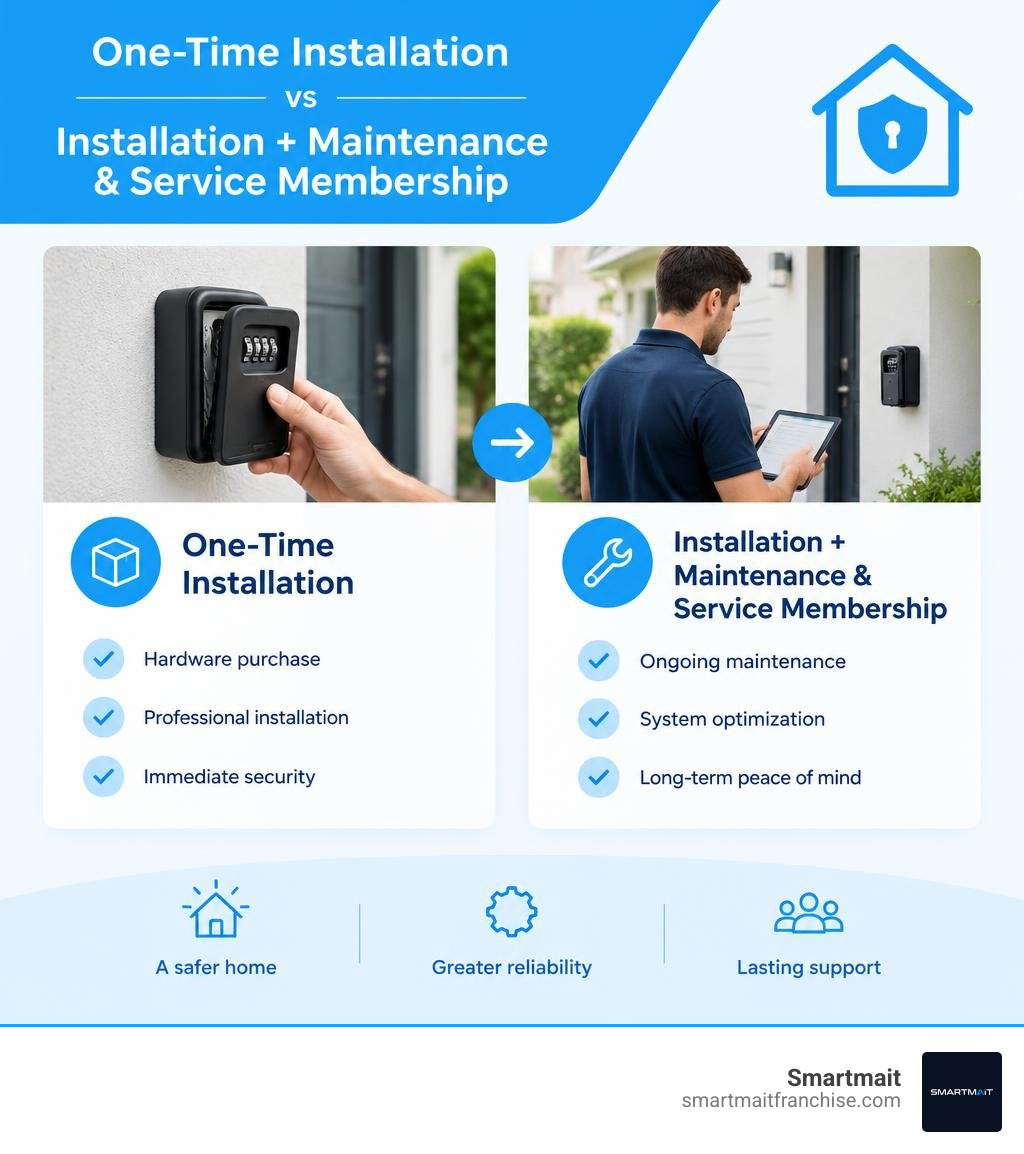
One-time installation compared with installation plus maintenance and service membership infographic

For prospective franchise buyers, the key question is whether the franchise model supports a repeatable service relationship after the initial project. Look for a clear process for scheduling maintenance, documenting system performance, training technicians, and communicating with clients over time. These operating practices are more relevant to a franchise decision than individual consumer products because they show how the business can standardize service delivery across a territory. They also help established low-voltage integrators assess whether a franchise conversion could reduce owner-dependence while preserving a consistent client experience overall. This focus keeps the article focused on franchise operations rather than products sold to homeowners.

Separating Consumer Searches From Franchise Evaluation

A consumer search can be useful only as a reminder that the franchise decision is different from purchasing a single device. Prospective operators should instead consider whether the franchisor has a repeatable way to turn an initial project into scheduled follow-up work. That includes a defined service scope, clear client communication, technician accountability, and systems for recording what was completed at each visit.

For an established integration business, this distinction also clarifies what must be standardized before a conversion. The value of a franchise framework is not the individual product installed at a property. It is the operating model that helps teams deliver consistent maintenance, optimization, and client support across a territory.

This approach keeps the evaluation centered on a franchise operator’s ability to deliver an organized service experience, train a capable team, and maintain productive client relationships after the first project.

It also keeps attention on the capabilities required to manage those relationships over time.

How Ongoing Services Fit a Smart-Building Franchise

When evaluating business models across the low-voltage integration sector, looking at broader market trends helps clarify why ongoing service agreements matter. Industry resources, such as the Industry Spotlight: Home Services and Maintenance, Cleaning & Sanitation Services, highlight the steady growth of home services built on long-term customer relationships rather than isolated project delivery.

In traditional installation setups, a technician might install access hardware or basic security enclosures, collect payment, and never speak with the property owner again. For an independent contractor or prospective franchise owner, this creates a feast-or-famine cycle where new revenue requires constant marketing to new buyers.

In contrast, modern smart-home and smart-building franchises emphasize long-term service relationships. By combining initial technology deployments with routine maintenance and optimization, operators create stability and foster customer loyalty across their exclusive territories.

Ongoing Service Offerings as Part of an Integration Business

Smart environments are dynamic ecosystems. Connected lighting, automated access systems, enterprise-grade networking, and energy management platforms require regular firmware upgrades, physical tune-ups, and operational optimization.

When an integration business structures its operations to provide lifecycle management, customers receive predictable performance and peace of mind. For a prospective franchise owner, integrating maintenance contracts directly into installation work changes the foundation of the business:

  • System Health Checks: Scheduled diagnostics for automated building controls and connected security layers.
  • Network Optimization: Periodic recalibration of access points, bandwidth allocation, and device configurations.
  • Hardware Tune-Ups: Physical inspection and cleaning of sensors, controllers, and motorized components.
  • Proactive Upgrades: Timely software and firmware updates that prevent compatibility failures before they cause disruptions.

This blended delivery structure fits naturally into a franchise framework, allowing operators to build an active client base while delivering dependable service standards.

Building Ongoing Customer Relationships

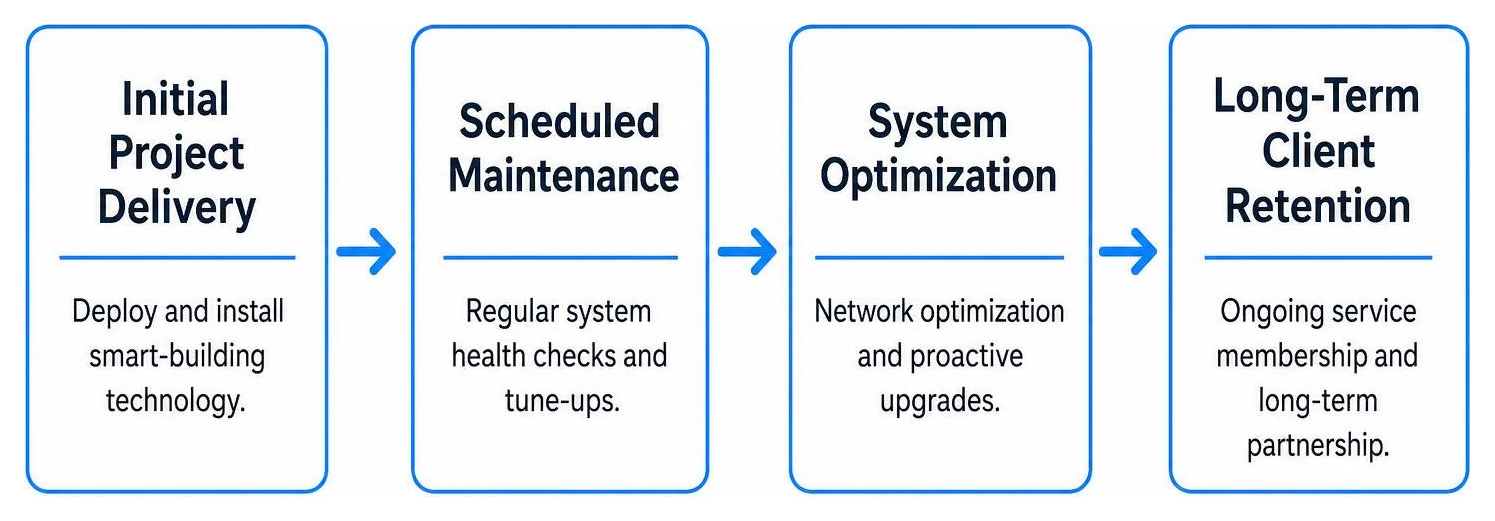
Establishing long-term customer relationships involves moving away from reactive service calls and toward structured service memberships. When a client signs up for scheduled system reviews, the relationship changes from an occasional repair request into a collaborative partnership.

Client lifecycle from initial project to long-term membership

Service memberships encourage consistent communication. Regular touchpoints allow field technicians to identify emerging client needs, suggest system improvements, and maintain peak performance for residential and commercial spaces. For established business owners seeking a conversion path, this model stabilizes technician scheduling and smooths operational capacity across changing seasons.

Evaluating the Business Opportunity

As you review smart-building franchise opportunities, assessing how service lines are structured is just as critical as examining initial installation workflows. Key operational areas to explore include:

  1. Systemized Workflows: Are standard operating procedures available for both routine checkups and complex diagnostics?
  2. Technician Onboarding: Does the franchise provide thorough training pathways for cross-skilling field technicians in maintenance protocols?
  3. Territory Demographics: Does the geographic market have a sufficient density of high-automation homes or commercial facilities that value ongoing service agreements?
  4. Operational Infrastructure: Does the franchisor provide client management platforms that support automated scheduling, membership tracking, and communication?

Taking time to explore the definitive guide to smart home solutions franchise viability can help prospective operators evaluate these operational components effectively.

Questions to Ask About Ongoing-Service Operations

Prospective franchise buyers can learn a great deal by asking how service work is handled after an installation is complete. The aim is not simply to confirm that maintenance is available. It is to understand whether the franchise has documented processes that a new operator can use consistently from the first client relationship onward.

Useful questions include how the team identifies systems that need follow-up, how clients are offered a maintenance relationship, and how recurring appointments are scheduled. Buyers should also ask whether technicians use shared checklists, whether client records capture service history, and whether the franchisor provides guidance for communicating recommended improvements without making unsupported promises.

For operators converting an established low-voltage business, the operational handoff matters just as much. A conversion may require new workflows for dispatch, documentation, technician onboarding, and quality control. Reviewing those workflows helps an owner compare the practical trade-offs of remaining independent with adopting a franchise system.

It is also important to understand where responsibility sits. Ask what support the franchisor provides for training, technology standards, service templates, and operational coaching, and what the local operator is expected to manage. Clear boundaries make it easier to build dependable service habits while maintaining a consistent customer experience.

Finally, evaluate whether the service model fits the target territory and the business owner’s capabilities. A strong model should be understandable, repeatable, and relevant to the types of smart-home and smart-building projects the local team is prepared to support. This keeps the assessment focused on sustainable operations rather than isolated installations.

Measuring Consistency in the Field

Consistency is visible in the small details of service delivery. Prospective owners should ask how technicians confirm the work completed, how they record changes to a system, and how managers review follow-up needs. A franchise model with repeatable field practices can help a local operator reduce avoidable variation as the team expands.

It is equally useful to consider how the model handles exceptions. Not every project or client request will fit a standard routine, so operators need an escalation path for complex questions. Understanding who provides guidance, how decisions are documented, and how lessons are shared across the business can reveal whether the franchise system supports dependable operations beyond the initial training period.

This kind of operational clarity helps prospective owners evaluate whether the franchise can support disciplined service delivery as local demand develops.

It also supports confident decisions about staffing, systems, and client follow-up.

How to Evaluate Recurring-Revenue Potential

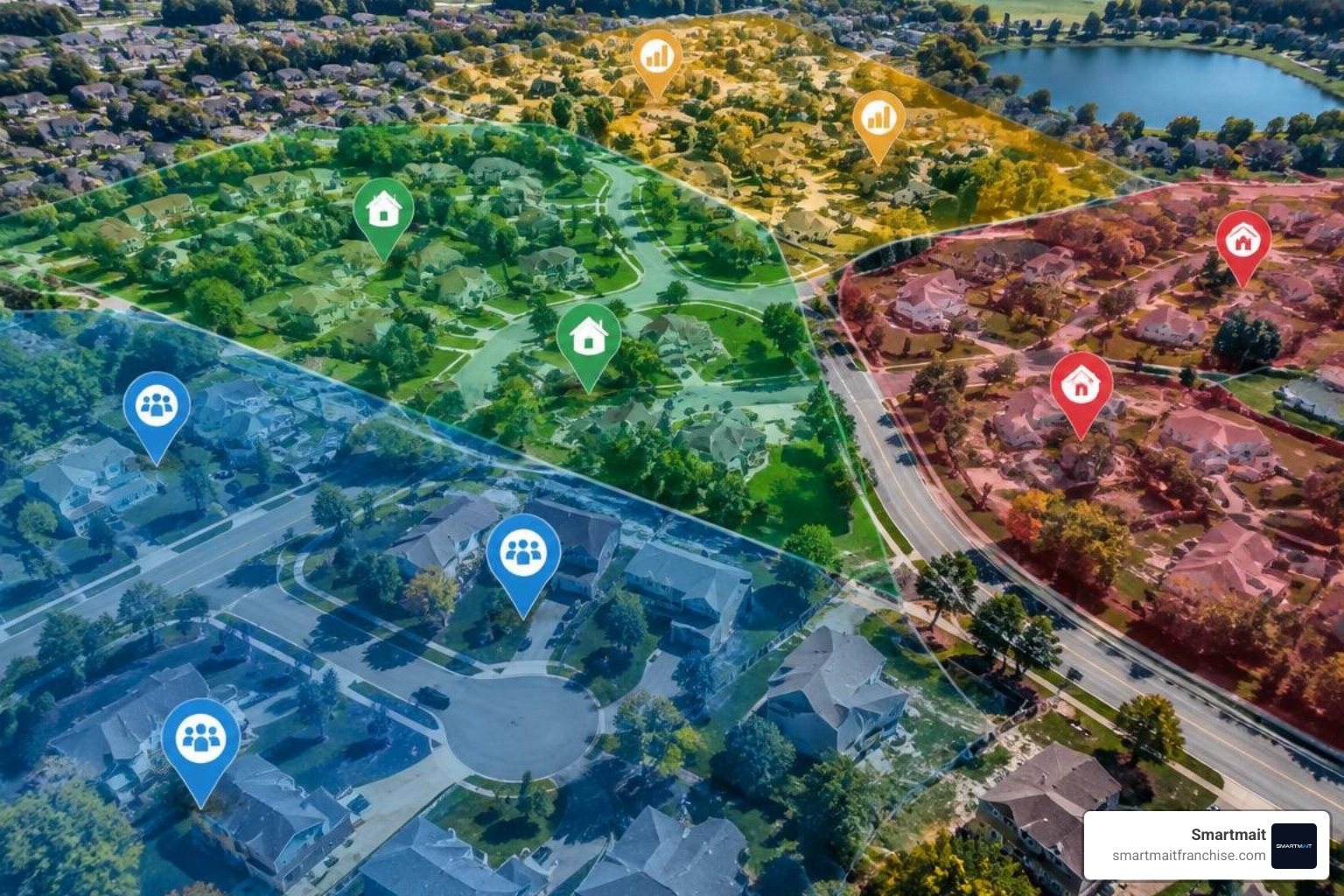
business owner reviewing territory analytics and service plans

Assessing the viability of service-membership models requires looking closely at territory demographics, client expectations, and service-delivery infrastructure. Rather than relying on guesswork, prospective franchisees must evaluate how effectively structured service programs solve real problems for property owners.

Service Scope and Customer Needs

Not every connected device warrants an ongoing service plan. Routine maintenance models are most effective for integrated, mission-critical systems where downtime causes inconvenience, safety concerns, or operational inefficiency.

High-value service targets typically include:

  • Distributed Control Ecosystems: Centralized smart-home processors, automation hubs, and touch panels.
  • Access and Perimeter Systems: Motorized gates, smart access hardware, and integrated intercom networks.
  • Network Backbones: Managed switches, commercial-grade routers, and structured low-voltage cabling.
  • Environmental Controls: Connected HVAC integration, smart shade automation, and energy monitoring panels.

When designing territory offerings, operators must match service packages to the specific property profiles in their area. Urban territories with luxury multi-dwelling units require different service scopes than suburban areas with sprawling single-family estates or light commercial facilities.

Training, Systems, and Service Delivery

A recurring-service model is only as dependable as the technicians who deliver it. For independent low-voltage integrators considering a franchise conversion, recruiting, training, and retaining skilled field technicians is often a primary operational challenge.

Franchise networks streamline these hurdles through structured technical curriculums and repeatable operational systems. Standardized diagnostic checklists ensure that every service visit delivers thorough value, regardless of which field technician handles the appointment. Reviewing a comprehensive guide to reliable smart home integration provides helpful perspective on how operational consistency underpins successful customer retention.

Costs, Support, and Value Considerations

When evaluating any franchise opportunity, prospective owners should carefully review the operational tools and ongoing support systems provided by the franchisor. A strong franchise framework helps operators manage customer relationships efficiently by providing:

  • Centralized Software Systems: Integrated scheduling, dispatch, and recurring service-billing platforms.
  • Brand Standards: Consistent service-level agreements and customer communication templates.
  • Continuing Education: Ongoing technical modules covering emerging automation standards, protocols, and hardware integrations.
  • Business Support: Operational coaching focused on optimizing field dispatching and client retention workflows.

All formal terms, business obligations, and operational requirements are outlined in detail within the franchisor’s Franchise Disclosure Document (FDD), which every prospective buyer should review thoroughly during due diligence.

Reviewing Service Readiness Before Launch

Before offering an ongoing-service program, prospective owners should map the client journey from the first consultation through later maintenance visits. This review should identify who explains the service relationship, how appointments are documented, what information technicians need in the field, and how unresolved issues are escalated. A clear process gives clients a more consistent experience and gives operators a practical way to monitor service quality.

The review should also cover technician readiness. Maintenance and optimization work can involve different responsibilities from an initial installation, including follow-up communication, system documentation, and careful diagnosis of changing client needs. A franchise candidate should look for structured training that helps technicians apply the same standards across visits while adapting to the specific systems already in place.

Operational tools matter because recurring work depends on reliable coordination. Scheduling, client records, service checklists, and internal communication should support each other rather than create separate manual tasks. When these tools are integrated into the franchise model, an operator can spend more time delivering consistent service and less time reconstructing what happened on a prior visit.

A practical evaluation also considers how the business will set expectations. Clients should understand what a service relationship covers, when they will hear from the team, and how they can request help. Clear expectations help protect the client experience and give the operator a foundation for long-term retention.

Prospective owners should also review how the service model adapts as the client base grows. Early processes may work well for a small number of appointments but become difficult to manage without clear ownership, consistent records, and dependable communication. A franchise framework should give local operators a practical structure for maintaining service standards as recurring work becomes a larger part of the business.

That structure can help the local team stay organized as service needs evolve.

Steps to Assess a Recurring-Service Opportunity

prospective franchise owner reviewing market territory and business plan

Navigating the evaluation process requires a methodical, step-by-step approach. By breaking down your review into clear phases, you can determine whether a smart-building integration franchise aligns with your professional background and business goals.

  1. Analyze Local Market Characteristics: Examine property values, commercial construction activity, and smart-device adoption rates within the target territory.
  2. Review Service Delivery Models: Assess how the franchisor balances one-time project workflows with long-term maintenance programs.
  3. Evaluate Operational Infrastructure: Examine the dispatching, client management, and quality-control systems provided to franchise operators.
  4. Assess Business Conversion Options: If you currently run an independent low-voltage integration or electrical business, evaluate how converting to an established franchise brand could help streamline operations, improve field recruitment, and build long-term enterprise value.
  5. Conduct FDD Due Diligence: Carefully review the Franchise Disclosure Document and consult with professional legal and franchise advisors to understand all operational guidelines.

For a deeper dive into the operational structures of low-voltage franchising, consult The Complete Guide to Smart Home Franchises.

As part of this review, prospective owners should speak with the franchisor about the day-to-day routines behind the model. Focus on how a new operator learns the service process, how technicians are supported as systems change, and how the local business maintains a consistent client experience. This practical perspective helps buyers assess whether the franchise approach fits their existing skills, staffing plans, and long-term business goals.

Buyers can also prepare a short list of operational questions before conversations with the franchisor. Ask how service appointments are prioritized, how technician performance is reviewed, and how client concerns are documented. The answers can reveal whether the system provides enough structure for a new franchise owner to build reliable routines while staying responsive to local client needs.

This preparation makes the franchise evaluation more practical and less dependent on assumptions about day-to-day operations.

Frequently Asked Questions About Recurring Services in a Franchise

Can ongoing services support recurring revenue?

Yes. In the low-voltage and smart-building integration sector, ongoing maintenance, system health monitoring, and regular optimization agreements allow operators to develop long-term service relationships. By providing routine checkups, firmware updates, and priority support, integration businesses can build predictable operational schedules and improve client retention over time.

What should prospective franchise owners evaluate before offering ongoing services?

Prospective owners should evaluate local territory demand, client property profiles, technician skill requirements, and the operational tools provided by the franchisor. Ensuring that the franchise system includes standardized diagnostic processes, centralized scheduling software, and comprehensive technician training is critical for delivering consistent service quality.

How can an existing integration business assess a franchise conversion?

Established integrators should examine whether joining a franchise network helps resolve common scaling hurdles, such as owner-dependence, technician recruitment, brand recognition, and operational standardization. Reviewing the franchise’s operating systems, territory structures, and conversion paths outlined in the FDD will clarify whether the model supports long-term succession planning and business growth.

Why does service documentation matter for a franchise operator?

Service documentation helps a franchise operator create continuity between the initial project and later appointments. Notes on the installed system, completed maintenance, client questions, and recommended next steps give technicians a clearer starting point when they return to a property. For prospective franchise buyers, the important question is whether the franchisor provides repeatable documentation practices that support consistent service quality as the local client base grows.

How should a prospective owner assess technician readiness?

A prospective owner should review the training path for both installation and ongoing-service work. Look for clear expectations around diagnostics, client communication, service records, and escalation procedures. A structured approach can help an operator onboard technicians more consistently and maintain reliable standards as the business develops.

Strong preparation helps prospective owners evaluate the model with greater clarity before committing to a franchise opportunity.

Conclusion

Building a sustainable low-voltage and smart-building integration business requires looking past one-off hardware sales and focusing on the total lifecycle of the systems you install. By pairing professional design and installation with proactive maintenance and ongoing optimization, smart-home operators create lasting relationships that benefit property owners and business owners alike.

If you are an entrepreneur seeking a dynamic business opportunity or an established integrator looking to scale beyond owner-dependence through a proven franchise framework, we invite you to take the next step.

To learn more about territory availability, training programs, and conversion opportunities, explore The Complete Guide to Smart Home Franchises and request your comprehensive Smartmait franchise information kit today.

Before moving forward, prospective owners should review how Smartmait supports training, operational consistency, and long-term client service. A focused conversation can help determine whether the franchise model aligns with an existing integration business or a planned entry into the low-voltage industry.

Requesting franchise information is a practical next step for learning how the Smartmait model approaches operator training, service standards, and the transition from an initial installation to an ongoing client relationship.

It also gives prospective owners a clear starting point for discussing how their experience and goals may fit the franchise model.

Power Under Control: Smart Energy Monitoring as a Smart-Building Franchise Opportunity

Why IoT Energy Monitoring Matters to Smart-Building Franchise Buyers

A smart energy monitoring system using IoT connects meters and sensors to software that shows how much energy a building uses and when. It can flag unusual use and help people decide where to cut waste. For a prospective franchise owner, the opportunity is not just installing the system. It is helping customers keep it working and use the data over time.

That makes energy monitoring worth studying as part of a smart-building service business. Before buying a territory or converting an existing business, look at local demand, the skills needed to support connected systems, and whether ongoing maintenance fits the business model.

I’m Dominic Hesano, a franchise development professional and business operator building Smartmait around connected-building installation and ongoing support. My work in smart-home and building services shapes how I evaluate a smart energy monitoring system using IoT as a potential service opportunity.

IoT energy monitoring uses meters and sensors, software insights, and ongoing service support infographic

Smart energy monitoring system using iot word roundup:

Understanding the Smart-Building Opportunity Around Energy Monitoring

Franchise business model connecting customer needs, smart-building services, and ongoing support

Energy management is undergoing a structural transformation across the United States. As properties become more interconnected, real-time energy tracking has shifted from a novelty to an operational necessity. Research shows that IoT-enabled energy management systems are projected to save over 1.6 petawatt-hours (PWH) of electricity by 2030—enough energy to power more than 150 million homes for an entire year. Backing this transition, the global IoT energy management market size is projected to reach $222.56 billion by 2030.

For entrepreneurs evaluating a franchise investment, these macro trends point to a durable service vertical. Property owners face rising power rates, aging grid infrastructure, and stricter local environmental reporting requirements. Implementing an intelligent monitoring framework allows facilities to identify waste, improve efficiency, and protect high-value electrical assets. Industry studies indicate that deploying IoT in energy management can reduce energy waste ranging from 15% to 49%, while smart equipment conservation alone saves 15% to 25% of total power draw.

To capture this market, smart-building operators do not simply deliver one-off hardware jobs. Instead, they position themselves as long-term energy partners. By maintaining system health, analyzing load telemetry, and ensuring continuous sensor calibration, franchise operators establish a continuous relationship that extends well past initial project completion.

Framework connecting IoT sensors, gateways, analytics platforms, and ongoing support services

Understanding these connected efficiency initiatives aligns closely with national infrastructure priorities, as detailed in A National Roadmap for Grid-Interactive Efficient Buildings.

How Energy Monitoring Fits into a Smart-Building Service Business

Commercial property managers, multi-family operators, and modern homeowners are searching for visibility into their daily utility consumption. A baseline installation often reveals immediate inefficiencies—such as HVAC equipment running during unoccupied hours, power factor anomalies, or unmitigated phantom loads. Academic research into design, power quality analysis, and implementation of smart energy meter using internet of things shows that tracking voltage, current, and total harmonic distortion helps facilities mitigate costly equipment downtime.

In a smart-building service business, energy intelligence serves as an operational anchor. When field teams install current transformers, environmental sensors, and smart gateways, they create a steady stream of operational data. This data enables franchise operators to offer ongoing diagnostic reviews, system updates, and preventative maintenance visits. As property owners see measurable consumption drops, the integration provider becomes an indispensable partner in managing their physical plant.

Evaluating Technology and Service Capabilities

Evaluating a smart-building franchise requires understanding the core architecture behind IoT-based monitoring. At a high level, these platforms operate across three distinct tiers:

  1. The Perception Layer: Hardware components including current transformers, voltage transducers, and environmental sensors that capture real-time electrical parameters.
  2. The Network and Transport Layer: Edge gateways and low-power communication protocols—such as MQTT, LoRaWAN, and NB-IoT—that securely transmit telemetry data without overwhelming local networks.
  3. The Application Layer: Cloud-based software, rule engines, and centralized dashboards that present actionable analytics and trigger automated alerts.

Studies highlighting the design and implementation of an IoT-based smart grid monitoring system for real-time energy management illustrate how microcontrollers like the ESP32 paired with lightweight messaging protocols (such as MQTT) deliver instant threshold notifications directly to building operators.

For franchise candidates, evaluating these capabilities is less about writing code and more about operational execution. A strong franchise framework provides standardized system designs, pre-configured software stacks, and clear field installation workflows. This structure ensures that technicians deliver consistent, enterprise-grade deployments across every client site. Prospective owners can review how these service capabilities are structured by reviewing Smartmait franchise information.

Business and Market Considerations for Franchise Buyers

Prospective franchise owner reviewing market and territory information

Entering the smart-building and low-voltage sector requires a clear evaluation of local demographics, commercial density, and service-market maturity. Operating an integration business involves distinct challenges compared to traditional home-service trades. Rather than chasing one-off repair tickets, a modern integration franchise focuses on building an installed base of connected residential and commercial accounts that generate ongoing service demand.

When assessing territory viability, prospective owners should evaluate the balance between new construction, retrofits, and commercial facilities. Regions with high energy costs, rapid commercial expansion, or aggressive building-efficiency mandates offer a receptive customer base. Exploring smart energy tracking provides franchise buyers with a clear framework for measuring real-time demand in their target regions.

Evaluating a Smart-Building Franchise Opportunity

A successful franchise partnership provides the tools, operational playbook, and technical support needed to establish market presence efficiently. When evaluating franchise options, candidates should examine several core operational pillars:

  • Standardized Field Procedures: Documented installation methodologies for power sensors, low-voltage control wiring, and gateway commissioning.
  • Service-Membership Architectures: Turnkey frameworks for offering ongoing maintenance plans, proactive monitoring retainers, and system performance checkups.
  • Supply Chain and Vendor Relationships: Direct access to vetted, commercial-grade hardware and software platforms that eliminate guesswork.
  • Ongoing Training and Operator Support: Comprehensive technical onboarding, safety training, and operational coaching for both franchise owners and their field staff.

By selecting an established brand model, franchise owners bypass the costly trial-and-error phase that often traps independent contractors. Those interested in building an integration business backed by a structured support team can explore Smartmait’s franchise opportunity.

Converting an Existing Integration or Home-Service Business

For established low-voltage integrators, electrical contractors, and security installers, converting an existing business to a franchise model offers a direct path toward operational maturity. Many independent integration owners find themselves trapped in an owner-dependent cycle—handling sales, technical troubleshooting, and daily operations simultaneously.

Franchise conversion provides the systems and brand equity needed to streamline operations, professionalize technician recruitment, and introduce formalized service-membership programs. By shifting from a purely transactional project model to an ongoing service framework, business owners can build institutional value, simplify succession planning, and scale their organizations beyond their own daily physical involvement.

Building a Business Around Ongoing Service

The fundamental difference between a volatile contracting business and an enduring service enterprise lies in client retention. In a traditional project-based model, an integration company must constantly secure new construction or renovation projects to sustain operations. Once the final invoice is paid, the customer relationship goes dormant.

A smart-building franchise flips this dynamic. Installing an energy monitoring system establishes a persistent digital link to the client’s physical property. Because connected systems require periodic sensor recalibration, firmware updates, network security audits, and data reviews, franchise operators are positioned to provide structured, recurring service memberships.

Developing Recurring-Revenue and Service-Membership Models

Service memberships in the smart-building trades formalize the ongoing relationship between the property owner and the service provider. By bundling system health monitoring, priority dispatch, quarterly analytical reviews, and scheduled physical tune-ups, franchisees create consistent touchpoints.

In research covering an IoT-based real-time energy monitoring and management system, ongoing data collection was shown to help facility owners continually optimize peak demand and eliminate operational waste. For a franchise operator, delivering these insights turns technical telemetry into clear business value for the client.

To implement a reliable service program, operators often follow a standardized multi-step lifecycle:

Process showing initial audit, system deployment, live data streaming, and ongoing service reviews

  1. Baseline Energy and Connectivity Audit: Establishing an initial profile of the building’s electrical infrastructure and network topology.
  2. Hardware Deployment and Commissioning: Installing calibrated current sensors, voltage taps, and IoT gateways using standardized low-voltage wiring practices.
  3. Data Integration and Threshold Setup: Connecting telemetry streams to centralized dashboards and setting automated alert thresholds for voltage spikes or load anomalies.
  4. Active Maintenance and Service Reviews: Providing routine hardware checkups, battery backup testing, and data analysis as part of a formal service membership.

Assessing Commercial and Multi-Family Market Segments

While single-family residences offer steady demand for automation, commercial buildings and multi-family communities represent significant scale for smart-building franchises. Commercial property owners face strict operating budgets and need granular visibility into sub-metered tenant spaces, common-area HVAC systems, and central refrigeration plants.

Field data demonstrates the direct financial impact of sub-metering: in a commercial deployment tracking 146 priority targets across 12 facilities, operators achieved a global reduction of 22 million kilowatt-hours by identifying abnormal overnight baselines and balancing three-phase loads.

Multi-family developers also prioritize sub-metering systems to allocate utility costs fairly among residents. By mastering these commercial and multi-tenant applications, franchise operators can expand their service footprint into high-density properties that require ongoing technical oversight.

The smart-building ecosystem is advancing quickly, driven by cloud computing, machine learning, and advanced sensor hardware. Modern platforms no longer rely solely on simple threshold alerts. Instead, they incorporate AI-driven pattern recognition to identify electrical signatures, predict mechanical failure in induction motors, and automatically balance loads.

Academic literature detailed in the safa-thaaer/monitoringenergyconsumption project illustrates how modern systems use heuristic device inference to break down whole-building consumption into individual appliance loads without requiring individual sub-meters on every plug. Furthermore, studies on close cookie preferences research on smart energy show that pairing long-range, low-power LoRa networks with power-line-backed data acquisition creates resilient infrastructure capable of maintaining data integrity during grid fluctuations.

For a franchise operator, these technical developments represent expanded service opportunities. As building systems become more sophisticated, property owners increasingly rely on trained, professional service providers to maintain, secure, and optimize their connected environments.

Several dominant industry shifts are shaping customer demand:

  • Distributed Renewable Integration: Properties pairing rooftop solar arrays and battery banks require advanced monitoring to manage bidirectional power flows. Operators can study our smart home battery storage guide to see how storage systems interact with overall building power.
  • Edge-Based Intelligence and Privacy: Property owners increasingly favor systems that process critical telemetry locally before transmitting summaries to the cloud. Understanding why smart homes without cloud dependency offer superior privacy and speed provides key context on balancing local network resilience with cloud accessibility.
  • Predictive Fault Detection: Machine learning models applied to grid monitoring systems can reduce energy waste by up to 15% compared to legacy monitoring, while warning operators about impending compressor or transformer breakdowns weeks before physical failure.

Certification and Training Paths for New Operators

Operating a professional smart-building integration franchise does not require an advanced degree in electrical engineering, but it does demand structured technical competencies and rigorous safety standards. A well-designed franchise system provides clear training pathways for new operators and their technicians.
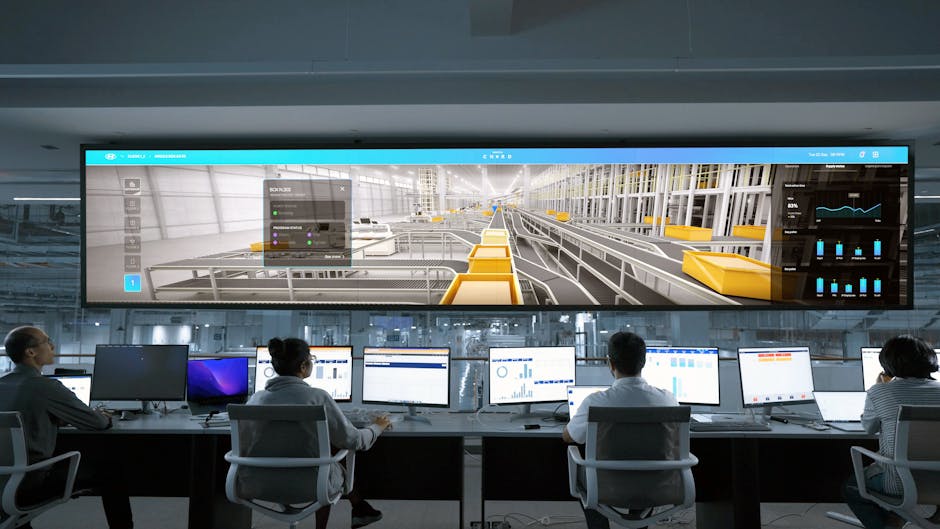
Key educational and operational benchmarks include:

  • Low-Voltage and Electrical Safety: Training on National Electrical Code (NEC) standards, current transformer safety, non-invasive sensor attachment, and low-voltage wiring protocols.
  • Network and Communication Fundamentals: Mastering Wi-Fi, Ethernet, Zigbee, LoRaWAN, and cellular backhauls. Candidates can explore our complete guide to choosing a smart home connectivity solution to understand how communication protocols interact in the field.
  • Software Dashboard and Gateway Commissioning: Learning how to configure edge devices, bind sensors to cloud tenants, and set up client-facing visualization dashboards.
  • Service Operations and Team Leadership: Establishing standard operating procedures for dispatching field technicians, managing customer accounts, and maintaining high service-level agreement (SLA) fulfillment.

Beginners entering the connected technology space can review our smart home 101 guide for a foundational overview of automation components and system interoperability.

Franchise Evaluation and Implementation Considerations

Investing in a franchise territory is an operational and strategic commitment. Successful candidates conduct thorough due diligence, evaluating both their local market dynamics and their personal readiness to manage a professional trade enterprise.

Research published in a low cost IoT-based smart energy monitoring and load management system case study proves that deploying accessible, locally calibrated IoT hardware can yield an average 12% reduction in consumption within 30 days. For prospective franchisees, this demonstrates that energy efficiency solutions deliver tangible, rapid results that build long-term client trust.

Understanding the Franchise Disclosure Document

The Franchise Disclosure Document (FDD) is the central legal and operational document provided to prospective buyers during the discovery process. It details the operational framework, franchisor support structures, and legal obligations of both parties.

When reviewing an FDD, prospective owners should carefully examine:

  • Item 8 (Restrictions on Products and Services): Outlines the approved vendors, hardware specifications, and proprietary software platforms required to deliver uniform service quality.
  • Item 9 and Item 15 (Franchisee’s Obligations and Participation): Defines operational expectations, management roles, and ongoing performance standards.
  • Item 11 (Franchisor’s Assistance, Systems, and Training): Details the initial onboarding curriculum, field training programs, operational software access, and ongoing technical support provided by the brand.
  • Item 12 (Territory Definitions): Clarifies geographical territory boundaries, customer assignment rules, and expansion protocols.

Prospective buyers should review all disclosure documents thoroughly with independent franchise attorneys and professional business advisors before making a final commitment. Discover how our brand structures these operational standards by requesting Smartmait franchise information.

Frequently Asked Questions About Smart-Building Franchises

Who may be a good fit for a smart-building franchise?

Ideal candidates include established low-voltage integrators, electrical service business owners, HVAC contractors, and experienced corporate managers looking to build an operational business. Successful franchisees possess strong operational leadership skills, an aptitude for managing field teams, and a commitment to delivering high-touch customer service built around recurring maintenance relationships.

How should buyers evaluate a franchise territory?

Territory evaluation involves analyzing regional commercial growth, single-family residential density, average utility rate trends, and local building energy codes. Prospective owners should also evaluate local competition to identify underserved customer segments—such as commercial light-industrial parks, educational campuses, and multi-tenant residential properties.

How can an existing integration business explore franchising?

Established business owners can evaluate franchise conversion by conducting an honest internal audit of their current operations. If an independent company struggles with inconsistent project cycles, technician turnover, or owner-dependent sales, converting to a franchise system provides immediate access to standardized service playbooks, brand equity, centralized technical training, and proven recurring-service business models.
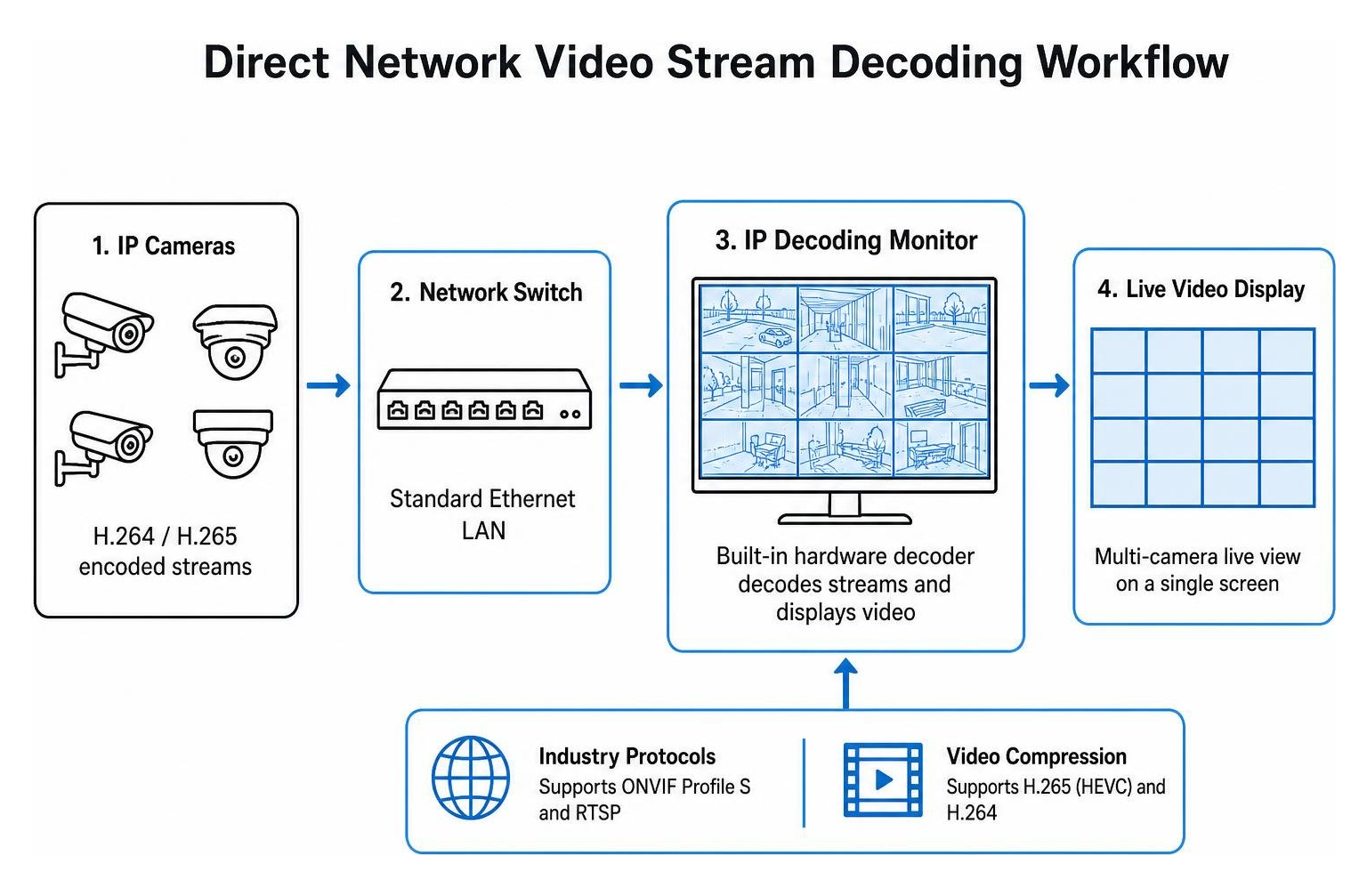
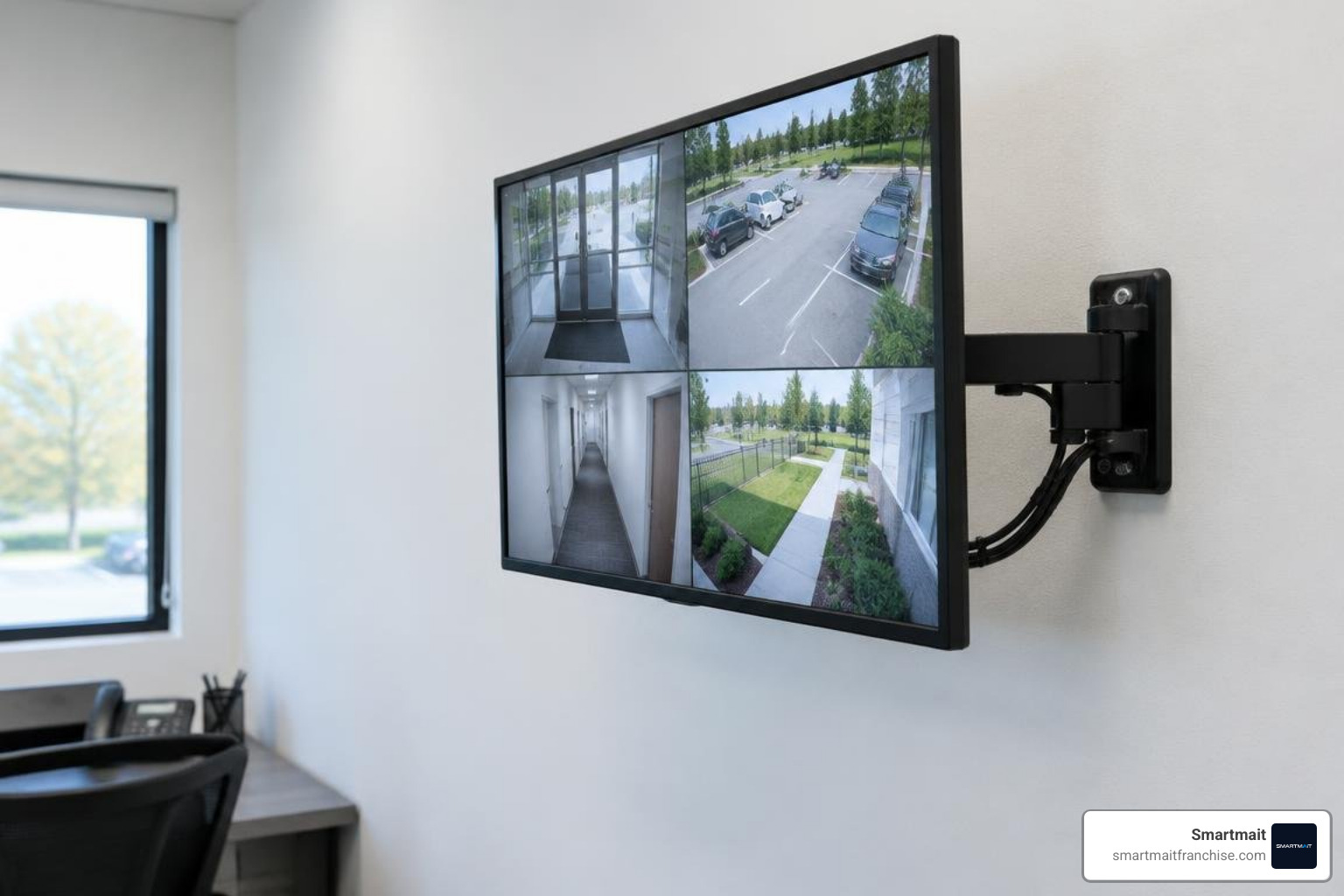
Conclusion

The transition toward intelligent, energy-efficient buildings is reshaping the low-voltage and property services sector. Building owners are no longer satisfied with passive utility meters; they demand real-time visibility, automated power quality protection, and proactive system maintenance.

Smartmait positions franchise owners at the center of this industry evolution. By uniting professional IoT hardware installation with long-term service memberships, our franchise model empowers entrepreneurs to build enduring, service-driven businesses.

If you are ready to evaluate a modern business opportunity in the connected property services sector, explore our commercial smart-building integration franchise information today to request an introductory discovery package and review open market opportunities.

Smart Lighting Franchise Opportunities: What Prospective Owners Should Evaluate

What “Smart Lights Near Me” Means for a Franchise Buyer

To assess the local demand behind “smart lights near me,” look beyond bulb sales. Research nearby homes and businesses that may need smart lighting installed, maintained, and updated. Then review the franchise territory, training, and service model to see whether the opportunity fits that market.

Smart lighting is one part of a broader smart-building business. For a prospective owner or an established installer considering conversion, the key question is whether local project work can support lasting service relationships.

I’m Dominic Hesano. My work in franchising, operations, and building Smartmait informs how I evaluate the business opportunity behind “smart lights near me.”

Smart lighting franchise checklist: local demand, territory, costs, training, and recurring services infographic

Smart lights near me helpful reading:

For broader context on the smart-building integration sector, the U.S. Bureau of Labor Statistics provides occupational data that can help prospective franchise buyers understand the skilled trades landscape.

Evaluating Smart Lighting as a Franchise Business Opportunity

The low-voltage and smart-building integration industry in the United States continues to evolve at a rapid pace. Modern residential properties and commercial facilities are increasingly reliant on automated controls, intelligent architectural illumination, and unified network management. When local property managers and homeowners search for smart lights near me, they are rarely looking for just a single retail product. Instead, they are seeking trusted professionals capable of designing, configuring, and maintaining complete low-voltage environments.

Low-voltage integration franchise workflow diagram

For entrepreneurs evaluating new business ownership, the smart lighting sector offers a dynamic entry point into the wider smart-building trades. A low-voltage integration business provides specialized design, structured cabling, hardware configuration, and long-term technical support. At Smartmait, we combine professional integration services with ongoing maintenance agreements, creating a foundation designed around customer retention.

Established integration and electrical trade business owners face a critical crossroad: whether to continue navigating operational friction alone or leverage a structured franchise model. Scaling an independent integration company often presents bottlenecks around technician recruitment, standardized training paths, and building predictable recurring-revenue programs. A specialized franchise system provides the operational frameworks, centralized brand collateral, and proven operational systems necessary to transition from a project-to-project contractor into an enterprise-level service business.

Assessing the Market and Your Business Background

Conducting thorough local market research is essential before choosing to invest in a low-voltage territory. Market demand is shaped by the density of high-end single-family residences, new commercial developments, hospitality venues, and architectural redesigns. Understanding the split between residential clients needing comprehensive lighting control and commercial operators seeking energy-efficient building automation helps prospective franchise buyers gauge local demand.

When evaluating whether an existing home-service or audio-video integration business fits a franchise model, owners must examine their current operating structure:

  • Operational independence: Are daily field operations overly dependent on the owner’s personal technical involvement?
  • Service catalog diversity: Does the current business deliver basic one-off installations, or does it incorporate unified smart-building solutions?
  • Expansion readiness: Is the company positioned to scale into multi-vehicle fleets or additional geographic territories?
  • Team retention: Are there defined career pathways and technical certification tracks to retain skilled low-voltage technicians?

Prospective owners coming from executive leadership, technical project management, or military backgrounds often bring strong leadership capabilities that align seamlessly with our standardized operational workflows. Pairing strong operational management with standardized field systems allows business owners to focus on team leadership and market expansion.

Understanding the Franchise Investment and Business Model

Evaluating a smart-building franchise opportunity requires a comprehensive review of the Franchise Disclosure Document (FDD). The FDD outlines vital non-financial operational structures, support mechanisms, territory protections, and mutual commitments between the franchisor and franchisee.

Understanding the difference between traditional contractor project workflows and recurring-membership models is critical to evaluating operational longevity. Single-project installation models force a business to constantly chase new customer acquisitions to cover fixed operational overhead. In contrast, incorporating ongoing maintenance, firmware updates, and scheduled network optimizations creates an engaged client base that drives long-term relationship value.

Evaluation Area Key Questions for Prospective Franchise Buyers Strategic Focus
Market Suitability What is the density of residential and commercial properties within the target territory? Customer Demand
Operational Framework Does the franchise provide structured operating manuals and technician training tracks? Scalability & Operations
Business Conversion How smoothly can an existing client list and team transition into the standardized brand system? Business Continuity
Service Continuity Are maintenance memberships integrated into the core service delivery workflow? Client Retention
System Support What marketing, technical routing, and vendor support resources are provided? Brand Infrastructure

Prospective owners must carefully assess these foundational pillars during their due diligence process, ensuring their operational vision aligns with the overarching brand strategy.

Smart Lighting Services and Recurring-Revenue Potential

Smart lighting serves as an intuitive gateway into comprehensive smart-building ecosystems. Once a residential or commercial client experiences the convenience of centralized lighting scenes, automated schedules, and integrated environmental controls, their interest in broader automation naturally expands. A professional integration business leverages lighting projects to introduce complete low-voltage solutions, spanning structured data cabling, intelligent access controls, and environmental management.

The primary competitive differentiator in the modern integration industry is the ability to maintain systems beyond the initial installation date. Advanced automation platforms require regular firmware management, wireless network optimizations, and physical inspections. By introducing service-membership agreements, integration businesses establish proactive maintenance schedules that ensure high client satisfaction while eliminating the instability of seasonal project cycles.

Building a Service Offering Around Customer Needs

Developing an effective service menu requires aligning technical solutions with the operational priorities of local property owners. High-performance properties require a structured, three-phase service model:

  1. Initial Architecture & Integration: Designing and installing low-voltage control systems, architectural fixtures, and dedicated network infrastructure.
  2. System Commissioning & Tuning: Establishing personalized operational schedules, circadian lighting profiles, and integrated automation triggers.
  3. Proactive Maintenance & Optimization: Delivering ongoing health checks, remote system diagnostics, priority support dispatching, and software updates.

By establishing clear expectations around ongoing service relationships, franchise operators position their businesses as essential technology partners rather than transactional contractors.

Planning for Sustainable Business Operations

Sustainable operations in the smart-building trades depend on maintaining balanced technician utilization. Project-based work often creates unpredictable staffing requirements, where field teams oscillate between excessive overtime during installation peaks and unbilled downtime between contracts.

Franchise systems mitigate these challenges by incorporating structured scheduling tools, standard operating procedures, and recurring service appointments. Balancing scheduled maintenance visits alongside major integration projects stabilizes technician routes, improves job satisfaction, and reduces costly field turnover. Furthermore, centralized technical training resources ensure that every technician delivers consistent, high-quality service across every residential and commercial project.

Territory, Training, and Franchise Readiness

Selecting the appropriate market territory and establishing rigorous operational readiness are key steps toward long-term business success. Success in the smart-building integration sector relies on clear market definition, continuous technical education, and systematic operational execution.

Prospective franchise partners must evaluate local market dynamics while taking advantage of the comprehensive operational onboarding and professional development provided by the franchisor. Discover how Smartmait supports new owners and established operators looking to scale within the low-voltage integration industry.

Evaluating a Territory and Local Market

Territory evaluation requires analyzing localized demographic and economic indicators rather than relying solely on raw population numbers. Prospective owners should assess:

  • Real estate development: Volume of high-value custom home builds, major residential remodels, and commercial tenant improvement projects.
  • Commercial activity: Density of boutique corporate offices, high-end retail storefronts, and hospitality spaces requiring commercial-grade architectural control.
  • Competitive landscape: Presence of fragmented single-operator contractors versus established, multi-crew integration firms.
  • Geographic efficiency: Drive-time feasibility and service-route density to optimize daily technician dispatching and vehicle utilization.

By establishing well-defined territory boundaries, a franchise system ensures operators can build localized brand recognition and dominate targeted market segments.

Preparing to Operate or Convert an Existing Business

For independent integration business owners, converting to a franchise model offers a structured path toward scaling beyond owner-dependence. Many independent operators find themselves trapped working inside the business—managing daily field installations, handling emergency service calls, and troubleshooting network issues—leaving little time for strategic business development.

The conversion process involves standardizing operational procedures, rebranding service vehicles and assets, implementing streamlined customer communication workflows, and training field staff according to formal industry standards. Technicians gain access to structured low-voltage certification pathways and advanced system integration training, ensuring that the business delivers enterprise-grade consistency on every job.

Frequently Asked Questions About Smart Lighting Franchises

What should I review before buying a smart lighting franchise?

Prospective owners should thoroughly examine the Franchise Disclosure Document (FDD), paying close attention to operational standards, system training programs, territory protections, and ongoing franchisor support commitments. It is equally important to evaluate the business model’s balance between project-based installation work and recurring maintenance services to ensure it aligns with your long-term business objectives.

Can an existing integration or home-service business convert to a franchise model?

Yes. Established low-voltage, audio-video, electrical, or home-service businesses can transition their existing operations into a structured franchise system. The conversion process focuses on implementing standardized operational systems, adopting formal technician certification pathways, and integrating recurring-revenue service memberships into the existing customer database.

How can recurring services contribute to a smart-building business?

Incorporating ongoing maintenance, system health checks, and optimization memberships transforms a transactional contractor business into an essential long-term technology partner. Proactive service agreements stabilize field technician scheduling, maximize customer retention, and generate ongoing client touchpoints that drive future system upgrade opportunities.

Conclusion

The rising demand for integrated smart-building technology presents a compelling opportunity for both new entrepreneurs and established integration business owners across the United States. Succeeding in the low-voltage trades requires more than technical skill; it demands operational discipline, structured field training, defined territory planning, and a strong service-membership model.

Whether you are looking to enter the smart-building integration space as a new business owner or seeking to scale an existing independent integration company beyond owner-dependence, partnering with an established franchise system provides the operational tools and brand foundation needed for sustainable growth.

Take the next step in evaluating your local market potential. Learn about Smartmait and request detailed franchise information to explore our available franchise territories and conversion opportunities.

Calculating Real Returns from Smart Home Franchise Financial Projections

How to Read Smart Home Franchise Financial Projections

To assess smart home franchise financial projections, start with the cash needed to open and operate until sales cover costs. Then forecast equipment sales, installation revenue, and ongoing maintenance income separately. Subtract labor, materials, overhead, royalties, and marketing fees to see when the unit may break even and whether it can earn a return on the full investment.

For a territory buyer or an integration business considering conversion, the key test is whether those numbers still work if sales grow more slowly than planned. A five-year forecast should show both that slower case and a stronger one, with assumptions tied to the local market. The U.S. Bureau of Labor Statistics provides useful context on employment and wage trends in electrical and electronics installation trades, which can help operators think through labor assumptions in their local territory.

I’m Dominic Hesano. My work in franchise development, sales, and local service operations informs how I approach smart home franchise financial projections, including the role of ongoing service in building repeat revenue.

Checklist for testing startup costs, revenue streams, fees, breakeven, and five-year returns infographic

Quick look at smart home franchise financial projections:

Core Components of Smart Home Franchise Financial Projections

Building an accurate operational forecast begins with understanding how capital flows into and out of an integration business. When prospective franchisees evaluate an opportunity, they often look solely at top-line equipment sales. However, true long-term enterprise value depends on how effectively you allocate startup capital, control overhead, and scale high-margin services.

Evaluating overall smart home franchise investment viability requires categorizing your budget into distinct capital buckets: initial franchise fees, facility or showroom buildouts, vehicle fleet outfitting, specialized low-voltage tooling, initial inventory, and working capital reserves.

Capital Allocation Category Primary Purpose Impact on Breakeven
Initial Franchise Fee Secures exclusive territory rights, onboarding, brand systems, and initial training Upfront sunk cost; amortized over the franchise term
Facility & Leasehold Upgrades Builds out the interactive design center, testing lab, and inventory staging area Fixed upfront expense; drives showroom conversion rates
Fleet & Tooling Packages Outfits mobile service vans, diagnostic meters, and low-voltage rigging gear Direct operational necessity; dictates field technician efficiency
Inventory & Equipment Staging Secures essential automation controllers, panels, networking hubs, and wiring Working asset; requires disciplined cash flow management
Operational Working Capital Covers technician payroll, facility lease, and marketing during the initial ramp Protects cash runway until operational breakeven is reached

Analyzing Startup Costs and Initial Capital Requirements

Every new territory launch demands a clear picture of liquidity. Beyond the initial franchise fee, which grants access to proprietary systems and brand power, capital outlays center on equipping your team for field execution.

A functional interactive design center or showroom allows prospective residential and commercial clients to experience automated environments firsthand. Outfitting this space alongside dedicated staging shelves ensures you can test equipment before bringing it to a customer site.

On the operational side, mobile service vehicles must be outfitted with specialized low-voltage termination tools, safety equipment, and secure storage racks. Maintaining a healthy working capital reserve is vital because it cushions payroll and overhead while your project pipeline matures.

Forecasting Recurring Revenue and High-Margin Service Mix

A common pitfall in independent contracting is relying entirely on one-off installations. When project installations slow down, cash flow dips. A resilient franchise model counters this by integrating steady service contracts, network monitoring, proactive maintenance agreements, and system optimization visits.

By examining the practical smart home service categories available to operators, franchisees can structure recurring revenue tiers. These recurring touchpoints create a predictable baseline of monthly cash flow, significantly reducing reliance on new construction starts and smoothing out seasonal fluctuations.

Key Unit Economics and Margin Drivers to Model

Understanding store-level unit economics helps you evaluate how day-to-day installation work translates into operational earnings. Tracking key metrics allows franchise operators to spot inefficiencies in field labor or lead generation before they affect the bottom line.

unit economics breakdown chart

Evaluating Royalties, Marketing Fees, and Store-Level EBITDA

Franchise models incorporate ongoing brand support through structured royalty fees and centralized marketing fund contributions. When modeling your numbers, incorporate these fees directly into your cost of goods sold and operating expenses.

  • Gross Margins: Generated by balancing equipment procurement discounts with structured billable labor rates.
  • Brand and Marketing Fund: Centralized lead generation campaigns, national brand assets, and digital search marketing reduce the local cost of customer acquisition.
  • Operating Expenses: Fixed overhead, facility leases, insurance, vehicle upkeep, and administrative staff.
  • Store-Level EBITDA Yield: Operational earnings remaining after all direct job costs, franchise royalties, and fixed local overhead are accounted for.

By leveraging brand-negotiated vendor pricing and standardized operational playbooks, a franchise unit aims to offset ongoing royalty contributions through enhanced purchasing power and elevated field efficiency.

Critical Unit Economics Behind Smart Home Franchise Financial Projections

To accurately map growth, prospective owners must track several core metrics:

  1. Customer Acquisition Cost (CAC) to Lifetime Value (LTV): A healthy installation business keeps acquisition costs low relative to long-term client spend, driven by ongoing support packages and system expansions.
  2. Average Transaction Value (ATV): Tracking the blended revenue of whole-home automation packages, light-commercial deployments, and retrofits.
  3. Billable Efficiency Rate: Maximizing the percentage of technician hours billed directly to installations and service calls versus non-billable drive time.
  4. Recurring Service Attachment Rate: The percentage of installation clients who enroll in ongoing system health monitoring, routine recalibration, and remote troubleshooting plans, such as those modeled in commercial security installation returns.

Building a 5-Year Revenue Forecast and Breakeven Model

A five-year forecast acts as an operational roadmap. It outlines how your business transitions from an initial single-van launch into an organized, multi-crew operation supported by recurring maintenance retainers.

timeline of multi-year operational scaling and breakeven

Growth Milestone Primary Operational Focus Target Financial Dynamic
Year 1: Launch & Stabilization Territory launch, field training, establishing local builder networks Achieving operational breakeven; absorbing initial working capital
Year 2: Capacity Optimization Adding secondary service vehicles, expanding service plan enrollments Stabilizing cash flow through recurring service contracts
Year 3: Commercial & Builder Scale Securing multi-unit residential developments and commercial integration Expanding operating leverage; widening EBITDA margins
Year 4: Multi-Crew Maturity Field supervisor leadership, dedicated maintenance and dispatch units Maximizing technician utilization and billable efficiency
Year 5: Enterprise Valuation Territory saturation, fleet optimization, high recurring client base Substantial recurring baseline; strong exit or succession value

Benchmarks for Year 1 Targets and Breakeven Timelines

During the first operating year, the primary objective is reaching operational breakeven—the point where monthly gross profit completely covers monthly overhead, payroll, and brand fees. Reaching this milestone efficiently requires rapid customer onboarding, strict scheduling discipline, and fast conversion of installation leads into active jobs.

Developing 5-Year Smart Home Franchise Financial Projections for Growth

As the business scales toward Year 5, top-line expansion is driven by adding service vans, deepening builder relationships, and compounding recurring memberships. Establishing consistent homebuilder automation partnerships creates a predictable flow of pre-wire and rough-in installations, while the residential retrofit market delivers higher immediate margins on hardware and custom programming.

Territory Sizing, Seasonality, and Risk Sensitivity Analysis

No financial model is complete without stress-testing assumptions against territory demographics, housing market shifts, and seasonal weather patterns.

territory sensitivity and demographic density matrix

Modeling Seasonal Demand and Market Cycles

Smart home installations often peak alongside seasonal real estate activity and new construction cycles in spring and summer. Conversely, winter months can see a deceleration in heavy construction rough-ins.

Franchisees hedge against these seasonal swings by pushing indoor retrofits, system upgrades, commercial facility optimization, and annual maintenance visits during traditionally slower months. The recurring revenue from proactive service memberships provides cash flow stability regardless of construction seasonality.

Adjusting Projections for Territory Scale and Local Demographics

The performance potential of an exclusive territory relies heavily on local demographic indicators:

  • Affluent Household Density: Higher concentrations of discretionary income accelerate adoption of whole-home automation, smart lighting, and architectural audio.
  • Active Housing Starts: A steady volume of single-family and multi-family residential construction fuels continuous low-voltage rough-in opportunities.
  • Commercial & Office Density: Mixed-use developments, corporate boardrooms, and boutique retail spaces diversify revenue away from pure residential reliance.
  • Conversion Advantages: Independent low-voltage contractors converting their existing enterprise to a franchise model can rapidly scale projections by plugging established client lists into structured recurring maintenance packages within their exclusive territory rights.

Frequently Asked Questions About Smart Home Franchise Financial Projections

What is the typical timeline to breakeven for a smart home franchise?

Operational breakeven depends on initial capital allocation, technician hiring speed, and local market sales execution. Operators who aggressively establish builder referral networks and prioritize recurring service attachments work to cover fixed monthly overhead as quickly as possible, preserving working capital for growth.

How much working capital is required beyond the initial franchise fee?

Working capital requirements vary based on facility choices, vehicle acquisition strategies, and local labor costs. Maintaining sufficient liquid reserves ensures uninterrupted payroll coverage, tool procurement, and marketing momentum while trade receivables and project milestone payments clear.

What EBITDA margins can a high-performing smart home franchise achieve?

Store-level EBITDA margins in low-voltage and smart building franchises are heavily dictated by service mix. Units with a high ratio of recurring service agreements, remote support contracts, and optimized field technician routing typically realize stronger operating margins than businesses reliant solely on competitive, one-time hardware bids.

Conclusion

Analyzing financial models provides the clarity needed to make an informed investment decision. Whether you are an entrepreneur looking to enter the smart building industry or an experienced low-voltage contractor seeking to scale beyond owner-dependence, evaluating your capital requirements, recurring revenue mix, and unit economics is the foundation of long-term success.

At Smartmait, we help franchise partners build scalable smart-home and smart-building integration businesses backed by proven systems, structured recurring maintenance frameworks, and comprehensive operational training.

If you are ready to evaluate territory opportunities and explore how our platform can support your business goals, visit the Smartmait Franchise Opportunity page and request our franchise information package today.

Upgrade Surveillance Viewing with the Ideal CCTV Security Monitor

Choose a CCTV Security Monitor That Matches Your Cameras and Viewing Needs

Choose a CCTV security monitor based on three things: your camera resolution, the number of feeds you need to see at once, and whether it will run all day. For most homes and small businesses, a 1080p, 60Hz, 24/7-rated monitor is a practical starting point. Choose 4K when you need to inspect fine detail or display several high-resolution feeds on a larger screen.

Look for:

  • 24/7-rated panel and thermal design for continuous viewing
  • Wide viewing angles, ideally IPS, for shared control rooms or reception areas
  • HDMI or DisplayPort for an NVR, plus network decoding if you want direct IP camera viewing
  • VESA mounting for secure wall, arm, or video-wall installation
  • ONVIF or RTSP support when using cameras from different brands
  • Built-in decoding if you want to reduce extra boxes, cabling, and setup steps

A standard TV can show camera footage, but a surveillance-focused display is built for longer operating hours, cleaner mounting, and the multi-camera workflows security teams use every day. This roundup will help you compare the right screen size, resolution, decoder options, audio, and mounting setup before you buy.

I am Dominic Hesano, a home and business automation professional working with smart technology, low-voltage systems, security cameras, networking, and ongoing support. My experience helps SmartMait customers choose a CCTV security monitor that fits the system they have today and can support as their security needs grow.

CCTV monitor selection criteria: resolution, channels, 24/7 rating, mounting, and compatibility infographic

Easy cctv security monitor glossary:

Key Features to Look for in a CCTV Security Monitor

When setting up a dependable physical security setup, your display is the command window through which all operations flow. Security breaches carry an average organizational cost of $4.45 million, but active visual monitoring significantly reduces incident response times to mitigate potential loss. Selecting an inadequate screen compromises even the most advanced high-megapixel cameras.

Standard desktop monitors and consumer displays are engineered for intermittent daily use—typically 6 to 8 hours. By contrast, a true surveillance monitor must operate continuously across an 8,760-hour yearly duty cycle.

Thermal dissipation plays a massive role in hardware lifespan. Surveillance displays feature specialized internal heat sinks, ventilation arrays, and commercial-grade chassis materials (such as heavy-duty ABS or industrial metal) that prevent internal components from degrading under continuous load. They also incorporate anti-burn-in algorithms, like subtle pixel shifting, which protect the panel when displaying static camera split-grids or channel timestamps for weeks at a time.

Proper hardware selection is an integral part of learning how to install security cameras properly to secure property boundaries effectively.

Choosing the Right CCTV Security Monitor Resolution

Matching panel resolution to incoming video feeds avoids pixelation and visual distortion. High-resolution IP cameras capturing 4K video provide four times the pixel detail of legacy 1080p sensors, making license plate capture and facial identification significantly more reliable.

  • 1080p Full HD (1920×1080): Ideal for compact installations (19-inch to 24-inch screens) or spot monitors displaying 1 to 4 camera streams. They are cost-effective and energy-efficient, often drawing under 20W during operation.
  • 4K Ultra HD (3840×2160): Recommended for screens 27 inches and larger, especially in control rooms managing 8, 16, or 32 simultaneous camera feeds. Research demonstrates that deploying 4K monitors in security operations centers can improve operator response times by up to 20% due to enhanced clarity across split-screen grids.

When comparing display capabilities, models like the EIZO DuraVision IP decoding monitor show how dedicated image processors optimize feed rendering. Review our video surveillance system comparison guide to align camera capabilities with your monitoring infrastructure.

Refresh Rate and Response Time for Motion Clarity

Surveillance footage relies on smooth visual motion tracking. While esports monitors push 144Hz to 240Hz, a 60Hz refresh rate is standard and sufficient for commercial surveillance, as most security cameras record at 15 to 30 frames per second (FPS).

Response time, measured in milliseconds (ms), determines how fast individual pixels shift color. A monitor with a slow response time produces motion blur or “ghosting”—a visual artifact where moving suspects or fast-moving vehicles leave a smudged trail across the screen. For crisp surveillance playback, look for response times between 5ms and 8ms to maintain edge definition during fast motion.

Hardware Architecture: Built-In Decoders vs. Separate Video Decoders

Managing surveillance video requires converting encoded network video streams (H.264 or H.265) into an active visual display. Security managers generally choose between two primary hardware architectures: monitors connected to an external decoder/NVR, or monitors equipped with an integrated IP hardware decoder.

Security control room display architecture

Commercial displays such as the Flashview 4K UHD surveillance IPS monitor offer dedicated, high-density IPS panels tailored for direct NVR outputs and video wall matrices. For organizations deploying targeted commercial camera arrays, our guide covering the best commercial security cameras offers valuable hardware insights.

How an IP Decoding CCTV Security Monitor Works

An IP decoding monitor is a standalone surveillance screen featuring an internal processing motherboard that connects directly to your network switch via an Ethernet LAN cable.

Direct network video stream decoding workflow

These displays eliminate the need for a dedicated local PC, client workstation, or operating system license. Operating without a PC removes recurring operating system update reboots and shrinks your network attack surface.

These displays handle modern video compression algorithms like H.265 (HEVC), which reduces bandwidth demand across local network infrastructure by up to 50% compared to legacy codecs. By supporting industry protocols such as ONVIF Profile S and RTSP, IP monitors can discover and display cameras across multi-vendor installations.

When laying out new camera feeds, refer to our step-by-step security camera installation checklist for smooth network integration.

Standalone Decoders and Video Management Software Integration

For large enterprise facilities, pairing standard commercial monitors with standalone video decoders connected to a centralized Video Management Software (VMS) platform offers maximum layout flexibility. VMS-integrated setups allow administrators to design automated event responses through custom APIs.

For instance, if an access-control door sensor registers an unauthorized forced entry, the VMS can automatically trigger an “Alert-to-Action” workflow that switches the monitor’s layout to a full-screen, high-bitrate live stream of that doorway. Integrating VMS platforms directly with decoding hardware can also reduce overall deployment and system commissioning times by up to 50%.

Control Room Installation, Connectivity, and Audio Setup

Proper mounting and cable management ensure long-term equipment reliability in tight security control rooms and public-view areas:

VESA mount security monitor wall installation

  1. VESA Mounting Standards: Ensure your monitor supports standard VESA configurations (75×75mm, 100×100mm, or 200×200mm). Articulating arms and ceiling-hung telescoping poles work well for retail public-view monitors (PVMs), while multi-display horizontal desk rails organize control stations.
  2. Cable Orientation and I/O Layout: Look for monitors designed with vertical-facing (downward or sideways) input ports. This lets you mount the display flush against flat wall surfaces without bending or straining HDMI, DisplayPort, or power cables.
  3. Power Over Ethernet (PoE) Spot Monitors: In remote retail hallways or entryway displays, running dedicated AC high-voltage lines is costly. PoE-powered spot monitors draw power and camera data over dual Cat6 Ethernet cables across runs up to 330 feet.
  4. Operating Temperature Tolerances: Commercial monitors must tolerate temperature fluctuations between 0°C to 50°C (32°F to 122°F), with power consumption averaging a low 20W to 48W during standard operation.
  5. Integrated Audio Capabilities: Monitors with integrated stereo speakers allow security guards to monitor two-way intercom interactions, listen to perimeter audio sensors, and hear immediate audible alarms triggered by AI analytics without requiring standalone external speakers.

Frequently Asked Questions About CCTV Security Monitors

Can a single monitor display multiple IP cameras simultaneously?

Yes. Professional surveillance monitors can display multi-channel grid layouts—including 1×1, 2×2 (4 channels), 3×3 (9 channels), and 4×4 (16 channels) on a single screen. Advanced enterprise IP monitors can register up to 48 network cameras and cycle through customized sequential display tours based on scheduled operator shifts or motion alerts.

What is the difference between a CCTV monitor and a standard TV?

Commercial CCTV monitors are built with industrial components designed for 24/7/365 continuous duty cycles (often lasting over 50,000 operational hours), wide-angle color accuracy (178°), and passive thermal cooling. Standard consumer televisions are designed for mixed media use (6–8 hours daily) and often suffer from panel burn-in, edge discoloration, and thermal throttling when displaying static camera feeds continuously.

Can you review recorded video playback directly on the display?

Yes. When connected to an NVR, DVR, or VMS client station, operators can use an on-screen mouse or client interface to pull up timeline scrubbing, pause live feeds, search event tags, and export incident clips. PC-less IP decoding monitors generally focus on ultra-low-latency live streaming, but many support network playback retrieval when paired with on-camera SD storage or network storage pools.

Conclusion

Selecting the right commercial surveillance monitor ensures that high-resolution camera investments translate into reliable, actionable situational awareness. Matching the right resolution, continuous 24/7 duty cycle, and flexible decoding architecture keeps control rooms operating smoothly without unexpected screen failures or unreadable feeds.

At Smartmait, we help businesses and homeowners design, mount, and manage complete security solutions with ongoing maintenance to keep systems running at peak performance. When you are ready to upgrade your security setup, explore our professional CCTV installation and maintenance services to build a dependable system tailored to your property.

Building a Smart Home Surveillance Service Business Through Franchising

Choosing Mobile-Connected CCTV as a Franchise Service

The best CCTV camera for the home with mobile connectivity is one that delivers reliable live viewing and alerts, secure app access, and a way to save footage that fits the customer’s needs. For a prospective franchise owner, the choice also has to fit a service model: can technicians install it consistently, maintain it, and help customers when the connection fails?

That is where surveillance becomes more than a one-time project. Smartmait’s U.S. franchise model combines smart-home installation with ongoing maintenance and optimization, giving operators a way to build lasting customer relationships.

I’m Dominic Hesano, and my work building Smartmait draws on experience in franchising, operations, and local service businesses. I look at the best cctv camera for home with mobile connectivity through that lens: not just what works on day one, but what an operator can support over time.

mobile CCTV selection and the path from installation to ongoing service infographic

Related content about best cctv camera for home with mobile connectivity:

The Role of Surveillance Services in a Smart-Home Franchise

Surveillance installation is often the gateway for residential and light-commercial clients entering the smart-building space. When clients look for security solutions, they want remote oversight: live feeds on mobile apps, instant push notifications, and clear playback. For a low-voltage integration business, providing these setups is a high-demand service that solves an immediate property protection concern.

However, hardware alone does not keep a system running smoothly over multiple years. Network configurations shift, firmware updates roll out, Wi-Fi passwords change, and environmental wear affects outdoor lenses. When independent integrators simply install hardware and leave, they miss the opportunity to provide long-term reliability. Within our franchise framework, we treat every installation as the starting point for ongoing maintenance and proactive system optimization.

Establishing ongoing service relationships allows an integration business to move past transactional revenue spikes. Technicians conduct annual camera realignments, lens cleanings, local network speed audits, and storage drive health checks. When clients need off-grid solutions for gates, perimeter lines, or outbuildings, operators can deploy cellular security camera systems alongside cctv systems installation wired and wireless architecture.

Developing consistent, territory-wide service standards ensures every client receives the same quality of work, regardless of which field technician arrives on site. This consistency protects brand reputation, increases customer retention, and builds an enduring business asset.

operational framework for moving from initial setup to service membership

Operating Models for Smart-Home Integration Businesses

Low-voltage contractors and smart-home installers generally structure their operations across three distinct models. Understanding how these models perform helps business owners choose a sustainable path for long-term growth.

Operating Model Revenue Pattern Customer Relationship Operational Demands
Project-Based Work Peaks and valleys driven entirely by new bids and construction cycles Transactional; ends once the final invoice is paid High sales pressure; constant need to generate new customer leads
Service-Only Model Steady recurring cash flow, but slower account expansion Ongoing maintenance agreements and support retainer calls Heavy focus on dispatching, ticket response, and technician utilization
Hybrid Franchise Model High-ticket initial installations paired with recurring service memberships Long-term partnership; continuous optimization and expansion Balanced workflow; repeatable SOPs for both installation and maintenance

Building Recurring Revenue Through Ongoing Service

For established integration business owners looking to scale, shifting from one-off projects to ongoing service agreements stabilizes operational capacity. Instead of wondering where next month’s installation jobs will come from, recurring service memberships smooth out seasonal dips in construction and remodeling.

Developing service tiers requires auditing client needs and field capacity. Routine services can include:

  • Scheduled network and Wi-Fi throughput testing for connected cameras
  • NVR, DVR, and local storage drive diagnostics
  • Re-securing and waterproofing exterior cabling and junction boxes
  • Auditing smart home device permissions and two-factor authentication settings
  • Assisting clients with multi-device mobile app updates and cloud storage adjustments

This ongoing engagement also creates natural touchpoints to introduce complementary services, such as smart access control, automated lighting, and structured pet monitoring cctv services.

Standardizing Installation and Maintenance Operations

The biggest obstacle to scaling an independent low-voltage business is owner dependence. When processes live only in the founder’s head, onboarding new technicians is chaotic, and work quality varies from truck to truck.

Franchising solves this bottleneck through Standard Operating Procedures (SOPs). Documented workflows define how every wire is labeled, how every bracket is mounted, and how field technicians educate the customer on mobile app configuration before leaving the driveway. Standardizing these operations reduces warranty callbacks, protects profit margins, and allows business owners to step out of the daily field technician role to focus on business management.

Evaluating a Territory for a Smart-Home Franchise

Selecting or converting a service territory requires an analysis of local demographics, residential housing turnover, high-density new construction, and the concentration of small-to-midsize commercial properties.

When evaluating a territory, prospective franchise owners analyze:

  • Concentration of single-family homes and smart-home adoption rates
  • Local commercial zones requiring low-voltage access control and perimeter video
  • Density of existing independent contractors versus integrated service providers
  • Geographic routing efficiency to maintain reasonable drive times for service calls

For independent operators already working within a defined service area, converting to an established franchise brand provides instant structural support, refined branding, and corporate operating playbooks designed to capture local market share.

prospective franchise owner evaluating territorial business opportunities

How to Evaluate a Smart-Home Franchise Opportunity

Evaluating a franchise opportunity requires looking beyond marketing brochures and assessing the operational infrastructure behind the brand. While independent contracting offers complete autonomy, it often leaves owners trapped working in the business rather than on it, struggling with marketing, vendor pricing, technical training, and technician hiring.

Joining a franchise system delivers an established framework for recruiting field staff, structured training tracks, group purchasing power, and proven client retention systems. When evaluating opportunities, prospective franchisees should review how the business model handles recurring service, operational support, and multi-vehicle scaling.

Understanding the FDD and Franchise Costs

The Franchise Disclosure Document (FDD) is the cornerstone of any franchise evaluation in the United States. Prospective franchise buyers must review all 23 items within the FDD to understand the legal relationship between the franchisor and franchisee.

When reviewing the FDD, focus on:

  • Item 1 & 2: Franchisor background and executive leadership experience
  • Item 5, 6, & 7: Complete disclosure of initial and ongoing fees, along with estimated initial investment ranges
  • Item 8: Restrictions on purchasing products and services, including authorized hardware vendors
  • Item 9 & 11: Franchisee obligations and the specific operational support provided by the franchisor
  • Item 12: Territorial rights, exclusivity terms, and service-area protections
  • Item 20: System statistics, including existing operating outlets and franchise growth trends

Prospective franchisees should always consult an experienced franchise attorney and a certified public accountant to thoroughly evaluate the FDD and business commitments before executing agreements.

Training, Certification, and Operational Readiness

A successful low-voltage and smart-building integration business requires rigorous technical standards. Prospective operators do not necessarily need decades of prior field wiring experience if they possess strong management capabilities, but their team must be trained to execute clean, code-compliant installations.

Comprehensive franchise onboarding programs prepare operators by covering:

  • Low-voltage cabling standards, structured wiring, and PoE network setups
  • Smart lighting, automated access control, and smart security integrations
  • Recruitment pipelines and technical assessment rubrics for hiring field technicians
  • Customer service protocols, mobile app walkthroughs, and dispatch management
  • Safety compliance, OSHA regulations, and local licensing readiness

For owners transitioning from traditional trades, our cctv installation franchise opportunities guide provides additional perspective on evolving into recurring smart-building services.

Franchise Support and Business-Model Fit

A franchise model must align with your personal strengths, operational background, and long-term business goals. If you enjoy building teams, optimizing workflows, and managing customer relationships, an executive-style smart-home service franchise provides the systems needed to build a multi-van operation.

Review the franchisor’s support architecture across:

  • Centralized Marketing & Lead Generation: Brand positioning, digital marketing collateral, and customer acquisition workflows
  • Operating Technology: Field service management software, automated client invoicing, and membership recurring billing platforms
  • Field Support: Access to technical integration specialists for complex commercial or luxury residential scopes
  • Peer Network: Collaboration with other franchise owners across non-competing U.S. markets

For established business owners seeking an eventual exit, aligning with a recognized brand and building recurring service revenue creates a much more valuable, transferable asset than an owner-dependent contracting firm. Integrating specialized revenue channels—such as understanding how to turn poe camera installation experience into a recurring service—is an effective way to diversify.

Frequently Asked Questions About Smart-Home Integration Franchising

Can an established integration business convert to a franchise model?

Yes. Many franchise systems actively welcome conversion franchisees—experienced low-voltage contractors, security installers, or audio/video integrators who want to accelerate growth. Converting an existing business allows an owner to rebrand under a national identity, implement proven operational playbooks, access institutional vendor relationships, and introduce structured service memberships to their existing customer database.

How can service memberships support a franchise business?

Service memberships transform a business from a transactional contracting firm into a relationship-driven service provider. By providing regular maintenance, network optimization, security audits, and priority support, franchise operators build predictable, recurring monthly cash flow. This model increases customer lifetime value and keeps competitors from taking over existing client accounts.

What should I review before buying a franchise territory?

Before purchasing a franchise territory, thoroughly review the entire Franchise Disclosure Document (FDD), validate the demographic density and housing dynamics of your proposed service area, and interview existing franchisees within the system. Additionally, assess your operational readiness, required state low-voltage licensing criteria, and ensure you have sufficient operating capital for business launch and technician onboarding.

Conclusion

The demand for integrated smart-home technology, automated access, and reliable remote surveillance continues to expand across both residential and light-commercial markets. However, capturing this demand sustainably requires more than just installing equipment—it demands standardized operations, professional customer service, and recurring maintenance programs that keep systems operating at peak performance.

Smartmait awards U.S. franchise territories to driven entrepreneurs and established integration business owners seeking to build a scalable, multi-vehicle smart-building enterprise. By combining technical installation with ongoing service memberships, our franchise model helps operators step out of the daily field grind and build a structured, equity-building business.

If you are ready to explore available territories, understand our operating playbooks, and evaluate whether franchise ownership aligns with your growth goals, request franchise information today to connect with our franchise development team.