

Why Smart Building IoT Matters to Commercial Real Estate
Smart building IoT connects sensors, equipment, and software so building teams can track energy use, spot problems, and respond to changes in real time. A traditional building management system (BMS) focuses on controlling equipment such as HVAC. IoT can add a monitoring layer across systems, including older buildings where a full controls upgrade may be costly.
For prospective U.S. franchise owners and established integrators, that gap is worth understanding. Commercial retrofits may create demand not only for low-voltage integration, but also for ongoing monitoring and support. The opportunity depends on each market and the services an operator can deliver.
I’m Dominic Hesano. My work building Smartmait and my background in franchise operations shape how I look at smart building IoT: as both a building technology trend and a potential service opportunity for franchise operators.
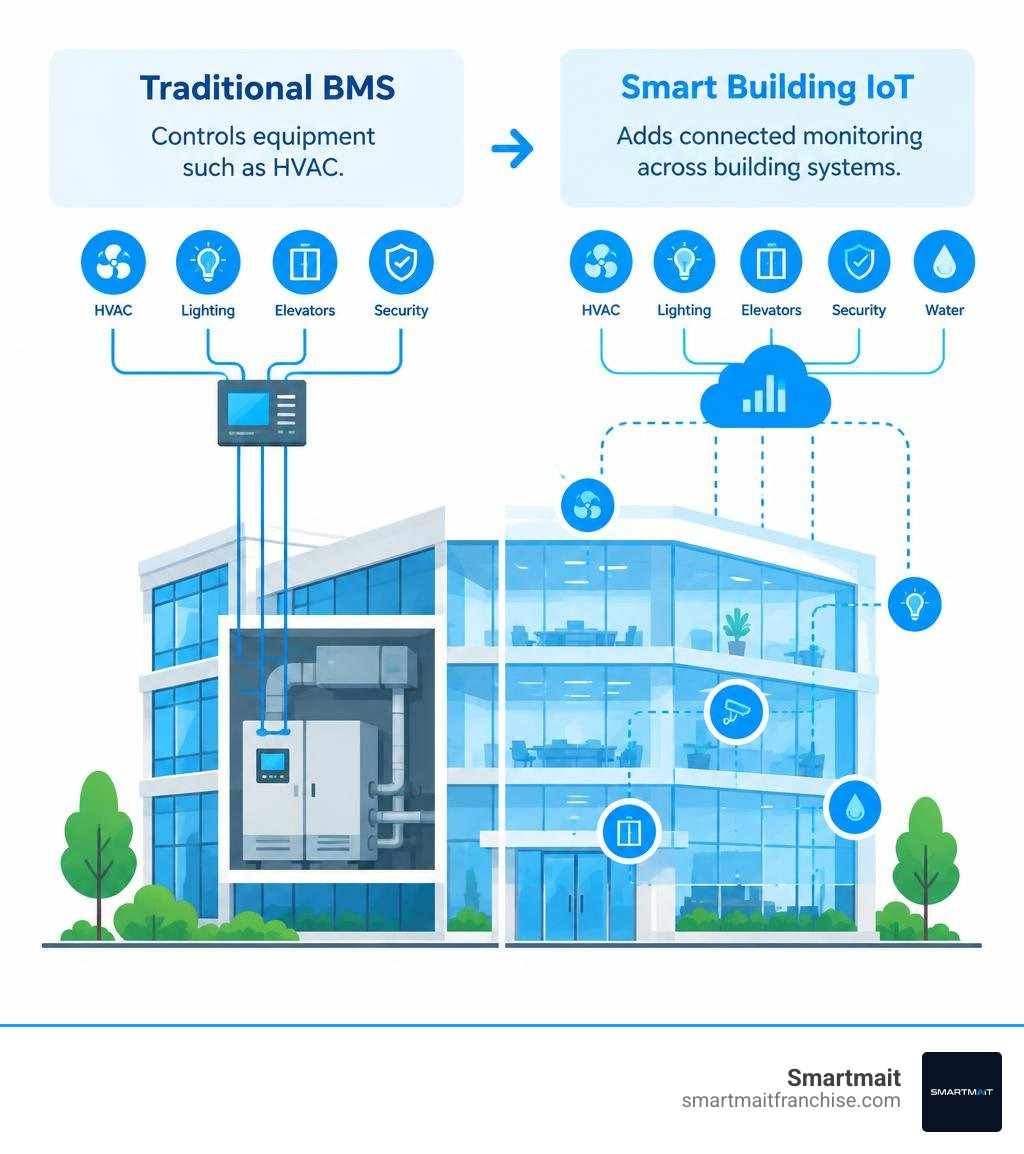
Common smart building iot vocab:
The Evolution of Smart Building IoT vs. Traditional BMS Architecture
Commercial facilities have traditionally relied on legacy automation systems designed primarily for heavy equipment control. In contrast, modern commercial building technology trends prioritize flexibility, accessibility, and fast data collection. Understanding how commercial building controls have evolved helps prospective franchise owners identify where service gaps exist in the commercial real estate market.
| Feature / Capability | Traditional BMS Architecture | Wireless IoT Monitoring Layer |
|---|---|---|
| Primary Focus | Heavy plant control (chillers, boilers, central air handling) | Environmental visibility, submetering, occupancy, and leak tracking |
| Wiring & Infrastructure | Hardwired, conduit-dependent, proprietary field buses | Wireless protocols (LoRaWAN, Zigbee, Z-Wave, cellular gateways) |
| Deployment Speed | Months of engineering and complex on-site wiring | Non-invasive retrofits deployed in hours or days |
| Software Model | On-premise, localized licensing, siloed workstations | Cloud-native or hybrid edge platforms with open REST APIs |
| Ongoing Support | Specialized emergency field repairs and proprietary vendor calls | Managed service agreements, continuous monitoring, and proactive alerts |
Traditional BMS Limitations and High Capex Barriers
Traditional building automation systems were engineered for new construction with large capital expenditure budgets. These systems rely on extensive copper wiring, dedicated control panels, and proprietary protocols that require specialized engineering teams to alter.
Because 80% of total building costs occur during day-to-day operations rather than initial construction, property managers frequently struggle with legacy infrastructure. Upgrading a hardwired legacy BMS often requires running new conduit through occupied spaces, creating high disruption and major capital hurdles for building owners. This dynamic creates an opening for low-voltage integration businesses capable of delivering fast, non-invasive visibility without tearing up drywall or shutting down operations.
Rapid Deployment and Overlay Sensor Architectures
Wireless IoT sensors remove the physical barriers that historically made building monitoring expensive. Using long-range, low-power technologies such as LoRaWAN alongside battery-operated sensors, an overlay monitoring layer can be established quickly across multi-story commercial properties.
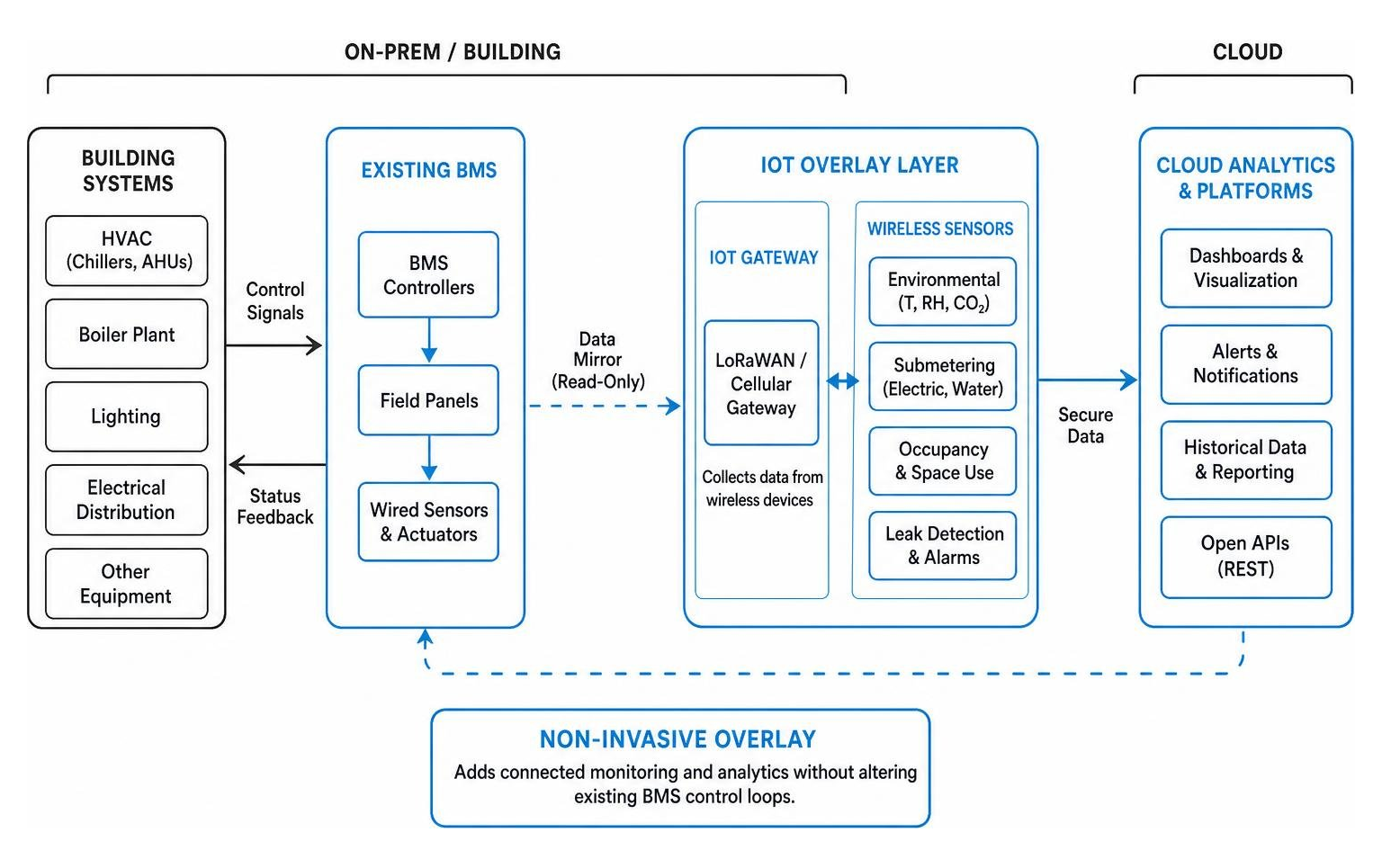
A single centralized gateway can capture telemetry from hundreds of wireless endpoints distributed across tenant suites, mechanical closets, and common areas. This non-invasive overlay architecture allows commercial integration businesses to deliver actionable data to facility managers without interfering with primary life-safety or plant control loops, making commercial retrofit services a flexible addition to an integrator’s service portfolio.
Architecture, Protocols, and System Integration
Modern commercial installations require a balance between edge intelligence and cloud harmonization. For integration business owners evaluating technical workflows, understanding how operational technology (OT) connects to information technology (IT) is critical for delivering reliable client solutions.

Core Components of a Scalable Smart Building IoT Ecosystem
A complete commercial IoT implementation consists of four primary structural tiers:
- Endpoint Sensors and Actuators: Battery-powered and line-powered devices capturing indoor environmental metrics, energy consumption, pipe temperatures, and door states.
- Edge Gateways and Area Managers: Local hardware devices that translate wireless signals, run local automation logic, and buffer data during network outages to maintain continuous monitoring.
- Harmonization and Cloud Platforms: Centralized platforms that normalize disparate data formats, generate digital twins of building assets, and execute rules engines.
- Open APIs and Presentation Dashboards: Secure interfaces that stream analytics to facility teams, mobile technician apps, and third-party tenant management software.
For prospective operators exploring the most practical smart home service categories for franchise operators, mastering how these layers interact is key to building a repeatable installation and service model.
Overcoming Interoperability, Legacy BMS, and Cybersecurity Hurdles
Commercial properties often feature a mix of legacy equipment from different eras. Delivering a unified monitoring solution requires bridging communication standards such as Modbus RTU/IP, BACnet MS/TP, and modern lightweight protocols like MQTT.
Security is equally vital when connecting commercial building assets. Implementations must incorporate robust encryption, secure credential storage, and alignment with information security standards such as ISO 27001 and ISO 27017. Maintaining clear physical or logical separation between operational monitoring networks and corporate tenant networks ensures building data remains protected against unauthorized access.
Key Commercial Benefits and High-ROI Operational Use Cases
Commercial property owners evaluate technology investments based on operational risk reduction, regulatory compliance, and asset value. Commercial IoT integrations address these priorities by making building performance measurable in real time.

Key Smart Building IoT Use Cases Driving Commercial Value
- Granular Energy Submetering: Buildings generate 40% of global emissions, with 75% of those emissions stemming directly from operational energy use. Submetering enables property managers to isolate high-draw zones and verify utility allocations accurately.
- Indoor Environmental Quality (IEQ): Monitoring carbon dioxide, humidity, volatile organic compounds, and temperature helps maintain productive work environments while optimizing ventilation runtimes.
- Predictive Maintenance: Vibration sensors and pipe surface temperature probes spot mechanical anomalies before complete equipment failure occurs.
- Automated Water Leak Detection: Strategically placed wireless leak sensors protect multi-tenant commercial properties from structural damage and unexpected downtime in riser closets and mechanical rooms.
Regulatory Compliance and Energy Efficiency Mandates
Commercial properties face increasing pressure from environmental standards and regional building energy performance mandates. Solutions that deliver automated tracking assist property owners in meeting efficiency benchmarks and attaining green building certifications.
Leveraging automated controls and continuous telemetry helps properties align with structured frameworks, including building automation energy efficiency standards such as EN ISO 52120-1. For commercial service providers, assisting building owners with compliance tracking provides a steady, year-round service opportunity.
The Commercial Integrator and Franchise Business Opportunity
The rising demand for commercial building intelligence presents an expanding market for low-voltage contractors, technology integrators, and trade entrepreneurs evaluating franchise ownership.
Capitalizing on Commercial Retrofit and Ongoing Service Demand
Many commercial properties remain unmonitored because full-scale automation overhauls are cost-prohibitive. Independent integrators often face challenges scaling their operations to capture these retrofits due to fragmented vendor relationships, customized bidding processes, and owner-dependent operations.
Joining a franchise system provides established business owners and new operators with standardized technology stacks, structured technician onboarding programs, and tested deployment methodologies. Integrators looking to evaluate overall business models can explore the ultimate guide to smart home franchise investment viability to understand how structured systems support multi-territory expansion.
Building High-Margin Recurring Revenue Through Managed Monitoring
The traditional low-voltage integration business model relies heavily on one-off project installations, leaving businesses vulnerable to construction market cycles. Smart building IoT enables a transition toward long-term service agreements:
- Continuous System Health Oversight: Monitoring gateway uptime, device signal strengths, and battery levels remotely.
- Scheduled Sensor Calibration: Conducting regular field inspections to ensure measurement accuracy across life-safety and environmental monitoring points.
- Priority Service Level Agreements (SLAs): Providing property managers with guaranteed response times for hardware remediation and system expansions.
This proactive service approach shifts the client relationship from reactive troubleshooting to an ongoing operational partnership, supporting higher business valuations for integration franchise owners.
Frequently Asked Questions about Smart Building Systems for Franchise Operators
How can franchise operators assess demand for IoT integration with legacy building automation?
Commercial building owners frequently seek ways to gain operational visibility without replacing functional legacy chillers or air handlers. Integrators can identify strong market demand in properties where facilities teams lack remote alarming, struggle with manual utility submetering, or manage older buildings that cannot accommodate new wiring conduits.
What factors affect the ROI and payback period for commercial IoT retrofits?
Payback periods vary based on baseline energy waste, local utility rate structures, and the cost of avoided property damage. Commercial implementations often demonstrate value quickly by identifying simultaneous heating and cooling faults, automating utility allocations, and preventing water leak damage before structural repairs are required.
Why are low-voltage integrators adding commercial IoT monitoring to their service offerings?
Adding wireless monitoring layers allows integration businesses to expand into commercial accounts without taking on the heavy engineering overhead of full plant commissioning. It creates opportunities for recurring managed monitoring agreements, broadens the technician skill base, and diversifies business revenue beyond residential installations.
Conclusion
The commercial real estate landscape is shifting toward connected, data-informed operations. As commercial property owners look to reduce operational overhead, maintain environmental compliance, and extend asset life cycles, low-voltage integration businesses that deliver scalable IoT monitoring will lead the trade services sector.
For prospective franchise buyers and independent integration business owners seeking to scale beyond owner-dependent operations, Smartmait offers a complete franchise framework combining standardized technical systems, field technician training, and structured recurring-revenue models.
Learn more about expanding your integration business with a commercial smart building franchise and request your franchise information kit today.