
Why Home Automation Without Cloud Creates a Stronger Service Advantage
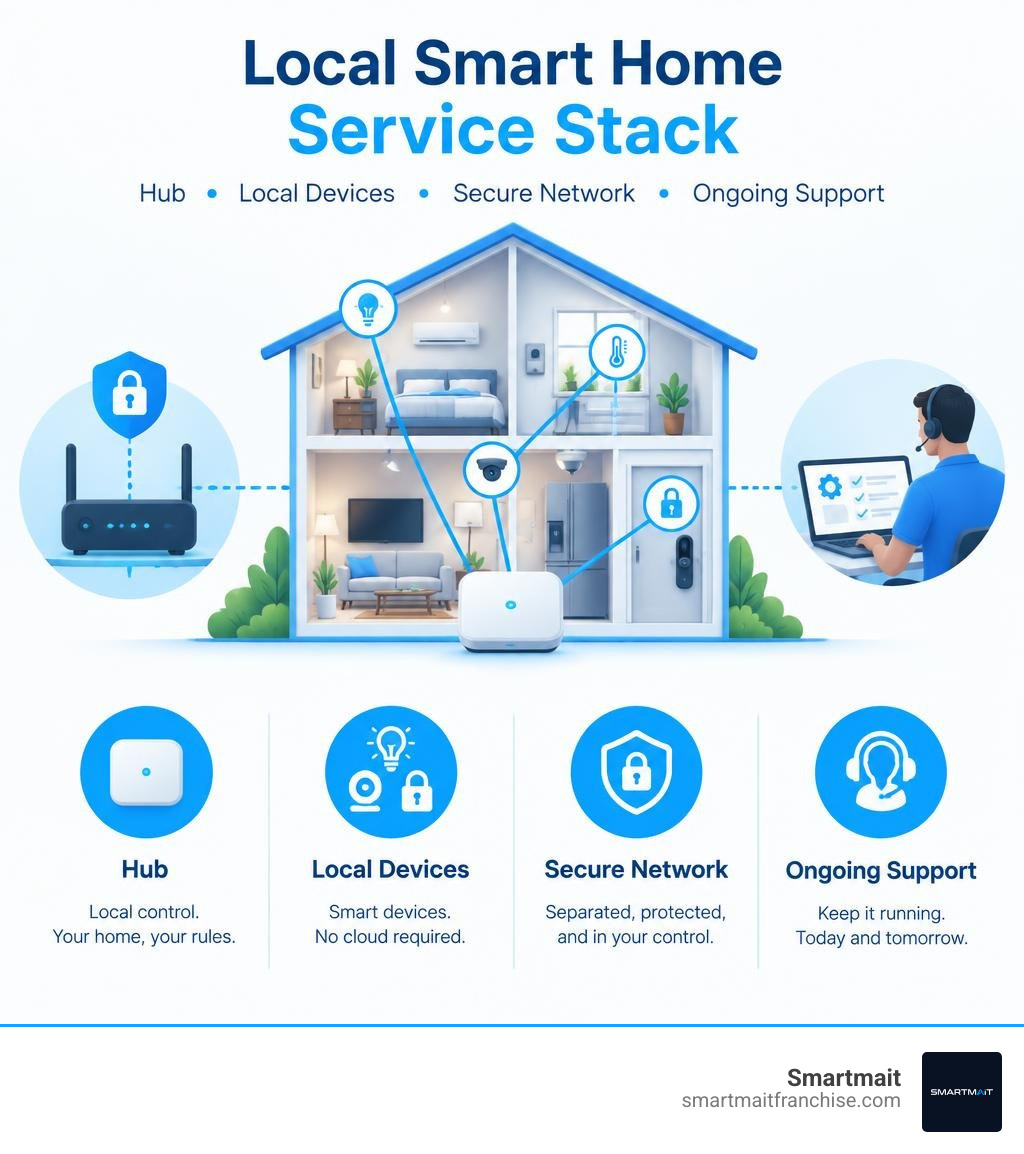
For smart-home franchise buyers and established integration businesses, home automation without cloud dependency means designing systems that keep core commands, data, and automations on local hardware and the local network. To build this capability into a service business:
- Standardize on a local automation hub and devices with local control paths.
- Use protocols such as Zigbee, Z-Wave, and local-network Wi-Fi devices where appropriate.
- Separate IoT devices from the main network and limit unnecessary outbound internet access.
- Build recurring support around backups, updates, network health, and automation reviews.
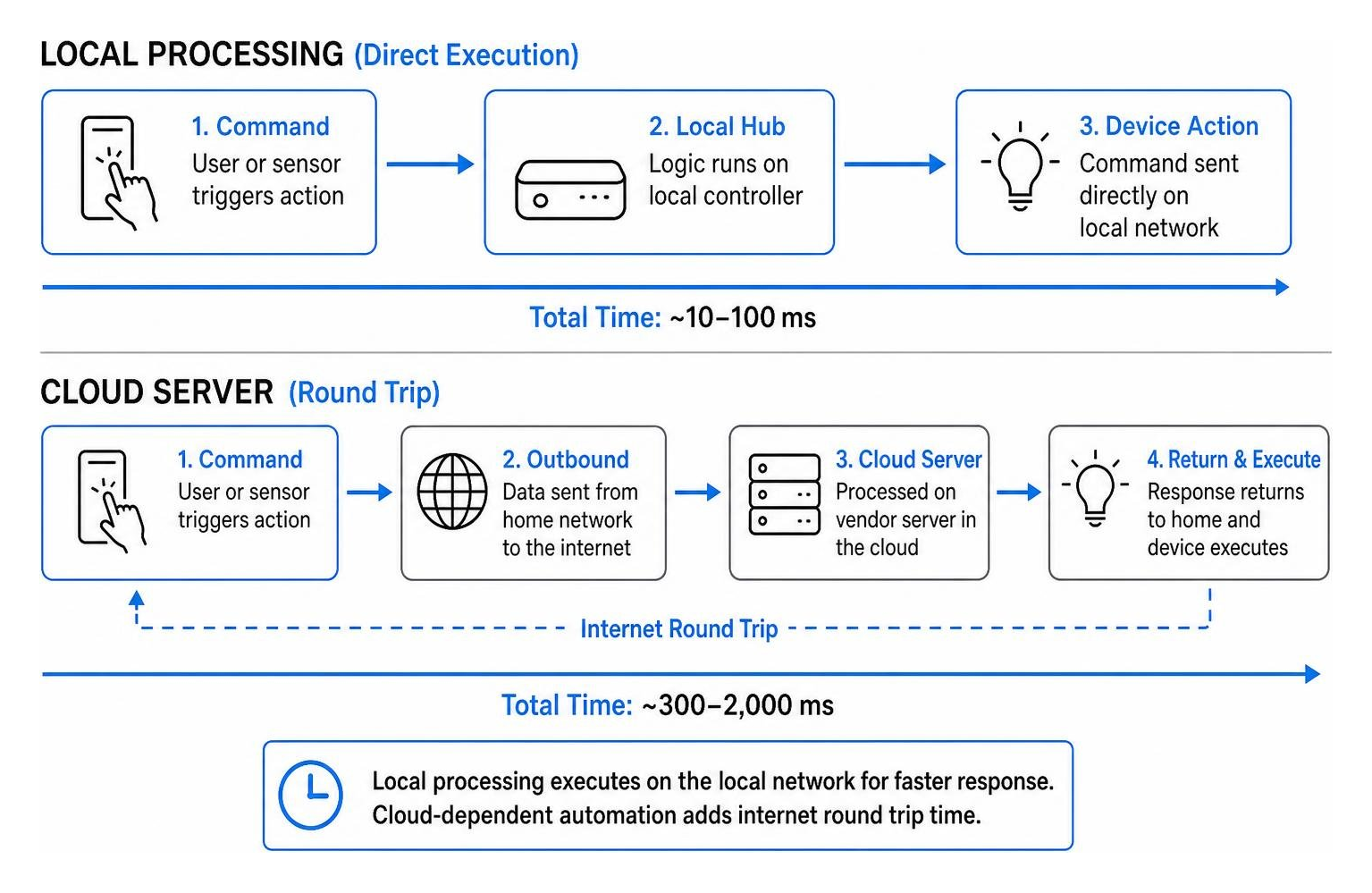
This approach gives customers faster responses, better privacy, and continued operation during many internet or vendor-service outages. Local commands can respond in roughly 10 to 100 milliseconds, while cloud-dependent commands may take 300 to 2,000 milliseconds due to the extra trip to remote servers.
For an operator, local-first design is more than a technical preference. It can reduce customer frustration with subscriptions and unreliable apps while creating clear long-term service needs: network management, secure remote support, configuration backups, device replacement, and system optimization.
I am Dominic Hesano, a franchise development professional and business operator building Smartmait around smart-home, low-voltage, networking, security, and automation services. My work in home automation without cloud dependency focuses on how reliable, privacy-aware systems can support durable customer relationships and scalable service operations.
Home automation without cloud word roundup:
Understanding Home Automation Without Cloud: Architecture and Core Differences
As we build and scale modern smart-building integration businesses across the United States, we see a massive shift in customer priorities. Property owners are exhausted by mandatory monthly subscriptions, unexpected cloud outages, and privacy intrusions. For prospective franchisees evaluating the smart-home service sector, adopting a local-first service delivery model transforms how we deliver value.
In a cloud-dependent model, every button press, sensor trigger, or automation request travels out through the customer’s modem, traverses multiple internet service provider (ISP) hops, processes inside a third-party data center, and travels back down to the target device. In contrast, local-first home automation without cloud executes the entire logic stack on a dedicated on-premises edge controller. The data never leaves the local area network (LAN) unless the customer explicitly requests off-site administrative visibility.
Understanding this architectural distinction is essential for operational teams. A comprehensive guide to reliable smart home integration emphasizes that local execution eliminates the common failure points associated with consumer-grade Wi-Fi gadgets. By reducing unnecessary external telemetry, integration businesses establish higher baseline reliability and insulate client homes from external disruptions.
| Architecture Dimension | Cloud-Dependent Integration Model | Local-First / Cloud-Free Service Model |
|---|---|---|
| Execution Point | Vendor server / Public cloud infrastructure | Local edge controller / On-premises hub |
| ISP Outage Impact | Total loss of automation and app controls | 100% normal on-site automation and control |
| Response Time | 300ms to 2,000ms (high latency) | 10ms to 100ms (near-instantaneous) |
| Ongoing Operating Cost | Recurring third-party cloud subscription fees | Zero mandatory third-party software subscriptions |
| Security & Privacy Risk | Outbound telemetry, vendor data aggregation | Complete data sovereignty, strict LAN containment |
| Service Revenue Model | Reactive troubleshooting when APIs change | Proactive network optimization and maintenance tiers |
Why Outages and Sunsetting Threaten Cloud-Dependent Systems
For independent integration business owners considering converting to a franchise model, customer churn caused by vendor decisions is a critical business risk. The consumer IoT landscape is filled with cautionary tales where cloud architectures rendered functional hardware useless:
- Abrupt cloud server shutdowns have historically disabled thousands of proprietary smart-home hubs across the country.
- Cloud service retirements by major tech vendors have repeatedly forced enterprise and residential users to scramble for alternative platforms.
- End-of-life decisions for cloud-tethered devices have eliminated remote access and core features for entire hardware generations.
When an independent installer relies on closed, cloud-tethered products, the installer absorbs the customer’s frustration when those services get sunsetted. Franchise operators who standardize on open, local protocols protect their brand equity. By ensuring the physical hardware remains locally controllable regardless of any external manufacturer’s corporate longevity, operators build durable client relationships that yield steady service agreements rather than angry support calls.
Latency and Data Sovereignty: 10ms Response Times vs Server Hops
Speed and privacy represent the two most compelling sales arguments for our franchise operators. When a homeowner walks into a room, a motion sensor should illuminate the lights instantly. In a local-first system, that command path executes in 10 to 100 milliseconds—a timeframe perceived by the human brain as instantaneous. Cloud-dependent solutions introduce round-trip network hops that inflate latency to 300 to 2,000 milliseconds. That slight pause when entering a dark room creates a frustrating user experience.
Simultaneously, data privacy has evolved from a niche preference into a primary purchasing criterion for affluent homeowners and commercial clients. Closed smart-home systems continuously transmit telemetry, occupancy patterns, and audio metadata to off-site cloud platforms. By delivering local data sovereignty, our franchise locations can offer residential and commercial clients complete digital privacy: all data stays within the property walls, protected from corporate profiling, third-party data broker harvesting, and external server breaches.
Essential Capabilities and Protocols for a Cloud-Free Integration Business

Transitioning an integration business from simple retail plug-ins to commercial-grade, cloud-free automation requires a structured approach to hardware and protocol standards. Reviewing our connectivity solution guide helps operators understand how to configure robust physical architectures that minimize service truck rolls.
Evaluating Wireless Standards: Zigbee, Z-Wave, and Thread
To deliver dependable local automation, professional technicians must master the primary wireless protocols that operate independently of external cloud servers:
- Zigbee (802.15.4): A mature, highly versatile mesh networking standard operating primarily on the 2.4 GHz spectrum. High-quality USB coordinators can manage hundreds of end-devices and routing nodes locally. Because it requires no vendor-cloud registration, Zigbee hardware installed ten years ago continues to run reliably today.
- Z-Wave: Operating on the sub-GHz band (908.42 MHz in the US), Z-Wave avoids all 2.4 GHz Wi-Fi interference. With strict certification requirements, interoperability across diverse manufacturers is exceptionally high. It is ideal for critical low-voltage infrastructure like smart deadbolts, water shut-off valves, and commercial sensors.
- Thread & Matter Local Fabrics: Thread brings low-power, self-healing IPv6 mesh networking to smart devices. When paired with Matter’s local connectivity layer, it provides direct, encrypted device-to-device communication without routing through cloud bridges.
Equipping technicians with comprehensive diagnostic training across these three wireless standards ensures our franchise locations can solve complex interference challenges and build resilient multi-vendor ecosystems.
Assessing Local-First Hardware Categories
A professional franchise operator evaluates equipment ecosystems based on long-term serviceability, ease of installation, and local API availability. Approved hardware categories include:
- Smart Relays & In-Wall Micro-Modules: Dry-contact relays and smart dimmers that communicate via Zigbee, Z-Wave, or local Wi-Fi APIs (such as local MQTT or REST). These preserve mechanical wall switch functionality even if the central processor is powered down.
- Local Network Video Recording (NVR) & Cameras: Power-over-Ethernet (PoE) security cameras streaming direct RTSP or ONVIF feeds into an on-premises NVR or edge AI processor. This eliminates monthly camera cloud storage fees while delivering real-time human and vehicle classification.
- Smart Thermostats & Environmental Monitors: Climate controls that accept direct local commands over Z-Wave or local network protocols, maintaining internal scheduling logic offline.
- Smart Locks and Access Control: Battery-efficient Z-Wave or Zigbee electronic deadbolts and commercial access relays that store user access credentials locally on the hardware.
Evaluating Local-First Delivery and Network-Service Capabilities
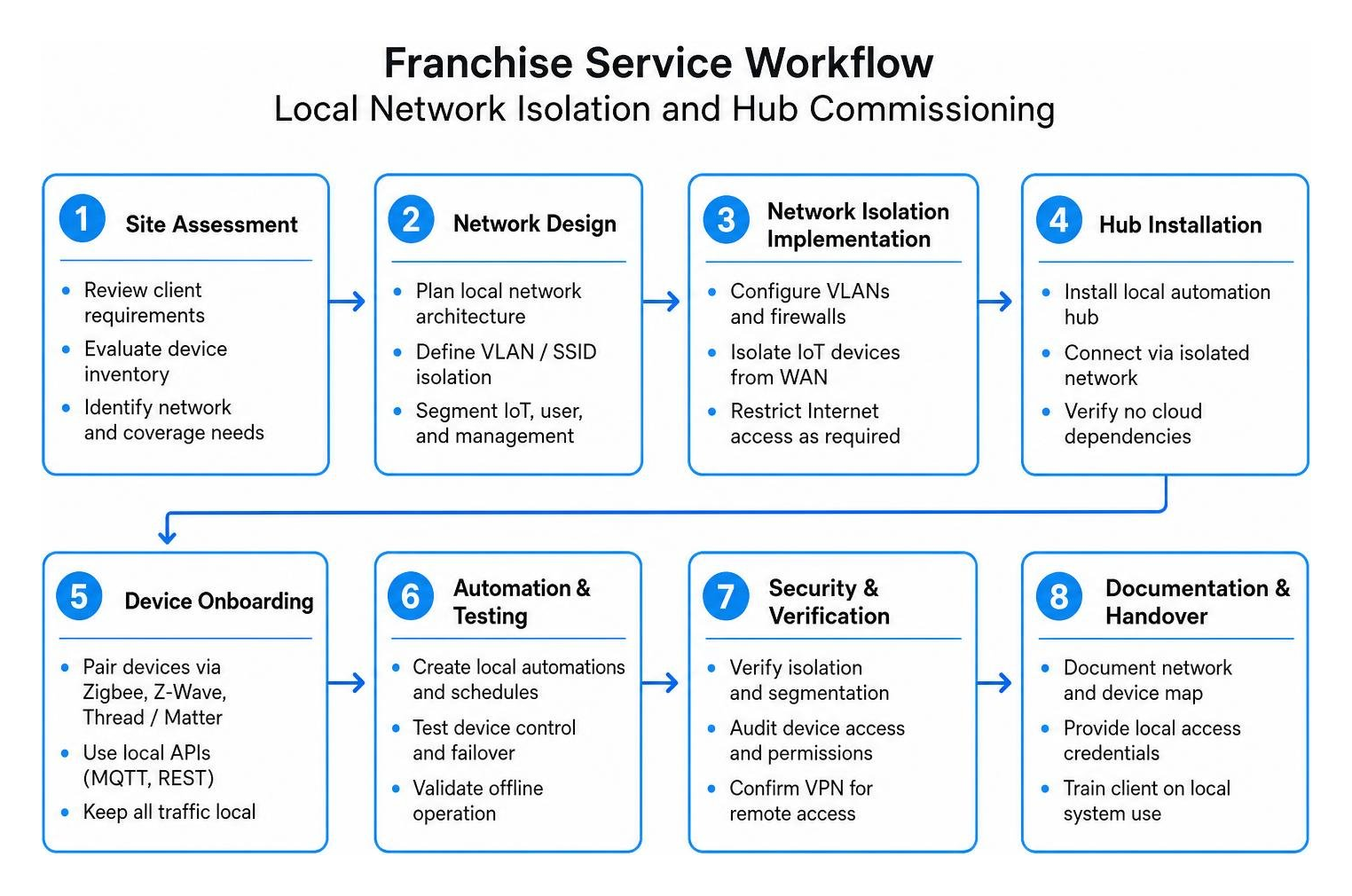
Delivering home automation without cloud dependency shifts an integrator’s core discipline from simple gadget installation to managed network infrastructure. Standardizing these processes allows franchise owners to recruit technicians with basic low-voltage backgrounds and train them into high-performing automation specialists. Following proven smart home WiFi setup strategies ensures that high-density wireless environments maintain peak throughput without dropped packets.
Assessing Local Automation Platforms and Support Requirements
The brain of the local smart home must be robust, vendor-agnostic, and completely functional without an active internet link. Standardizing on mature, locally hosted automation engines supporting thousands of protocol integrations demonstrates the operational strength of edge computing.
For a scaling franchise system, standardizing on a dedicated local automation engine enables repeatable operational processes:
- Pre-Engineered Standard Operating Procedures: Blueprints and pre-configured deployment images allow field technicians to commission comprehensive lighting, climate, and security automations in minutes.
- Automated Encrypted Backups: Nightly hub configuration backups stored on local Network Attached Storage (NAS) or an encrypted administrative partition guarantee rapid disaster recovery.
- Standardized Network Commissioning: Consistent naming schemes and IP allocations make ongoing system audits seamless across all managed properties in a franchise territory.
Network Hardening: VLAN Isolation, Firewall Rules, and DNS Sinkholing
True data privacy requires network-level containment. Our franchise model incorporates enterprise-grade network hardening into standard residential and commercial integration packages:
- Virtual Local Area Network (VLAN) Segmentation: We place all IoT devices on an isolated VLAN (e.g., VLAN 40), separating them entirely from the client’s personal computers, financial workstations, and mobile devices.
- Strict Egress Firewall Rules: We configure firewall policies that drop all outbound WAN traffic originating from the IoT VLAN. The smart switches, sensors, and camera bridges can talk freely to the local hub, but cannot phone home to remote overseas servers.
- DNS-Level Filtering: Deploying on-premises DNS sinkholes strips out tracking domains, diagnostic telemetry, and advertising beacons before they ever hit the gateway.
This level of cybersecurity hardening positions our franchise operators as sophisticated technology advisors, enabling them to capture premium commercial and executive residential service accounts.
Advanced Privacy Services: Local Voice Control and Secure Remote Access
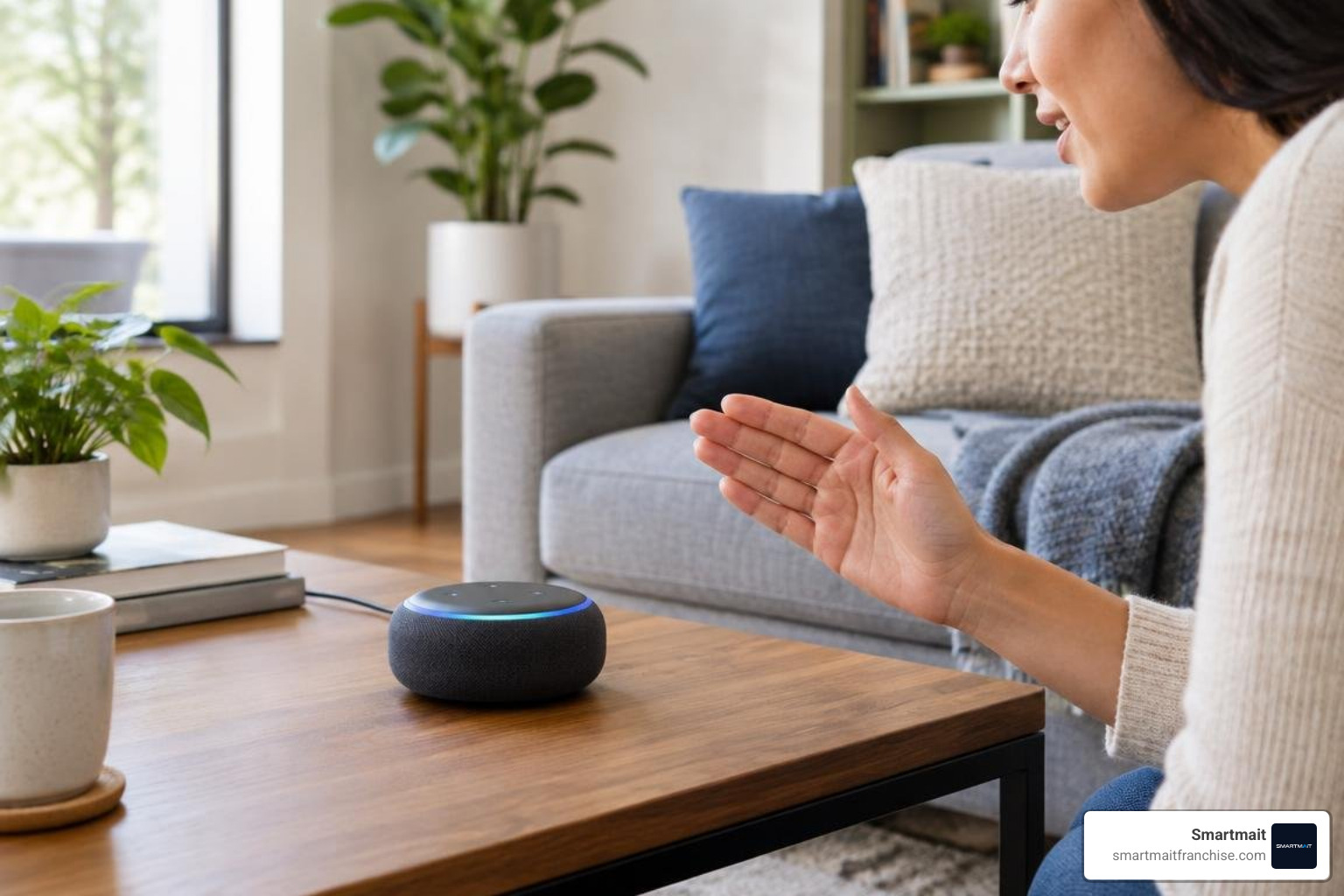
One of the historical hurdles of cloud-free automation was the reliance on proprietary commercial voice assistants. In 2026, breakthroughs in open edge computing have enabled entirely private, local voice processing pipelines that fit naturally into our service catalog. To explore how voice commands integrate into client spaces, read our smart home voice commands guide.
Evaluating Voice Assistance in Local Automation
Local voice processing uses lightweight, edge-based artificial intelligence to process speech without transmitting audio recordings to corporate servers:
- Wake-Word Detection: Highly optimized micro-models run directly on satellite microphones to detect custom wake words instantly with near-zero power consumption.
- On-Device Speech-to-Text: Compact neural speech engines convert audio waveforms to text strings inside the local home server in a fraction of a second.
- Intent Processing: Local intent engines parse the transcribed text, match it to the exact entity (such as “turn off living room sconces”), and trigger the automation directly over the LAN.
For franchise owners, deploying private local voice control solves the constant customer annoyance of corporate voice assistants misinterpreting commands or injecting unsolicited promotional responses.
Encrypted Remote Access Without Vendor Servers
Clients naturally expect to check their security cameras or adjust their climate control while traveling. Traditional smart homes achieve this by opening continuous outbound connections to a vendor cloud broker.
In our local-first framework, franchise operators provide secure remote access without introducing third-party security vulnerabilities:
- WireGuard / Zero-Trust Mesh VPNs: We establish end-to-end encrypted private tunnels directly to the client’s local controller, allowing mobile devices to access the local dashboard as if they were sitting on the home Wi-Fi.
- Hardened Reverse Proxies with Mutual TLS: For clients requiring frictionless app access without running a continuous VPN profile, we deploy reverse proxies with strict SSL encryption and multi-factor authentication.
- Zero Inbound Port Forwarding: By avoiding traditional router port-forwarding rules, the property’s network remains completely invisible to automated public port scanners.
Managing Trade-Offs, Limitations, and Ongoing Maintenance
Operating a local-first automation business requires honest communication regarding technical trade-offs. While cloud-based consumer gadgets promise effortless plug-and-play setup, they offload control to third-party servers. Local-first systems require deliberate engineering, professional deployment, and disciplined ongoing care.
This trade-off is precisely where our franchise business model excels. By packaging technical complexity into structured service tiers, we convert operational maintenance into reliable, recurring service agreements. Implementing practical home automation solutions allows our operators to structure comprehensive quarterly and annual maintenance plans that cover:
- Supervised Firmware Updates: Testing and validating device updates in controlled staging environments before rolling them out to client hardware, preventing broken automations.
- Network Health Audits: Monitoring Zigbee and Z-Wave mesh routing tables, verifying RF signal strength, and eliminating channel interference caused by neighboring Wi-Fi networks.
- Local Backup Verification: Regularly auditing configuration backups and testing physical restoration workflows to ensure business continuity.
- Proactive Battery Replacement Schedules: Tracking battery voltage across hundreds of distributed sensors and replacing them during scheduled visits before devices go offline.
By managing these maintenance requirements through structured service memberships, franchise operators escape the boom-and-bust cycle of one-time project installations, creating predictable revenue and lasting customer retention.
Frequently Asked Questions About Local-First Smart-Home Integration Businesses
Can a local-first smart-home system function without an internet connection?
Yes. A properly engineered local-first smart-home runs 100% of its logic, sensor tracking, schedule triggers, and switch actuations on the local area network. Even during extended ISP outages or severe weather events that take down regional internet infrastructure, on-site wall switches, motion automations, environmental controls, and local security systems continue to operate without interruption.
How can prospective franchise owners evaluate equipment that does not require cloud subscriptions?
When selecting equipment partners, operators evaluate products using four criteria: native protocol support (Zigbee, Z-Wave, Thread), local API availability (MQTT, local REST, or native Matter binding), documentation of “Local Push” communication, and the absence of mandatory user account registration. Hardware that meets these standards guarantees that the physical device can be commissioned, operated, and maintained without ongoing vendor cloud connectivity.
Is a local-first integration business more difficult to operate and maintain?
While local-first integration requires deeper networking and protocol knowledge than setting up retail Wi-Fi gadgets, it delivers higher long-term reliability and fewer emergency support calls. Within our franchise framework, comprehensive technician training programs, standardized operating blueprints, and structured recurring-maintenance workflows simplify deployment, allowing operators to run a scalable, highly profitable service enterprise.
Conclusion
The growing demand for data privacy, near-instant system responsiveness, and freedom from subscription fatigue has made local-first automation the definitive standard for premium residential and commercial spaces. For prospective franchise buyers and independent low-voltage integrators seeking a scalable path forward, mastering home automation without cloud dependency provides an insurmountable competitive moat against retail installers.
Smartmait equips franchise operators with the standardized technical frameworks, comprehensive technician training pathways, and recurring-revenue business models necessary to lead the smart-building and integration industry in their exclusive territories.
If you are an established low-voltage contractor ready to convert your business to a structured national brand, or an ambitious entrepreneur evaluating executive franchise ownership opportunities in the expanding smart-building market, request your Smartmait franchise information package today to speak with our franchise development team.