
Smart Home Insurance Discounts Can Create Recurring Service Demand
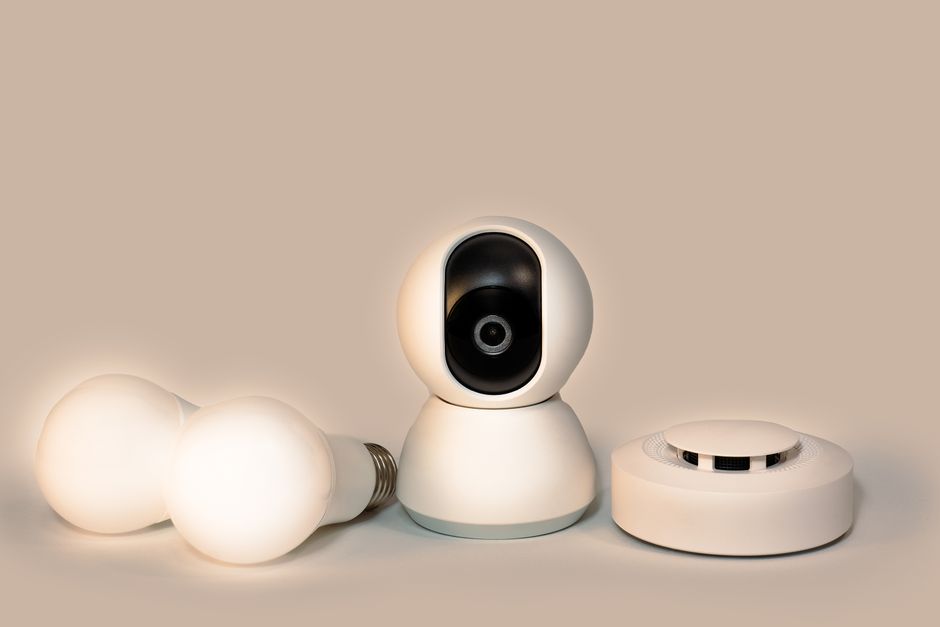
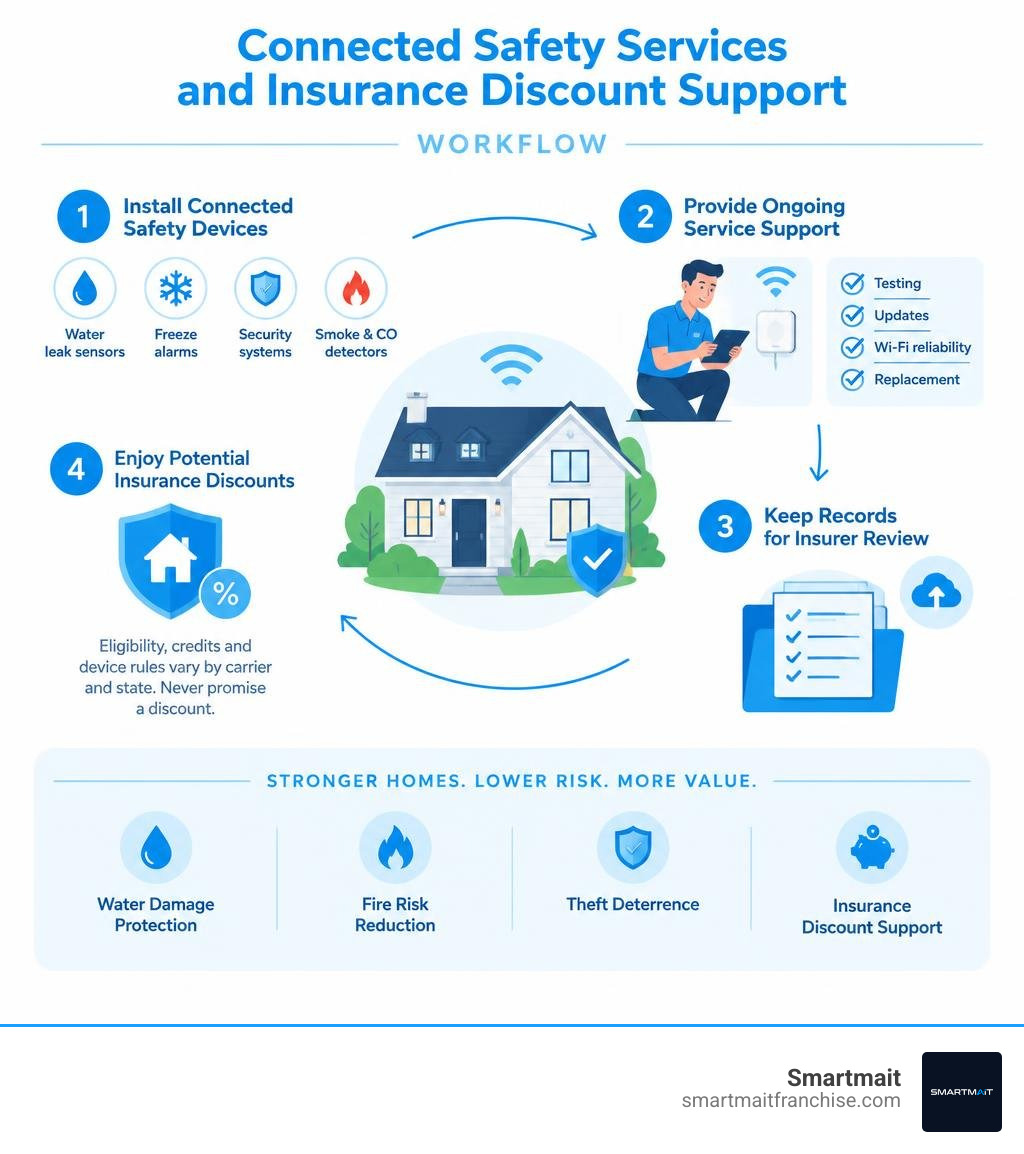
Smart home insurance discounts can help franchise operators sell more than one-time installations. Connected water-leak sensors, freeze alarms, monitored security systems, and smart smoke or carbon monoxide detectors can reduce the chance or cost of a claim. When customers ask about potential policy credits, a well-run integration business can provide the installation, documentation, testing, and ongoing support they need. According to the Insurance Information Institute, policyholders should review coverage details and risk-reduction options with their carrier.
For prospective Smartmait franchise owners, the opportunity is clear:
- Install connected safety devices that address costly water, fire, and theft risks.
- Build service plans for testing, firmware updates, Wi-Fi reliability, and device replacement.
- Help customers keep installation records and monitoring details for insurer review.
- Never promise a discount – eligibility, credits, and device rules vary by carrier and state.
Water prevention is especially valuable. About 1 in 60 homes has a water or freezing claim each year, with average water damage claims near $14,000. That makes leak detection and automatic shutoff systems a strong foundation for recurring customer relationships, not just a smart-home add-on.
I am Dominic Hesano, a franchise development professional and operator building Smartmait in the smart-home, low-voltage, security, networking, and automation space. My experience with connected-system installation, support, and service models informs how franchise operators can approach smart home insurance discounts as a customer-value and recurring-revenue opportunity.
Smart home insurance discounts vocab explained:
How Smart Home Insurance Discounts Create a Franchise-Service Opportunity

For entrepreneurs evaluating a franchise territory and independent low-voltage integrators seeking an operational roadmap, the smart home landscape has fundamentally shifted. As of September 2026, connected devices are no longer viewed merely as luxury lifestyle conveniences. Instead, major property and casualty insurers treat connected sensors as essential risk-mitigation assets.
Nearly six out of ten property owners express a desire to invest in connected devices specifically capable of detecting issues, issuing real-time alerts, and stopping property damage before it escalates. When policyholders realize that risk-reducing hardware can lead to potential premium credits—often ranging from 1% to 3% for basic intrusion setups and up to 5% to 15% for comprehensive, professionally monitored multi-peril systems—demand for certified deployment surges.
This consumer incentive creates an ideal bridge for franchise operators to move beyond transactional, one-and-done hardware jobs. By building recurring service memberships centered on system health, sensor calibration, and network uptime, franchise businesses create lasting relationships. Operators who understand how to choose the best smart home monthly service for peace of mind can structure operational packages that solve long-term maintenance headaches for clients while establishing predictable operational flow.
| Service Category | Primary Perils Addressed | Consumer Risk Profile | Franchise Service & Maintenance Opportunity |
|---|---|---|---|
| Flow-Based Water Defense | Non-weather leaks, plumbing bursts, supply line failures | High frequency; ~$14,000 average claim severity | Annual valve testing, flow sensor calibration, emergency shutoff bypass checks |
| Low-Temperature & Freeze Monitoring | Sub-freezing pipe ruptures, HVAC failure during winter | Seasonal spikes; ~$27,000 average claim severity | Pre-winter sensor checks, threshold alert testing, battery replacements |
| Life Safety & Fire Detection | Electrical fires, smoldering materials, carbon monoxide | Catastrophic loss; life safety threat | Smoke sensor cleaning, acoustic listener checks, central monitoring link audits |
| Perimeter & Monitored Intrusion | Burglary, forced entry, package theft ($15B annual impact) | High property loss; top 5 loss peril | Camera firmware updates, sensor alignment, central dispatch connectivity testing |
| Connected Appliance Telemetry | Internal component failures, overflow, thermal runaway | Appliance wear and surge damage | IoT gateway sync, diagnostic reporting, appliance integration checkups |
Quantifying Potential Revenue by Device and Service Category
Understanding how insurers categorize property hazards helps franchise owners configure their service catalogs effectively. Water damage remains the second most frequent homeowners insurance claim behind wind and hail. Non-weather water claims and frozen pipe bursts represent massive losses—an average frozen-pipe claim costs approximately $27,000.
Because of this severity, insurers reward active protection. Devices such as automated water shutoff valves, acoustic pipe sensors, and sub-floor leak detectors carry significant weight in insurer discount matrices. Similarly, monitored life-safety sensors that detect smoke, rapid heat rise, and electrical arcing address catastrophic fire risks. When combined with whole-home security, these installations help clients pursue policy savings while creating four distinct service touchpoints for franchise operators:
- Initial Site Evaluation and System Architecture: Assessing plumbing risers, entry points, and high-risk electrical zones.
- Precision Low-Voltage and Sensor Deployment: Commissioning hardware according to carrier and manufacturer standards.
- Third-Party Central Station Integration: Establishing verified reporting links to licensed central monitoring stations.
- Scheduled Maintenance and Recertification: Providing routine battery changes, valve cycling, and documentation updates for policy renewal.
How Insurance Risk Reduction Shapes Service Demand
Insurance carriers build their underwriting on actuarial models that reward verified loss reduction. When a smart home platform detects a plumbing breach and actuates a physical ball valve in milliseconds, it transforms a potential five-figure claim into a minor mop-up.
Franchise operators serve as the trusted technical professionals who ensure these systems remain operational over time. Insurers increasingly seek verified installations, as unmaintained DIY sensors with dead batteries or disconnected Wi-Fi provide zero real-world protection.
When positioning these capabilities, franchise owners must train their field teams to speak clearly about risk reduction while maintaining strict compliance: never promise or guarantee specific discount percentages. Because underwriting guidelines, policy endorsements, and multi-policy bundling rules vary widely across carriers, our operational model focuses on delivering professional documentation, certified installation, and robust technical support.
High-Impact Service Categories for Smart-Home and Smart-Building Franchise Operators
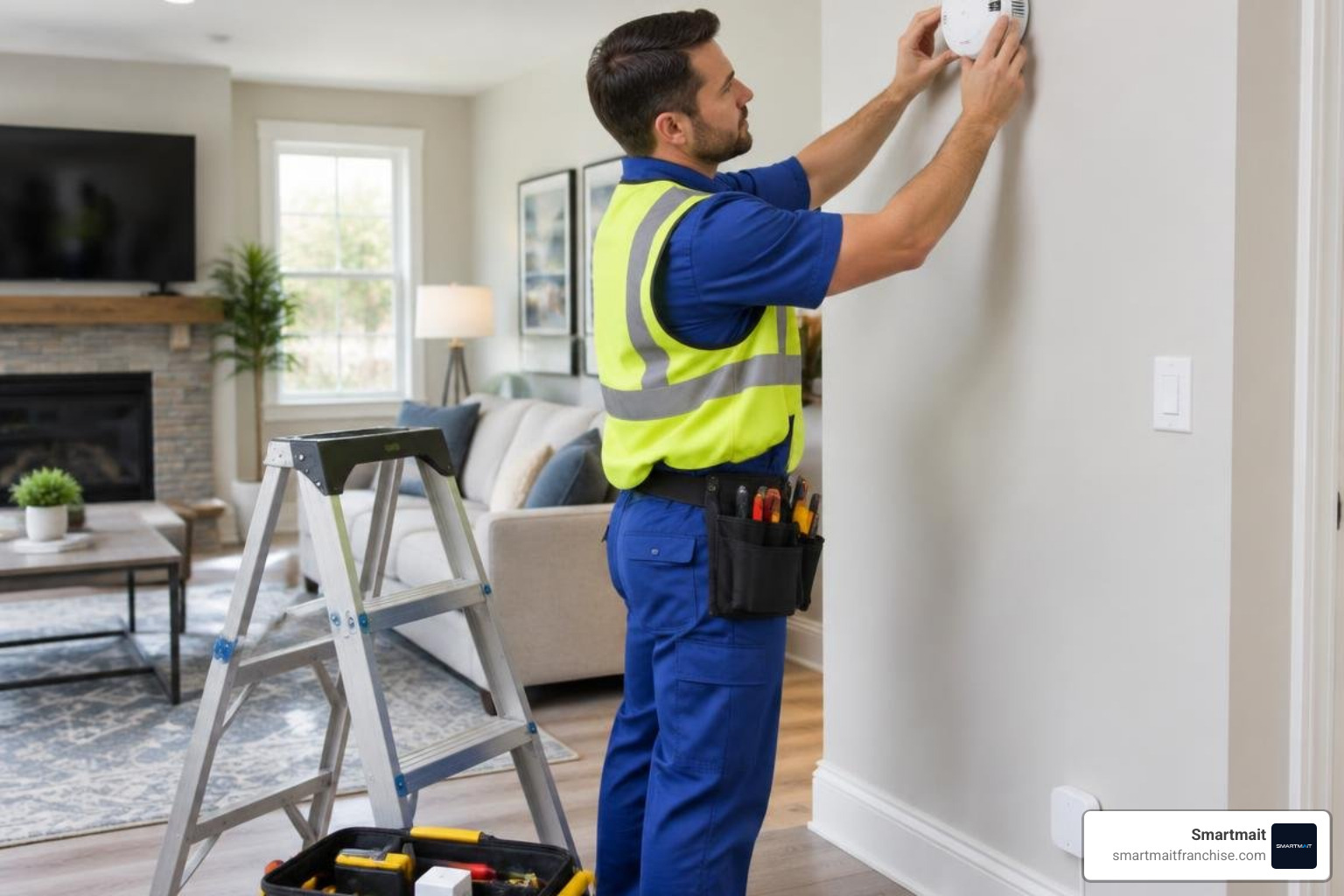
Operating a territory successfully requires a deep understanding of which hardware ecosystems provide measurable risk mitigation. Systems that simply control ambient lighting or play music rarely move the needle for underwriting departments. In contrast, protective infrastructure directly protects properties against the primary drivers of insurance claims.
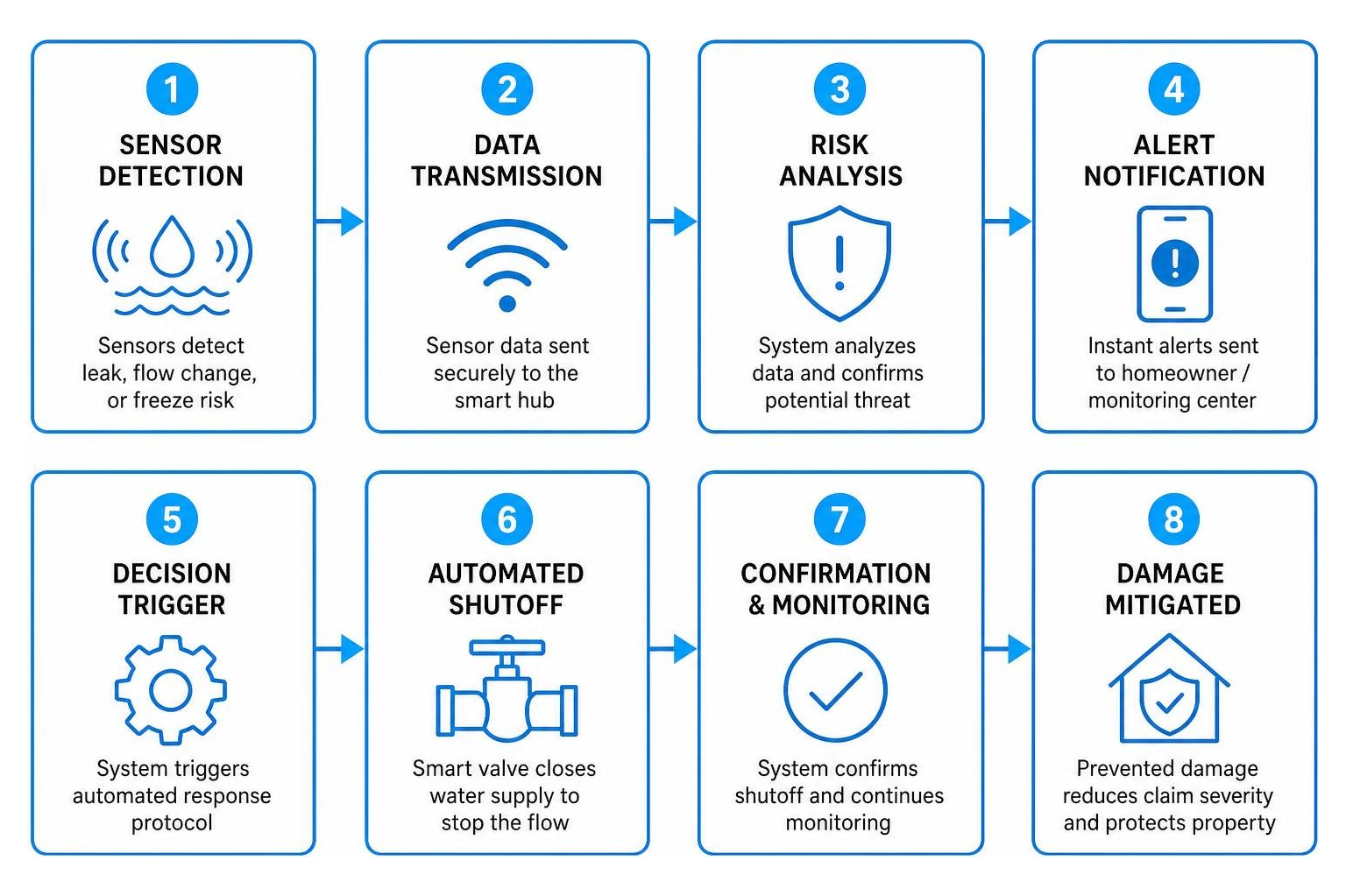
Franchise owners benefit from organizing their service offerings around integrated systems that offer multi-layer protection, making it easier to scale their service footprints.
Water and Fire Prevention Services That Support Customer Retention
Water mitigation technology has evolved into two primary operational tiers: point-of-use wireless pucks placed near appliances, and whole-building, inline flow-monitoring valves. Whole-building systems monitor pressure dynamics, water flow rates, and ambient pipe temperatures to spot micro-leaks and freeze conditions.
Pairing flow monitors with electrical hazard sensors and certified life-safety detectors provides broad peril coverage:
- Automated Shutoff Infrastructure: Motorized valves that cut main water supplies instantly upon moisture detection.
- Freeze-Warning Nodes: Thermal probes that alert property owners before sub-freezing indoor temperatures cause structural pipe bursts.
- Acoustic and Electrical Monitoring: Sensors that identify electrical micro-arcs and abnormal heat signatures inside breaker panels before structural ignition occurs.
- Connected Life Safety: Hardwired or wireless smoke and carbon monoxide detectors linked to unified communication hubs for instantaneous remote alerting.
These systems require routine operational audits. Valves must be cycled to prevent mineral buildup, sensor batteries require scheduled testing, and IoT communication protocols need ongoing optimization. This requirement naturally aligns with a recurring service membership model.
Monitored Security and Smart Locks as Ongoing Service Offerings
Burglary and property crimes consistently rank among the top five property loss perils, while package theft alone accounts for an estimated $15 billion in annual consumer losses. Consequently, insurance carriers have long provided premium credits for properties equipped with monitored intrusion detection.
Modern connected security pairs physical barriers with real-time digital verification:
- Central Station Monitored Alarms: Security panels connected via redundant cellular paths to professional dispatch centers.
- Smart Deadbolts and Access Control: Keyless commercial-grade access systems providing encrypted access logs and remote locking capabilities.
- Perimeter Optical and Motion Sensors: High-resolution video doorbells and exterior cameras with intelligent motion filtering to deter unauthorized entry.
By helping property owners find the best home security options, franchise operators install reliable systems that deter intrusion while supporting the owner’s eligibility for protective device credits.
Smart Appliances and Connected IoT Platforms in a Franchise-Service Model
The Internet of Things (IoT) has expanded into major household appliances. Modern refrigerators, dishwashers, washing machines, and water heaters now feature integrated telemetry and internal moisture sensors. This connectivity opens new service avenues for low-voltage integration businesses.
Recent industry developments highlight this momentum. Initiatives such as the collaboration between Samsung Electronics and Hartford Steam Boiler (HSB) under the Home Connectivity Alliance (HCA) specifications illustrate how real-time appliance data can support insurance risk evaluation. When appliances communicate diagnostic health and early risk indicators directly through platforms like SmartThings, property owners can unlock policy benefits while staying ahead of equipment breakdowns.
Qualifying Connected Appliances and Integration Opportunities
For a franchise operator, connected appliances represent an expanding endpoint ecosystem that requires setup, network configuration, and ongoing management. Appliances manufactured from 2020 onward frequently include onboard intelligence capable of detecting internal flow abnormalities, pump failures, and power anomalies.
Franchise technicians can assist clients by establishing a unified gateway for all connected devices. By helping customers set up unified home management systems, operators ensure that diagnostic alerts reach the customer immediately. Technicians can also offer preventative service calls when appliance sensors register abnormal operational patterns, transforming raw telemetry into proactive maintenance visits.
Balancing Data Sharing, Cybersecurity, and Malfunction Risks
While connected technology brings significant protective advantages, it introduces digital vulnerabilities that require professional oversight. Unsecured IoT devices can expose networks to unauthorized access, and unstable local Wi-Fi networks can cause sensors to drop offline, leaving properties unprotected.
Franchise businesses can address these challenges by providing comprehensive network hardening services:
- Network Segmentation: Isolating smart home devices and safety sensors on secure, dedicated virtual local area networks (VLANs).
- Firmware Lifecycle Management: Routinely auditing and updating device firmware to patch emerging cybersecurity vulnerabilities.
- Power Stability Infrastructure: Installing battery backups and surge suppression to keep security gateways and shutoff valves operational during power outages.
- Data Privacy Consultation: Assisting property owners with opt-in protocols so they share only necessary operational data with insurance partners.
Establishing robust technical foundations helps franchise operators protect their clients’ digital privacy while maintaining the reliability of physical safety systems.
Building a Compliant, Recurring-Revenue Franchise Offering
Transitioning from an ad-hoc installation business to an organized, multi-territory franchise requires standardized operational processes. For independent business owners considering conversion, building a recurring-revenue model centered on maintenance and compliance offers operational stability.
Franchise organizations support operators with standard operating procedures for system verification, technician training, and customer service delivery. When an integration business provides documented proof of installation and regular system testing, it delivers tangible value that helps clients validate their protective equipment with insurance providers.
Required Documentation and Verification Steps
Insurance carriers maintain strict verification processes before applying protective credits to a policy. Franchise technicians must follow structured commissioning checklists to ensure clients receive complete documentation:
- Certificate of Professional Installation: Formal documentation detailing the make, model, serial numbers, and physical locations of installed safety hardware.
- Central Station Monitoring Agreements: Proof of an active monitoring contract with an accredited, licensed dispatch facility.
- Activation Compliance Verification: Ensuring devices are fully commissioned, connected to carrier-approved applications, and functional within carrier-specified onboarding windows (such as 55-day activation timelines).
- Annual System Health Logs: Maintained records of annual valve cycling, sensor testing, and battery replacements to support policy renewals.
Establishing consistent documentation workflows protects the credibility of the franchise while making policy updates straightforward for clients.
Evaluating Market Demand and Service Eligibility
Market demand for connected safety installations varies across geographic territories based on climate conditions, regional perils, and state insurance regulations. For example:
- Western States: Carriers often emphasize brushfire defense, water mitigation, and perimeter intrusion protection, with distinct discount structures across perils.
- Northern and Cold-Climate States: Freeze warnings, pipe-temperature sensors, and automated water shutoff systems see elevated demand due to seasonal freeze-thaw cycles.
- All-Peril Markets: States like Washington often utilize standardized all-peril discount frameworks for participating connected homes.
Independent contractors exploring conversion to a franchise network can leverage territory research to align their service mix with regional demands. By understanding regional climate risks and carrier requirements, franchise owners can package the right balance of life-safety, water-defense, and security services for their local customer base.
Frequently Asked Questions About Smart Home Insurance Discounts for Franchise Owners
Do franchise operators need professional installation capabilities to support smart home insurance services?
Yes, professional installation capabilities are essential for operating a compliant smart-building franchise. While consumers can purchase basic DIY battery-powered sensors, insurance carriers frequently reserve their most significant protective device credits for hardwired, professionally commissioned, or central-station-monitored installations.
Franchise technicians receive structured training to install high-voltage and low-voltage interfaces, plumb automated shutoff valves safely, segment network traffic, and provide the formal documentation carriers require for policy endorsements.
How can smart appliances create recurring revenue for franchise operators?
Smart appliances generate recurring revenue through structured service memberships, regular diagnostic inspections, and proactive maintenance visits. Connected appliances report real-time operational status, such as filter clogs, pump strain, power surges, and moisture leaks.
Franchise operators can provide subscription-based system checkups, audit IoT connectivity, update device firmware, and inspect mechanical connections, resolving small issues before they escalate into major water damage or electrical hazards.
Do smart home insurance discounts vary by state and insurance provider?
Yes, smart home insurance incentives vary significantly by state jurisdiction and insurance carrier. State insurance commissioners regulate how carriers structure policy credits, resulting in varying discount caps and peril-specific rules across state lines.
Furthermore, carriers maintain proprietary risk algorithms—some offer free or subsidized loss-prevention hardware upon policy enrollment, while others apply premium reductions upon receiving proof of professional monitoring. Franchise owners are trained to navigate these regional variations to guide their clients effectively.
Conclusion
The expansion of connected safety technology has transformed how property owners manage risk and how low-voltage professionals structure their businesses. By moving beyond one-off hardware sales, integration companies can build sustainable operations powered by recurring service memberships, routine maintenance, and certified system support.
Smartmait positions franchise owners to lead this evolving market. As a seller of elite U.S. franchise territories in the low-voltage and smart-building integration industry, we equip operators with proven workflows, technician training, and comprehensive support systems. Whether you are an experienced entrepreneur evaluating a new business opportunity or an established independent integration contractor seeking to scale beyond owner-dependent operations, our franchise model provides the framework to build a modern, service-driven enterprise.
To learn more about territory opportunities, operational support, and our franchise evaluation process, scale your enterprise with a premier smart building and low-voltage franchise and request your comprehensive franchise information package today.