
Reliable Smart Home Integration Starts With Expert Design
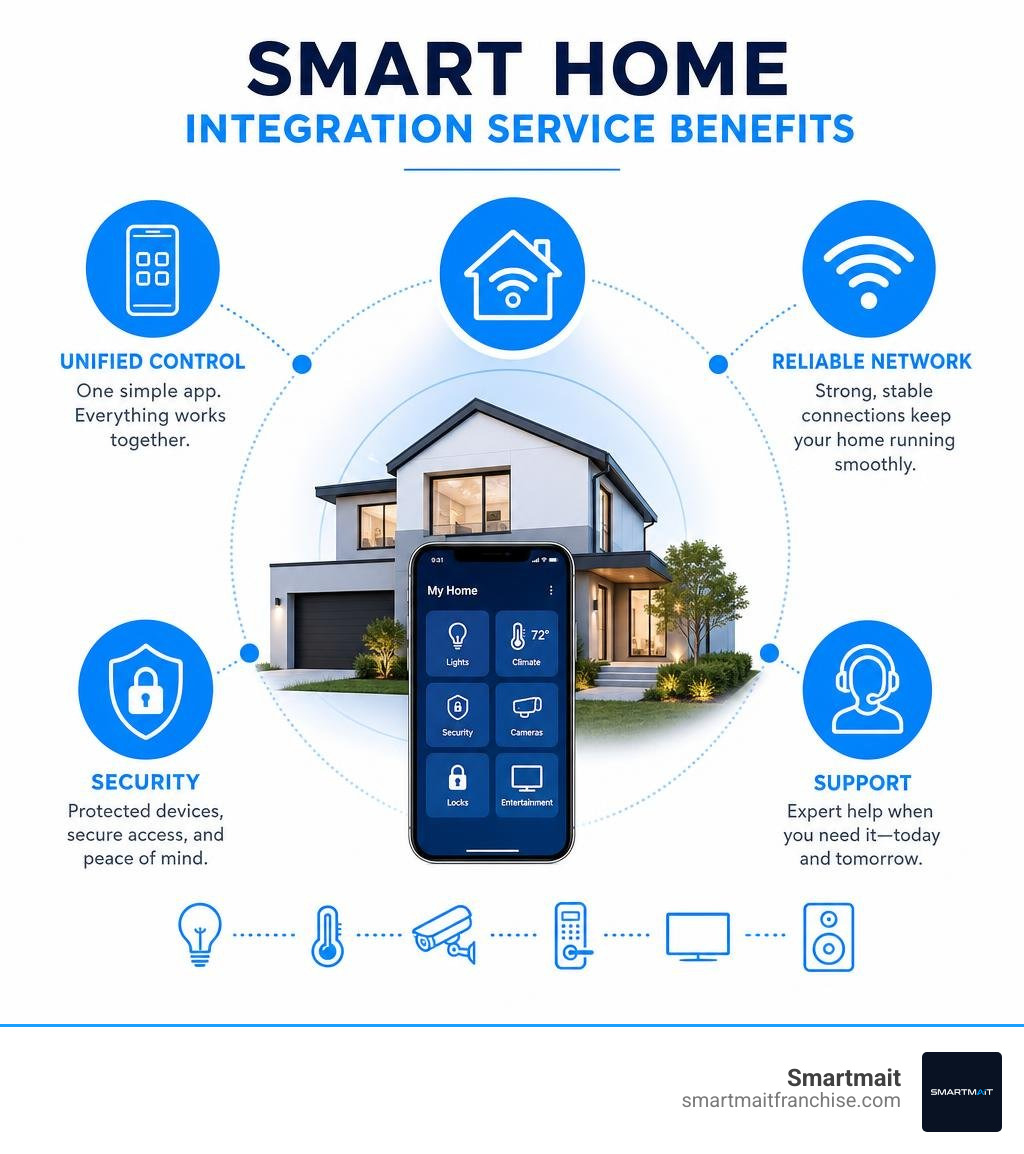
A smart home integration service connects your lighting, climate controls, security devices, Wi-Fi, entertainment, and connected appliances into one system that works reliably. The right expert does more than install devices: they assess your network, match compatible products, create useful automations, secure access, and provide support when technology needs attention.
For homeowners and small businesses tired of disconnected apps and devices that stop responding, professional integration can provide:
- One clear control experience for the systems you use every day
- Reliable connectivity built around the right hub, network, and communication protocols
- Smarter automation for lighting, temperature, locks, cameras, and alerts
- Stronger protection through secure setup, access controls, and ongoing updates
- Long-term support as devices, needs, and software change
A smart home is not simply a collection of internet-connected gadgets. It is a coordinated environment where devices can share information and respond to schedules, sensors, voice commands, and real-life routines. When the design is sound, a thermostat can adjust for comfort and efficiency, lights can respond to occupancy or daylight, and security sensors can send meaningful alerts instead of constant noise.
I’m Dominic Hesano, a franchise development professional and business operator focused on making smart home integration service more dependable through professional installation, low-voltage systems, networking, security, lighting, audio/video, and ongoing support. At Smartmait, I focus on the practical side of connected technology: helping customers get systems that are clear, useful, and built to last.
Must-know smart home integration service terms:
Understanding Smart Home Technology and Communication Protocols
Smart home technology has evolved dramatically since 1975, when the X10 protocol) first attempted automation by sending 120 kHz radio frequency bursts across existing household AC wiring. In 1984, the American Association of Home Builders coined the term “smart house,” envisioning a fully interconnected residence. Today, modern home automation relies on internet-of-things (IoT) ecosystems where edge sensors, controllers, and cloud databases coordinate seamlessly. To build a system that works without constant glitches, check out our In-Depth Guide to Home Automation Basics.
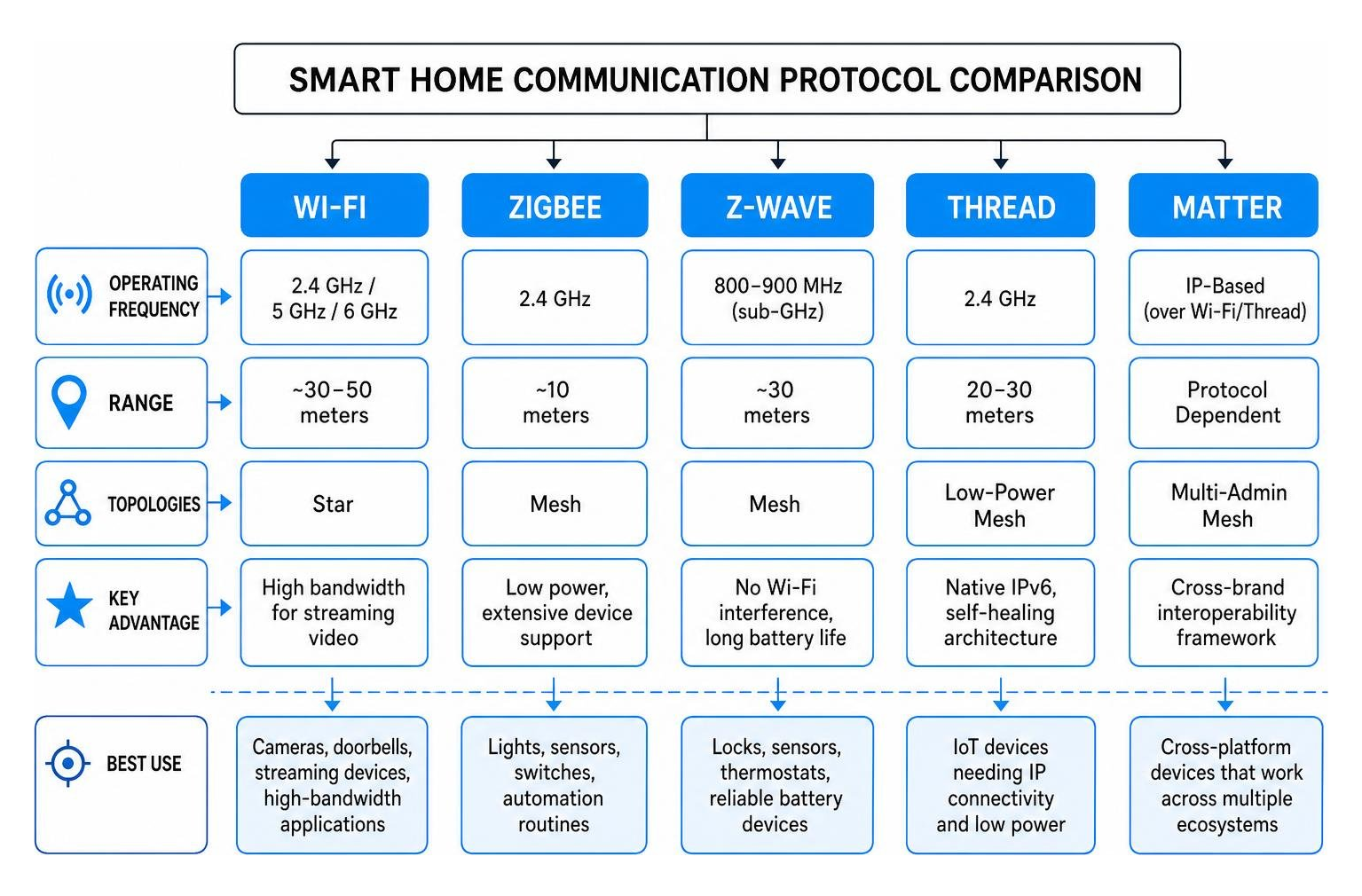
At its core, a smart home relies on two layers: the logical hub layer and the wireless radio layer. Smart home platforms like Home Assistant illustrate the massive scale of modern IoT, supporting thousands of brands across over a hundred device categories—from lights, locks, and climate controllers to vacuum cleaners and energy monitors. Managing these devices requires understanding local polling, cloud pushes, and local push architectures.
| Protocol | Operating Frequency | Range | Topologies | Key Advantage |
|---|---|---|---|---|
| Wi-Fi | 2.4 GHz / 5 GHz / 6 GHz | ~30-50 meters | Star | High bandwidth for streaming video |
| Zigbee | 2.4 GHz | ~10 meters | Mesh | Low power, extensive device support |
| Z-Wave | 800-900 MHz (sub-GHz) | ~30 meters | Mesh | No Wi-Fi interference, long battery life |
| Thread | 2.4 GHz | 20-30 meters | Low-Power Mesh | Native IPv6, self-healing architecture |
| Matter | IP-Based (over Wi-Fi/Thread) | Protocol Dependent | Multi-Admin Mesh | Cross-brand interoperability framework |
Wireless Protocols: Zigbee, Z-Wave, Matter, and Thread
Choosing the right wireless radio standards determines how resilient your ecosystem will be. The two traditional stalwarts of home automation are Zigbee and Z-Wave. Both utilize mesh networking topology, meaning every mains-powered node acts as a repeater to pass signals along, extending total coverage.
Zigbee operates primarily on the 2.4 GHz spectrum with a node-to-node range of around 10 meters. It handles rapid local commands with ease. Z-Wave operates on sub-gigahertz frequencies (around 908 MHz in North America), providing a longer point-to-point range of about 30 meters and easily passing through solid walls without interference from 2.4 GHz Wi-Fi signals.
The modern standard landscape shifted dramatically with the rollout of Matter and Thread. Thread is a low-power, IPv6-addressable mesh network protocol running on the 2.4 GHz band with a typical range of 20 to 30 meters. Because Thread natively supports IP standards, devices communicate directly with your local network without needing cloud translation bridges.
Building on this foundation is Matter, an application layer standard created by the Connectivity Standards Alliance (supported by tech giants like Apple, Google, and Amazon). Matter establishes a universal language across Wi-Fi and Thread, allowing a Matter-certified smart lock or switch to work natively across multiple controller ecosystems simultaneously.
Network Infrastructure and Smart Home Integration Service Design
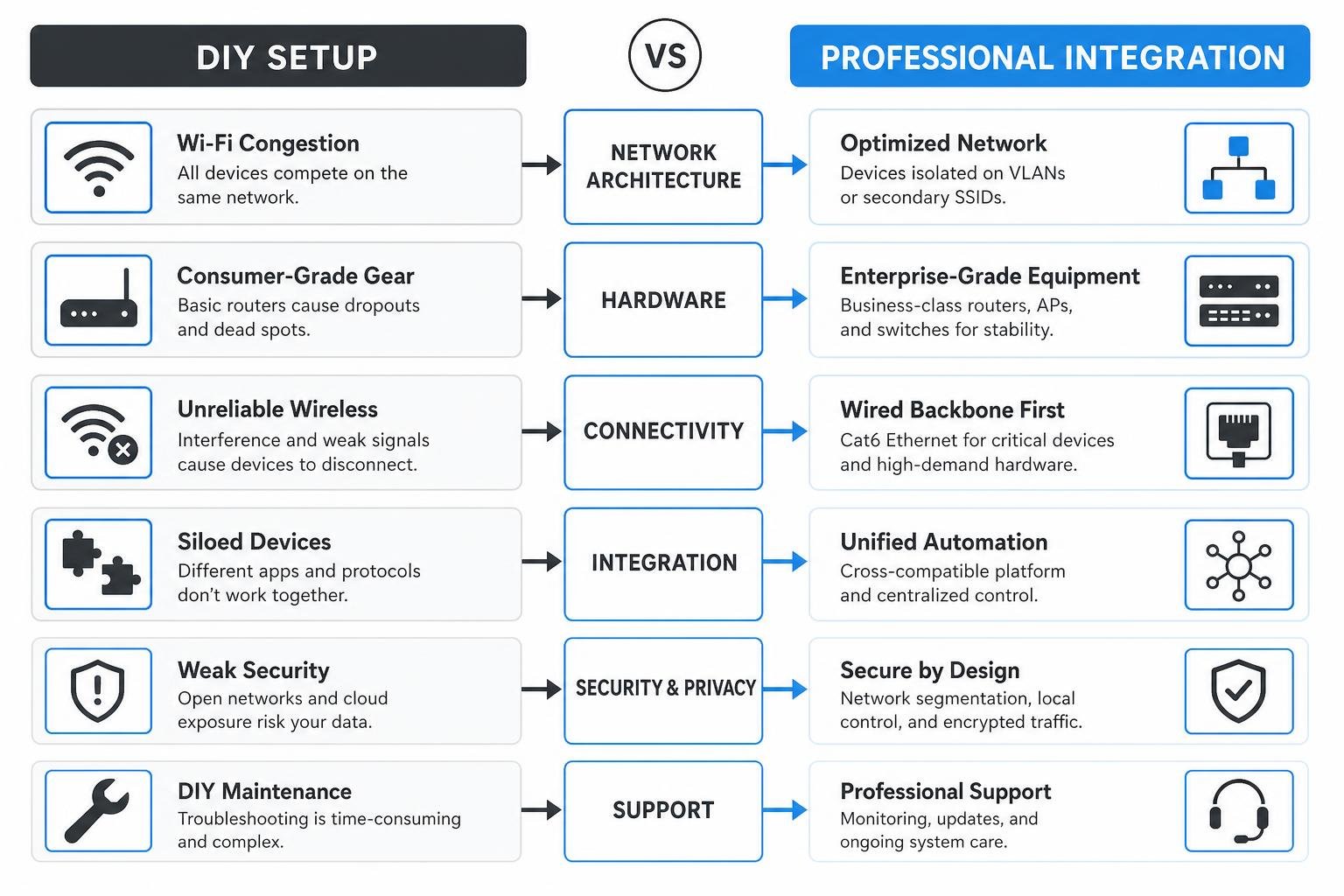
Even the most advanced IoT standards fail if the supporting home network is inadequate. A primary reason DIY systems break down is Wi-Fi congestion. When dozens of cheap smart plugs, smart bulbs, and security cameras compete for bandwidth on a consumer-grade gateway, dropouts occur.
Our team designs custom network solutions that prevent bottlenecking. We isolate smart home devices on dedicated VLANs (Virtual Local Area Networks) or secondary SSIDs, reserving primary Wi-Fi bands for personal computers and media streaming. To prevent wireless gridlock, read our guide on Smart Home WiFi Setup 101 Stop Your Devices from Fighting for Bandwidth.
For high-demand hardware—such as 4K IP security cameras, primary smart home hubs, and video doorbells—we always prioritize structured Cat6 ethernet hardwiring. Hardwired backbones remove latency, eliminate dead spots, and preserve wireless airtime for truly portable equipment.
Core Components and Key Benefits of Smart Home Systems

A comprehensive smart home integration service transforms isolated products into a unified ecosystem. By linking your environmental controls, security hardware, and lighting networks, you achieve operational benefits that far exceed manual switches or disconnected mobile apps.
Energy Efficiency and Environmental Control
Intelligent climate and lighting controls yield measurable savings while maximizing indoor comfort. Smart thermostats analyze daily household schedules, weather forecasts, and room occupancy sensors to dynamically modify target temperatures. Rather than running high heating or cooling cycles in an empty house, climate systems enter energy-saving eco modes and pre-condition rooms prior to your arrival.
Smart lighting systems automatically adjust output based on available daylight, auto-extinguish when rooms are vacant, and enforce scheduling routines. Outside, smart irrigation monitors parse localized soil moisture levels and hyper-local rain forecasts, suppressing sprinkler cycles when rainfall occurs and preventing water waste. Furthermore, inline water monitors continuously track flow rates, automatically closing the main supply valve within milliseconds if a burst pipe or leak is detected.
Enhanced Home Security and Automation Convenience
Modern security goes far beyond traditional, passive burglar alarms. Smart motion sensors use advanced spatial tracking and edge processing to differentiate between household pets, authorized residents, delivery personnel, and potential intruders.
When an unexpected disturbance occurs, automated routines trigger instantly: exterior floodlights flash, interior lights illuminate, and real-time push alerts with live video feeds send directly to your phone.
Integrated electronic door locks allow keyless entry via biometric scanners, geofencing, or temporary digital access codes for guests and service workers. Coupled with automated shading, automated routines can lower window blinds during peak solar heat or close garage doors at sunset automatically.
Why Work with a Professional Smart Home Integration Service
While buying off-the-shelf smart gadgets from a store seems straightforward, integrating dozens of cross-brand products into a cohesive unit quickly becomes overwhelming. Professional smart home Integrators eliminate the trial-and-error approach by engineering a unified platform customized to your exact floorplan and lifestyle.
Overcoming Interoperability and Privacy Challenges
Interoperability remains a major obstacle in modern home automation. Devices operating on mismatched protocols or closed proprietary apps often refuse to communicate. Professional installation services solve this by architecting system topologies around cross-compatible frameworks like Matter, local IP controllers, or unified hubs.
Data privacy and network hardening are equally crucial. Standard off-the-shelf smart hardware frequently transmits unencrypted telemetry data over open cloud channels. We secure your installation by:
- Enforcing local processing protocols so commands execute inside your home without requiring external cloud access.
- Deploying robust multi-factor authentication (MFA) across all controller accounts.
- Isolating home automation hardware on secure VLANs with active firewall rules.
- Updating device firmware regularly to plug known security vulnerabilities.
System Maintenance and Choosing a Smart Home Integration Service
A home automation ecosystem is not a static setup; it is a dynamic digital environment requiring ongoing optimization. As device software updates roll out and household demands change, systems require routine adjustments.
At Smartmait, our unique service model pairs top-tier initial installation with proactive maintenance plans. Rather than leaving you stranded when a network gateway resets or an integration breaks, our technicians offer continuous system support, remote network health monitoring, and routine system health audits. To learn more about selecting a long-term partner, read The Ins and Outs of Finding a Reliable Smart Home Service and explore how we assist when tech issues arise in How to Find Reliable Smart Home Help When Your Tech Goes Rogue.
Planning System Upgrades and New Construction Projects
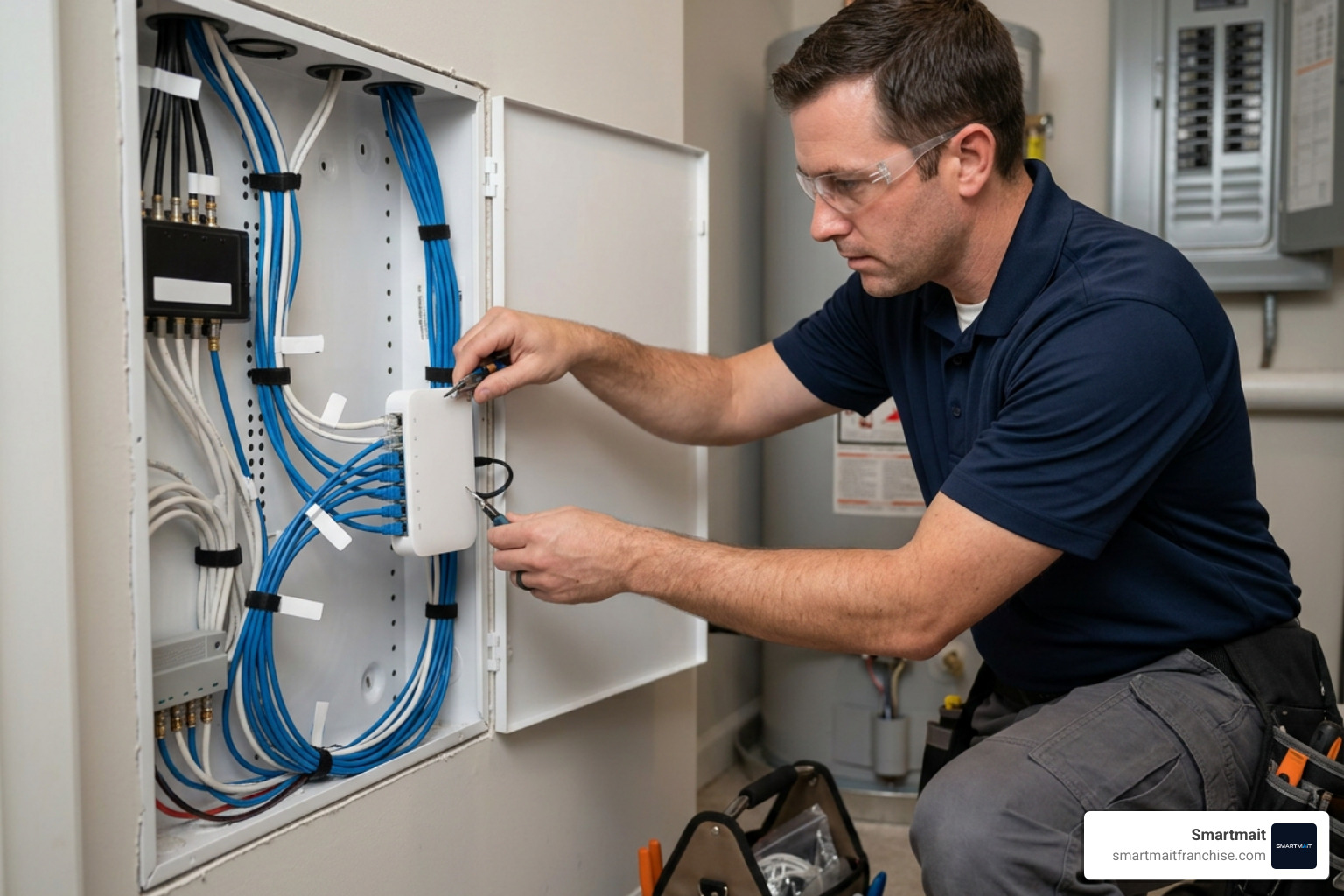
Whether you are retrofitting an existing residence or planning a custom dream build, proper project scoping is essential for long-term scalability.
Planning Smart Home Upgrades and Retrofits
Upgrading an existing home requires auditing current wiring, network performance, and legacy hardware. Many older homes lack neutral wires inside wall switch boxes—a requirement for many hardwired smart switches. In such scenarios, integration specialists use specialized low-voltage protocols or smart switch architectures designed for no-neutral wiring.
When upgrading legacy setups, we preserve functioning hardware by deploying protocol bridges or smart relays. If your system encounters persistent glitches, check out The Smart Way to Plan Your Next Smart Home System Upgrade and follow our practical guide on How to Troubleshoot Smart Home Issues in 7 Days.
Integrating Smart Tech in New Builds
Building a home provides the perfect opportunity to implement structured wiring and future-proof design before drywall is installed. Pre-wiring with Cat6, fiber, and dedicated low-voltage power lines ensures your system operates with absolute stability.
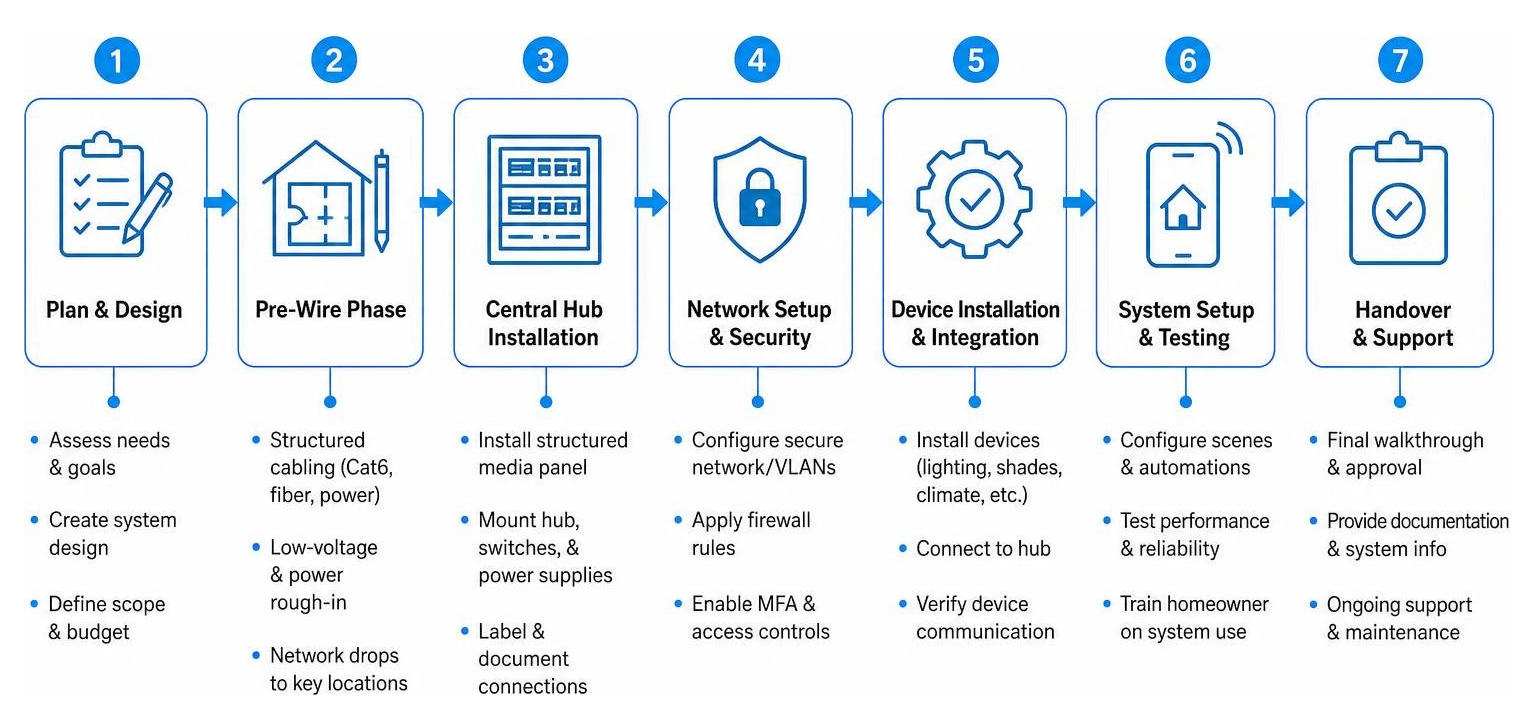
When building new, partner with your general contractor early. Learn key questions to ask your builder in The Blueprint for Smart Home Construction What to Ask Your Contractor, and review feature recommendations in Smart Home New Construction Must-Have Features for Your Dream Build.
Future Trends: AI and Predictive Automation in 2026
The landscape of home automation is shifting from passive, reactive setups to proactive, context-aware environments. Driven by advancements in local artificial intelligence, machine learning, and agentic AI models, modern smart systems operate contextually without relying solely on rigid rule triggers.
Instead of waiting for a manual voice command, predictive smart homes interpret subtle context clues—such as time of day, historical occupant habits, local climate data, and sensor inputs—to make intelligent operational decisions.
For example, an AI-enabled climate system can anticipate thermal shifts based on solar angle and historical room usage, lowering shading before a space overheats. Similarly, predictive servicing monitors HVAC power draws and compressor vibration frequencies, alerting our maintenance team to service components before a major system breakdown occurs.
Frequently Asked Questions About Smart Home Systems
How much does professional smart home setup cost?
Professional integration costs vary based on home size, project scope, hardware choices, and network complexity. Entry-level retrofits focusing on climate, lighting, and security typically range from $1,500 to $5,000, while comprehensive hardwired custom builds can range from $10,000 to over $50,000. Project scoping includes hardware procurement, network infrastructure, installation labor, custom programming, and ongoing service plans.
Can older devices connect to a modern smart system?
Yes. Legacy hardware like traditional garage door openers, HVAC equipment, and existing alarm sensors can usually be integrated using protocol bridges, smart dry-contact relays, or smart plugs. Professional integrators specialize in bridging older hardware into unified modern dashboards.
What happens to smart devices when internet connection drops?
A professionally designed smart home integration service prioritizes local processing over cloud connectivity. Core functions like physical wall switches, local motion automations, scheduled lighting scenes, and internal security sensors continue running locally during internet outages. Only cloud-dependent capabilities, such as remote mobile access or voice processing models, temporarily pause until internet connectivity is restored.
Conclusion
A reliable smart home requires more than unboxing independent gadgets—it demands thoughtful network design, standard protocol selection, proper hardware integration, and dedicated long-term care. Partnering with a dedicated smart home integration service ensures your residence delivers lasting security, convenience, and energy savings without the friction of frequent technical failures.
At Smartmait, we deliver end-to-end technology solutions—from initial planning and low-voltage installation to continuous maintenance and system upgrades. Discover how our professional installation team transforms connected spaces by visiting our primary portal at Smart Home Solutions, or learn about joining our expanding national franchise network through The Complete Guide to Smart Home Franchises.