

Is a Smart Home Franchise the Right Business for You?
A smart home franchise gives entrepreneurs a proven system to sell, install, and support connected home technology — without building a brand or business model from scratch.
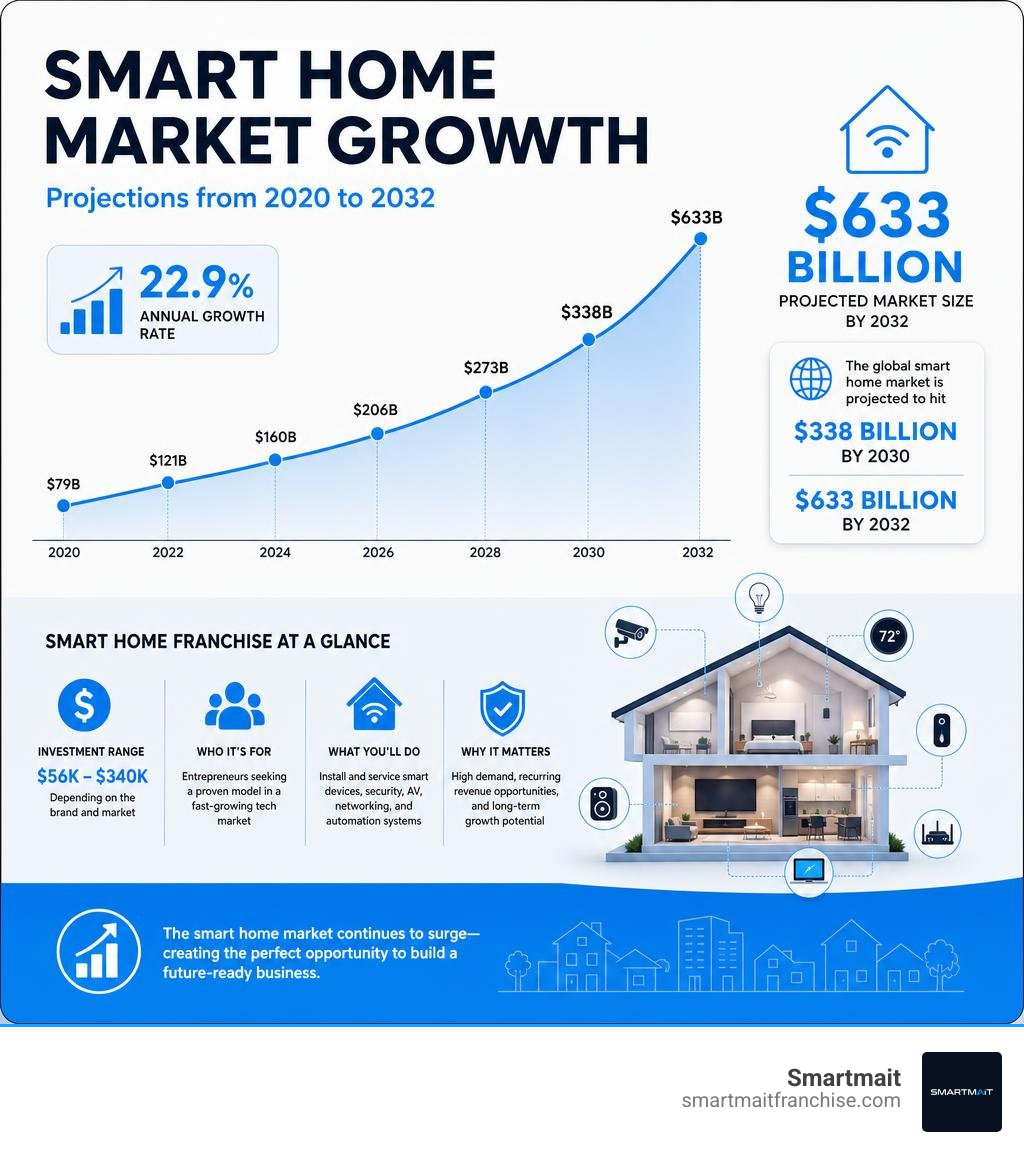
Here’s what you need to know at a glance:
- What it is: A licensed business model where you operate under an established smart home brand, using their training, tools, and systems
- What you’ll do: Install and service smart devices — lighting, security cameras, thermostats, audio/video, networking, and automation systems
- Investment range: Roughly $56,000 to $340,000 depending on the brand and market
- Who it’s for: Entrepreneurs who want to tap a fast-growing tech market with structured support behind them
- Market size: The global smart home market is projected to hit $338 billion by 2030 and $633 billion by 2032
The demand is real. Homeowners and businesses want smarter, more connected spaces — but most don’t want to figure it out themselves. They want a trusted professional who can design it, install it, and keep it running. That gap is exactly where smart home franchises operate.
And the timing matters. The smart home sector is growing at a 22.9% annual rate, making it one of the fastest-expanding categories in the entire home services industry.
I’m Dominic Hesano, a franchise development professional who has worked in sales, operations, and local service businesses — and I’m currently building Smartmait, a smart home franchise model focused on bringing professional automation, security, networking, and AV solutions to both residential and commercial customers. In this guide, I’ll walk you through everything you need to evaluate whether this opportunity is the right fit for you.
Smart home franchise glossary:
What is a Smart Home Franchise?
At its core, a smart home franchise is a turnkey business model that enables you to offer expert residential and commercial technology services under an established brand name. Instead of spending years testing different software, trial-and-erroring equipment compatibility, and trying to build local trust from scratch, you step into a pre-packaged ecosystem.
When you invest in a franchise, you are purchasing more than just a logo. You gain access to:
- Established Brand Recognition: Instantly building trust with clients who want professional, certified technicians in their homes.
- Operational Systems: Integrated CRM platforms, custom quoting tools, automated scheduling, and inventory management systems designed specifically for technology integrators.
- Partnerships and Purchasing Power: Direct relationships with leading hardware manufacturers, allowing you to secure preferred pricing on premium smart devices.
- Centralized Support: Many franchisors provide centralized engineering support, remote troubleshooting assistance, and even 24/7 customer call centers to handle tier-one tech support on your behalf.
By simplifying the technical complexity of connected devices, smart home franchises bridge the massive gap between complicated technology and everyday consumers who just want their systems to work seamlessly.
Smart Home Franchise vs. Independent Business
Starting a business in the home automation space presents a classic entrepreneurial dilemma: do you go it alone as an independent integrator, or do you align with a franchise network?
While starting an independent business gives you total control over every minute detail, it also forces you to wear every single hat. You must act as the lead technician, the marketing director, the accountant, and the customer service representative. More importantly, independent business owners must independently vet and build relationships with major hardware manufacturers—a process that can take years and require high minimum order volumes.
A smart home franchise significantly reduces these operational risks. By providing a structured playbook, comprehensive technical training, and pre-negotiated supplier rates, franchising accelerates your path to profitability.
Here is a side-by-side comparison of the two paths:
| Feature | Smart Home Franchise | Independent Business |
|---|---|---|
| Brand Trust | Immediate; backed by national presence and professional marketing assets. | Built slowly over years through local networking and self-funded ads. |
| Startup Support | Structured onboarding, territory analysis, and site selection/storage planning. | Entirely self-guided; high risk of costly early-stage mistakes. |
| Technical Training | Comprehensive bootcamps covering installation, networking, and system design. | Self-taught or reliant on expensive individual manufacturer certifications. |
| Supply Chain & Pricing | Preferred pricing and direct access to top-tier smart home brands. | Retail or distributor pricing with minimal bargaining power. |
| Marketing & Lead Gen | Done-for-you local SEO, digital marketing campaigns, and brand awareness. | Self-designed campaigns with unproven local conversion rates. |
| Administrative Burden | Centralized software, proprietary CRM systems, and sometimes 24/7 call support. | Manual scheduling, invoicing, and handling late-night support calls yourself. |
Core Services Offered by Industry Integrators
To build a resilient service business, you need to offer solutions that solve real, daily problems for your clients. Professional smart home Integrators do not just mount TVs; they design cohesive ecosystems where devices talk to one another.

A high-performing smart home franchise typically specializes in several core service pillars:
- Smart Lighting & Motorized Shades: Designing automated lighting scenes and motorized window treatments that adapt to the time of day, improving energy efficiency and enhancing home security.
- Whole-Home Networking & Wi-Fi: Building robust, enterprise-grade wireless networks. Since a smart home is only as reliable as its network, high-performance Wi-Fi is the foundation of every project.
- Home Security & Access Control: Installing smart locks, video doorbells, AI-powered security cameras, and smart garage controls that give homeowners real-time peace of mind.
- Climate Control & Smart Energy: Integrating smart thermostats, smart irrigation controllers, and energy monitoring systems to reduce utility bills and promote sustainable living.
- Immersive Home Entertainment: Designing custom home theaters, multi-room audio systems, outdoor soundscapes, and clean video installations.
By offering a comprehensive suite of services, franchisees can position themselves as a single point of contact for all of a client’s technology needs, maximizing the average transaction value.
The Market Opportunity for a Smart Home Franchise
The consumer demand for smart technology has transitioned from a niche luxury for early adopters into a mainstream expectation. Homeowners and commercial property managers are realizing that smart systems are no longer “nice-to-have” gadgets—they are essential components of modern property management.

The numbers paint a incredibly clear picture of this growth trajectory:
- The global smart home market is projected to reach $338 billion by 2030.
- Long-term forecasts suggest the market will expand to a staggering $633 billion by 2032, fueled by a blistering 22.9% compound annual growth rate (CAGR).
- Even conservative, mid-term projections show the market growing from $124.1 billion in 2020 to $190.61 billion by 2027 (a 15.2% CAGR).
This explosive growth is driven by several converging trends. First, the sheer volume of connected devices has made professional installation a necessity; the average consumer simply does not have the time or technical expertise to configure dozens of smart devices to work in harmony. Second, rising energy costs are driving demand for automated climate and lighting systems that actively reduce waste. Finally, an aging population is looking to smart home technology to help them safely age in place through remote monitoring and voice-activated assistance.
New Construction and Smart Integration
One of the most lucrative avenues for a smart home business is partnering with home builders, architects, and interior designers during the construction phase. Retrofitting a finished home with smart technology can sometimes be challenging, but integrating systems from the ground up allows for clean, robust, and deeply integrated solutions.
Pre-wiring a home during construction ensures that the physical infrastructure—such as high-speed category cabling and dedicated power lines—is perfectly positioned to support future technological upgrades. This collaborative approach is discussed in detail in our guide on Smart Home New Construction Must-Have Features for Your Dream Build.
By establishing relationships with local builders, franchisees can secure high-volume, high-ticket contracts to pre-wire and equip entire new developments, creating a highly predictable pipeline of project revenue.
Key Services and Revenue Models
To build a highly profitable and sustainable business, a smart home franchise must move beyond the traditional “one-and-done” installation model. While large-scale installations generate excellent upfront revenue, the real magic of a modern home services business lies in recurring revenue.
A diversified smart home revenue model relies on three core pillars:
- Upfront Installation Services: High-ticket projects including home theaters, whole-home audio, network rollouts, and complete automation system designs.
- System Upgrades & Hardware Sales: Technology moves fast. Clients regularly look to upgrade their cameras, processors, and smart displays every few years, creating a built-in cycle of repeat hardware sales.
- Ongoing Maintenance & Optimization: Offering proactive support plans, remote monitoring, and scheduled on-site tune-ups to ensure the client’s system remains flawless year-round.
By combining top-tier installations with ongoing maintenance, a franchise can enjoy both high-margin project cash flow and predictable monthly recurring revenue (MRR) that covers overhead and drives long-term business value.
Typical Investment and Costs for a Smart Home Franchise
Before diving into business ownership, it is crucial to understand the financial requirements. Because smart home franchises can often be operated as mobile, home-based businesses, the barrier to entry is remarkably reasonable compared to brick-and-mortar retail or food concepts.
Financial requirements vary depending on the specific franchise model you choose:
- Low-Cost, Mobile Models: Some entry-level concepts require a minimum of $50,000 in liquid capital, with a total initial investment ranging between $56,300 and $72,700. These models focus heavily on low overhead, starting from a home office with a single branded service vehicle.
- Mid-Range Tech Service Models: Other mobile-first smart home franchises have a total investment range of $128,718 to $220,491, which typically includes a standard 6.5% royalty fee, initial marketing capital, equipment inventory, and three months of working capital.
- Enterprise Integration Models: High-end custom integration franchises can require an initial investment range of $130,400 to $339,000, targeting larger territories and requiring higher liquid capital (around $100,000) to support larger teams and extensive inventory.
To put this in perspective, let’s look at how the smart home market compares to other high-demand home service sectors found in directories like Home Franchise Opportunities :
- The residential cleaning market is valued at $20 billion, with 61% of U.S. families utilizing professional cleaning services.
- The home organization market is projected to reach $15.3 billion by 2028.
- The pet grooming market is valued at $2.16 billion and is expected to reach $3 billion by 2030.
While these traditional home service markets are massive, the smart home technology sector offers a unique advantage: substantially higher average transaction values and a lack of consolidated national competitors. Furthermore, top-tier corporate locations in the smart home space have demonstrated outstanding unit economics, with some networks reporting an average total revenue of $3,798,399 and a 61.1% average gross profit margin (before direct labor) across their operating locations.
Building Long-Term Client Loyalty
The secret to maximizing the lifetime value of a customer is shifting your business relationship from a basic service provider to a trusted technology adviser. When a client knows they can rely on you to keep their home safe, connected, and running smoothly, they will never look elsewhere.
This proactive approach is at the core of our business philosophy. We focus heavily on building predictable service memberships that provide clients with regular system health checks, priority support, and remote troubleshooting. You can explore these strategies in depth by reading our guides on How Smart Home Franchises Can Lock In Client Loyalty and Smart Home Customer Retention Strategies That Actually Work.
These recurring service models not only provide peace of mind to the client but also build a highly stable, recurring revenue stream that enhances the resale value of your franchise.
Frequently Asked Questions About Smart Home Franchises
Do I need a background in technology to own a franchise?
No! This is one of the most common misconceptions about entering the smart home space. While having an interest in technology is certainly helpful, franchisors do not expect you to be a master programmer or an electrical engineer.
The primary role of a franchise owner is to lead and grow the business. You will focus on local networking, building relationships with home builders, managing your team, and driving local marketing. Franchisors provide comprehensive training programs that cover everything from basic low-voltage wiring to advanced system programming. As your business grows, you will hire dedicated, tech-savvy field technicians to handle the day-to-day installations, allowing you to focus entirely on scaling operations.
What is the typical timeline to launch operations?
Because many smart home franchises operate on a mobile, home-based model, the timeline from signing your franchise agreement to your grand opening is incredibly fast.
On average, you can expect to launch your business within 90 to 120 days. During this period, you will:
- Complete your initial corporate training and technical certifications.
- Secure your exclusive territory and establish your home-based office.
- Acquire and wrap your branded service vehicle.
- Purchase your initial equipment inventory and tools.
- Launch your local, done-for-you digital marketing campaigns to begin generating immediate leads.
Can I run this as a home-based business?
Absolutely. In fact, most smart home franchises are intentionally designed to be run directly from a home office, especially during the first few years of operation.
By eliminating the need for an expensive brick-and-mortar retail storefront, you significantly reduce your monthly overhead and keep your margins high. All you need to get started is a secure storage space of approximately 100 to 150 square feet (such as a clean garage or small storage unit) to hold inventory, secure parking for your service vehicle, and a computer to manage scheduling and client relationships. As your business scales and you add multiple technicians and vehicles to your fleet, you can easily transition into a small commercial warehouse space.
Conclusion
The smart home revolution is no longer a trend of the future—it is happening right now. As the global smart home market accelerates toward a projected $633 billion by 2032, the demand for professional, reliable, and friendly technology integrators has never been higher.
At Smartmait, we have built a franchise model specifically designed to help entrepreneurs capitalize on this massive shift. By combining top-tier smart home and smart building installation services with structured, recurring maintenance memberships, we help our franchise partners build highly profitable, resilient businesses with built-in client loyalty.
If you are ready to take control of your financial future, step into a high-growth tech industry, and build a business backed by complete training and support, we would love to connect. Visit Smartmait today to learn more about our available territories and take the first step on your business ownership journey.