
Why Smart Home Accessibility Features Matter to Integration Operators
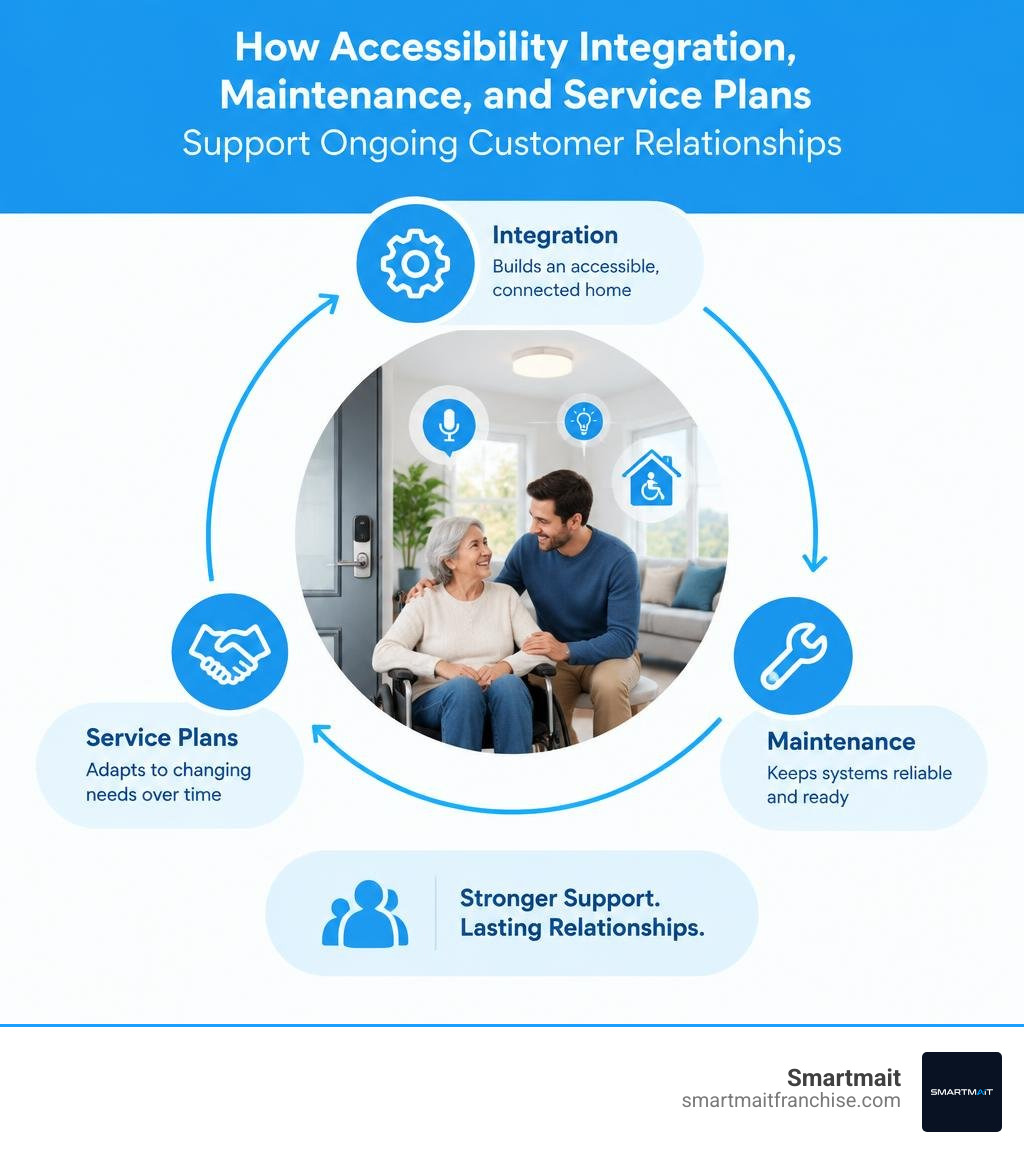
Smart home accessibility features include voice control, hands-free entry, presence-based lighting, and controls that can change with a person’s needs. For a prospective franchise buyer, the opportunity is not just installing devices. It is evaluating whether a local market needs trained operators who can integrate these systems, keep them reliable, and support them over time.
Accessibility also raises questions that a standard smart-home job may not: Will the system work when the internet is down? Can it serve more than one person? Who will maintain it as needs change? Those questions can help an integration business assess its training, service plans, and potential for ongoing customer relationships.
I’m Dominic Hesano, a franchise development professional and business operator building Smartmait in the smart-technology and low-voltage integration space. My work in franchising and service businesses shapes how I evaluate smart home accessibility features as a market opportunity for operators.
Smart home accessibility features word roundup:
Smart Home Accessibility: A Market Area for Integration Operators
When evaluating the low-voltage and smart-building integration industry, prospective franchise owners and established independent contractors often look for segments with strong demand and long-term customer engagement. Accessible integration represents a meaningful shift from discretionary gadget installations to functional living infrastructure.
For trade operators, designing spaces that support independent living requires a structured operational framework. The table below outlines key technology categories and their operational considerations for an integration franchise.
| Technology Category | Functional Role | Operational & Integration Considerations | Ongoing Service & Maintenance Scope |
|---|---|---|---|
| Environmental Controls | Automated lighting, climate, shades | Redundant local network controls, zero-touch scheduling | Routine firmware validation, scene remapping, sensor calibration |
| Hands-Free Access | Proximity locks, automatic door operators | Power-loss backup systems, hardware alignment | Mechanical inspection, battery health checks, credential maintenance |
| Presence & Radar Sensing | True room occupancy detection | Multi-sensor field-of-view tuning, privacy boundary setup | Sensitivity adjustments, interference troubleshooting |
| Assistive Interface Relays | Contact closures, voice hubs, adaptive switches | Low-latency protocol routing, local execution fallback | Input hardware diagnostics, integration health checks |
In our industry, the primary differentiator between one-off installation work and a sustainable integration model is how a business manages long-term hardware health and infrastructure coordination.
Consumer Smart Homes and Specialized Accessibility Systems
A critical distinction in this market sector is the difference between standard consumer automation and specialized assistive systems, often categorized in healthcare environments as Electronic Aids to Daily Living (EADLs).
Consumer smart devices focus primarily on user convenience. In contrast, specialized systems integrate critical environmental access—such as automated hospital bed articulation, nurse call relays, and specialized sip-and-puff or eye-gaze inputs. While specialized medical equipment remains the domain of clinical assistive technology professionals, low-voltage integrators bridge the gap by connecting non-critical home infrastructure (lighting, door locks, thermostats, and shades) into accessible control layers.
Understanding this boundary allows integration operators to coordinate with occupational therapists, specialized equipment providers, and family decision-makers without stepping outside professional trade licensing scopes. By mastering the underlying network infrastructure, an integration franchise positions itself as the dependable operational partner for the surrounding living space.
Evaluating Changing Accessibility Needs in the Market
Human accessibility requirements are rarely static. A household managing progressive conditions—such as ALS, multiple sclerosis, or advanced aging—faces evolving physical and cognitive needs over time.
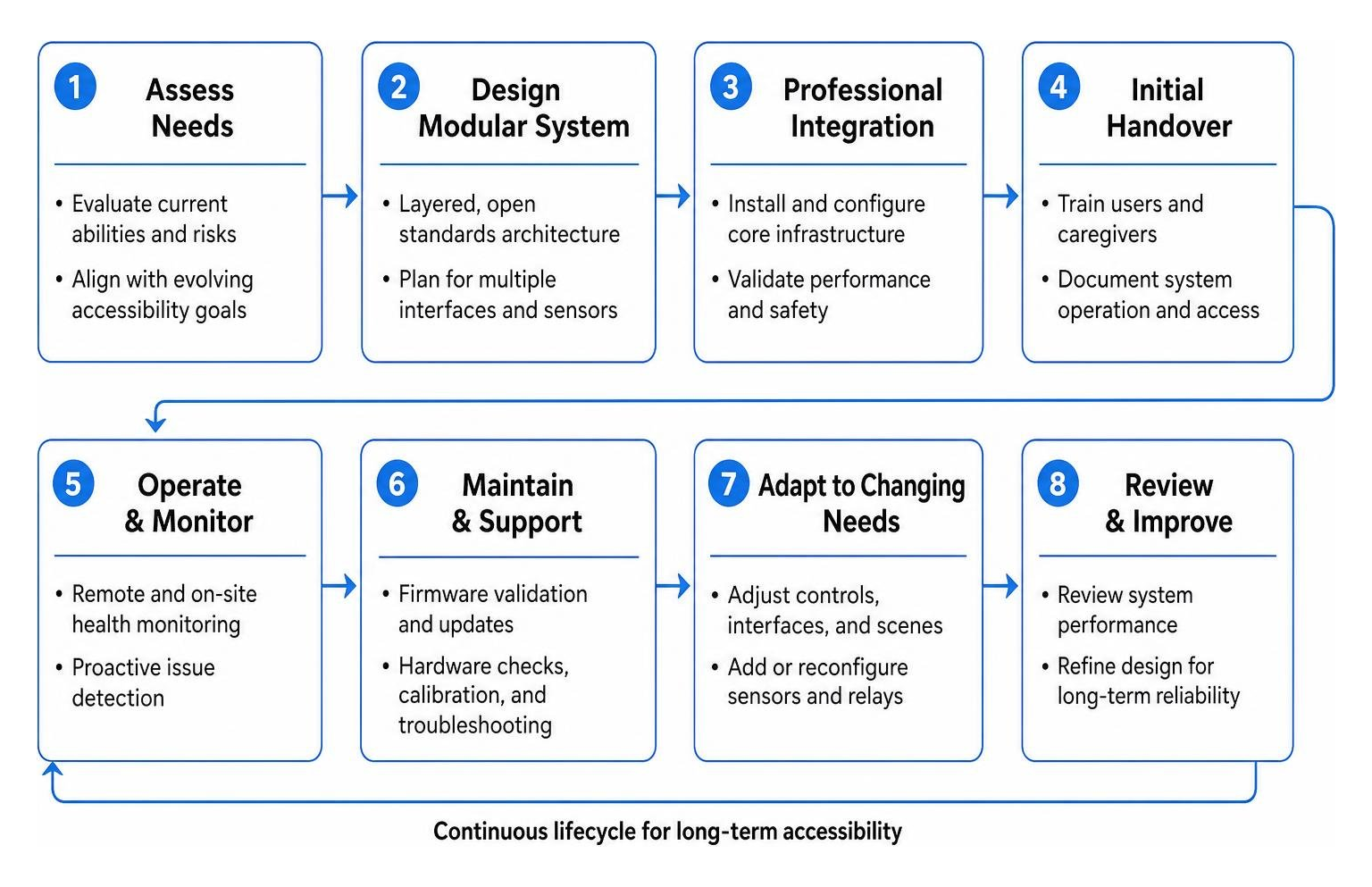
An independent integration contractor often struggles to support these shifts due to a lack of standardized operating procedures. A franchise system, however, leverages structured training pathways that enable technicians to design modular architectures. Systems built on adaptable, open standards allow control inputs to transition smoothly—from standard mobile apps to voice commands, and eventually to passive ambient sensing or adaptive switch relays—without requiring a costly, disruptive overhaul of the home’s core wiring.
Beyond Voice Control: Emerging Smart-Building Trends
Early smart-home deployments relied heavily on voice assistants as the primary interface for users with limited mobility. However, market trends demonstrate that voice control alone has distinct operational limitations.
Speech fatigue, progressive dysarthria, and background acoustic interference can make speech-dependent systems inconsistent for vulnerable occupants. Modern smart-building design is shifting toward zero-UI (zero-user-interface) automation, where environmental systems anticipate resident needs based on passive ambient data.
Voice Control and Other Automation Approaches
While voice control remains a valuable tool for rapid adjustments, relying solely on cloud-based voice platforms introduces service vulnerabilities. If an active internet connection drops, standard cloud-processed voice commands become completely unresponsive.
To build dependable systems, integration businesses must evaluate local-first control processing, batch automation routines, and deterministic fallback options. Developing robust smart home connectivity solutions allows an integration team to configure local control processors that maintain essential functions regardless of external internet uptime.
Presence Sensing as an Industry Trend
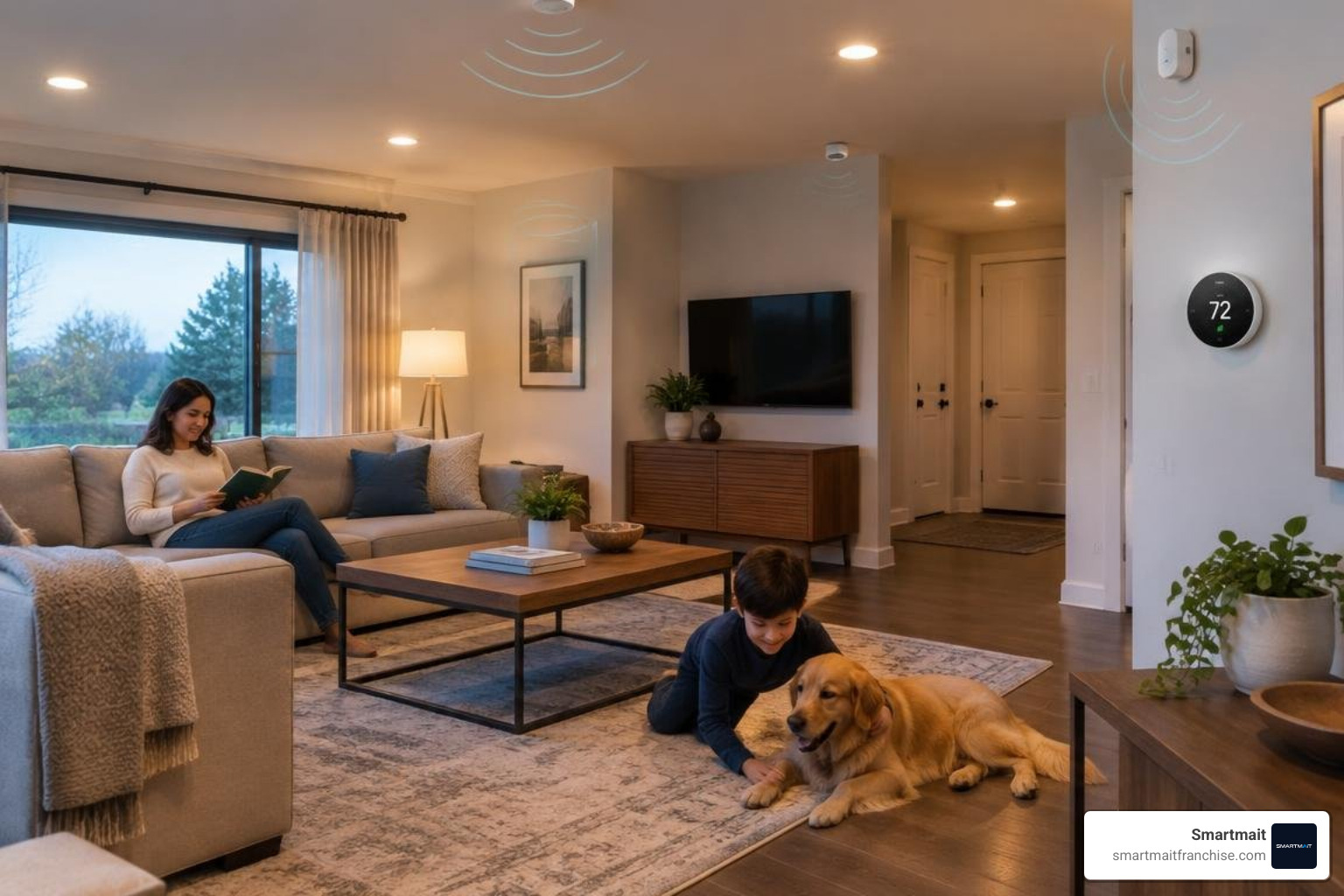
A significant operational upgrade over legacy motion detectors is the adoption of millimeter-wave (mmWave) presence sensing. Traditional passive infrared (PIR) motion sensors only register active physical movement, routinely turning off lights or environmental systems when an occupant sits quietly, rests, or reads.
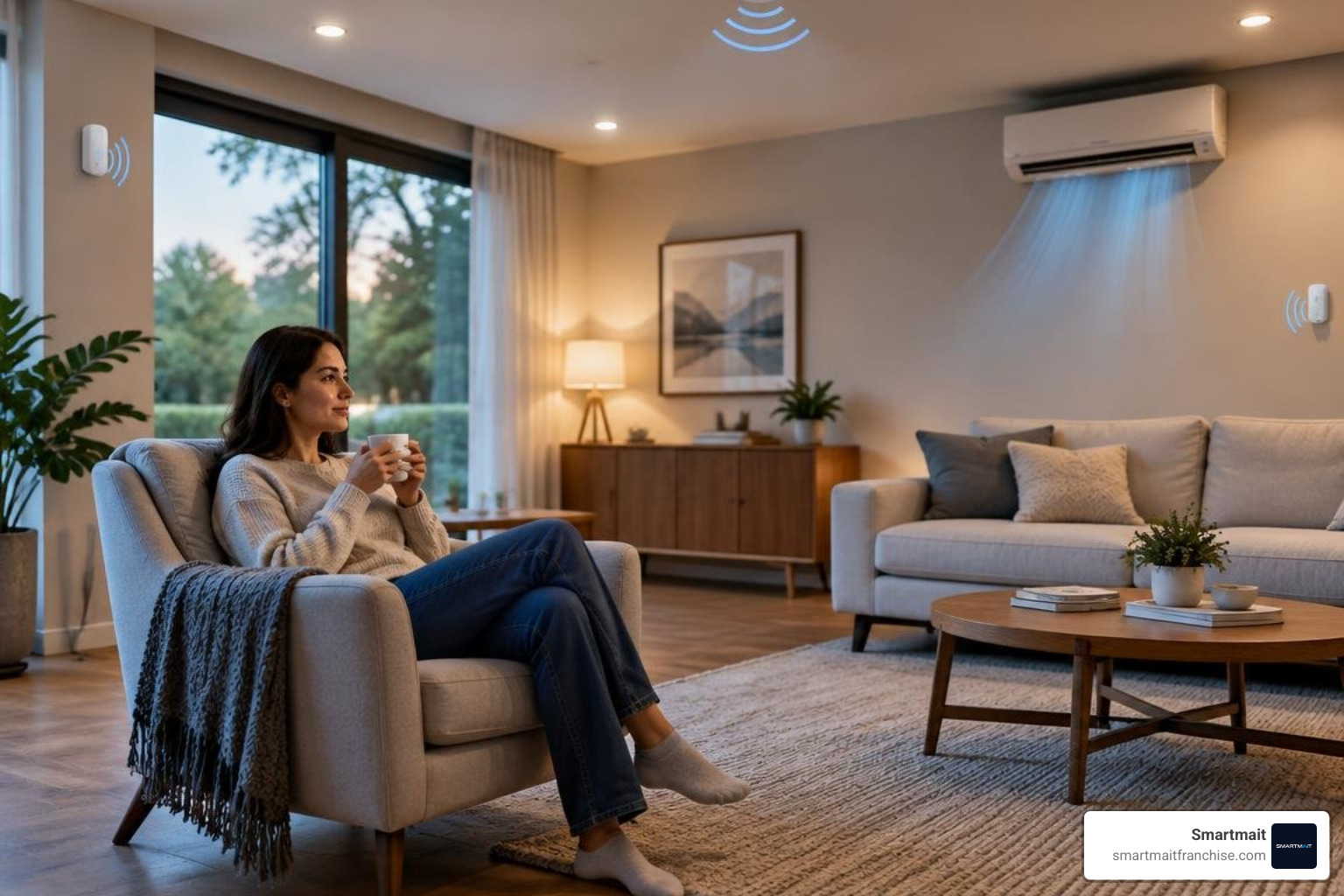
Presence sensors detect micro-movements, including the subtle physical motion of human respiration. This ensures that environmental systems remain active as long as the space is occupied. For low-voltage franchisees, deploying advanced presence hardware requires trained technical calibration:
- Mapping spatial detection zones to avoid false triggers from ceiling fans or HVAC registers.
- Programming appropriate absence confirmation windows tailored to an individual’s mobility speed.
- Establishing local automation routines that link lighting, temperature, and ventilation directly to sustained presence data.
Identity-Aware Automation: Market and Business Considerations
The next operational frontier for smart-building professionals is context-aware and identity-aware automation. Traditional presence sensing verifies that someone is in a room, but it cannot determine who has entered. Identity awareness solves this challenge by tailoring the environment to specific occupants.
Hands-Free Entry and Connected Access
Ultra Wideband (UWB) wireless technology is transforming hands-free access control. Unlike legacy Bluetooth or proximity fobs that merely estimate signal strength, UWB measures precise time-of-flight distance and directional angle.
This technological precision enables entry points to unlock automatically when an authorized user approaches with an enrolled wearable or mobile credential, without requiring manual app interaction, physical keypads, or spoken commands. For trade operators, deploying these access systems demands precision hardware alignment, dependable power management, and rigorous testing across all access pathways.
Multi-Occupancy Needs and Service Models
Multi-occupancy households present unique integration complexities. When a resident with specific accessibility needs shares living space with family members or rotating caregivers, conflicting preferences can cause friction.
Identity-aware automation enables systems to apply tailored profiles automatically. If a primary resident enters a room, lighting and climate adjust to their therapeutic preferences; if a caregiver enters, standard overhead lighting engages without overriding individualized schedules. Supporting these dynamic multi-user environments creates ongoing opportunities for service memberships, scheduled system check-ups, and user-profile adjustments.
Interoperability, Infrastructure, and Security Standards
For an integration franchise, field profitability and client trust depend on platform interoperability and system resilience. Operating within standardized ecosystems prevents vendor lock-in and reduces truck rolls caused by proprietary firmware incompatibilities.
Matter, Thread, and Cross-Platform Ecosystems
The widespread industry adoption of Matter over Thread protocols provides a unified baseline for connected building infrastructure. By establishing a low-latency, self-healing IPv6 mesh network, Thread allows certified low-voltage devices from diverse manufacturers to communicate locally without relying on third-party cloud bridges.
For integration operators, this standardized foundation simplifies technician onboarding, streamlines diagnostic procedures, and ensures that accessibility automations execute instantaneously across cross-platform hubs.
Privacy, Security, and Reliability Considerations
Deploying continuous sensing, presence radar, and identity tracking introduces heightened privacy and security considerations. Clients and their families require complete confidence that ambient data remains secure within their private network.
Franchise operators address these concerns through standardized enterprise-grade practices:
- Keeping data processing local to eliminate unnecessary cloud transmissions.
- Segmenting IoT hardware onto dedicated virtual local area networks (VLANs).
- Implementing zero-trust device enrollment procedures.
- Establishing proactive maintenance schedules to ensure connected nodes receive regular security patches.
Frequently Asked Questions for Prospective Franchise Buyers
How does accessibility-related integration fit into a smart-home franchise opportunity?
Integrating accessibility-focused systems allows an operator to move beyond discretionary consumer gadgets into essential, functional home automation. This focus builds enduring client relationships and creates a natural pipeline for ongoing system optimization and service memberships.
What should operators consider when evaluating presence-sensing technology?
Operators must evaluate the sensor’s underlying technology (such as mmWave radar vs. standard PIR), its local processing capabilities, and its configuration flexibility. Precise spatial zone mapping and absence confirmation adjustments are critical to prevent false-negative shutoffs for occupants with limited mobility.
How can an integration business prepare for changing customer needs?
Preparation relies on standardized, modular infrastructure. By deploying open, interoperable protocols like Matter and Thread paired with local automation controllers, an integration business can adapt control inputs and user profiles over time without rewiring the client’s home.
Conclusion
Evaluating emerging smart-building trends—from millimeter-wave presence detection and Ultra Wideband access to decentralized local automation protocols—highlights the growing demand for professional, trained low-voltage integrators. For entrepreneurs and established trade contractors, building a resilient operation requires structured technician training, robust field processes, and predictable recurring service frameworks.
Smartmait offers a comprehensive U.S. franchise system designed for prospective business owners and established low-voltage or home-service contractors looking to scale through a proven operational model.
To explore available territories and learn how our system supports trade operators, request Smartmait franchise information today.