
Why Smart Home Electrical Installation Matters to Franchise Operators
Smart home electrical installation starts with a scope check: identify the devices a project must support, review the existing wiring and network, and flag panel capacity or new-circuit work for a qualified electrician. For a prospective franchise operator, that check helps separate a simple device setup from a larger integration project—and shows where ongoing maintenance may be needed.
In 2026, connected homes may combine wired data, wireless devices, and energy controls. Operators who understand how those layers fit together can plan work more clearly, coordinate the right trades, and build service relationships beyond the first installation.
I’m Dominic Hesano. My background in franchise development and service-business operations informs my work building Smartmait, where smart home electrical installation is part of a broader integration and ongoing-support opportunity.
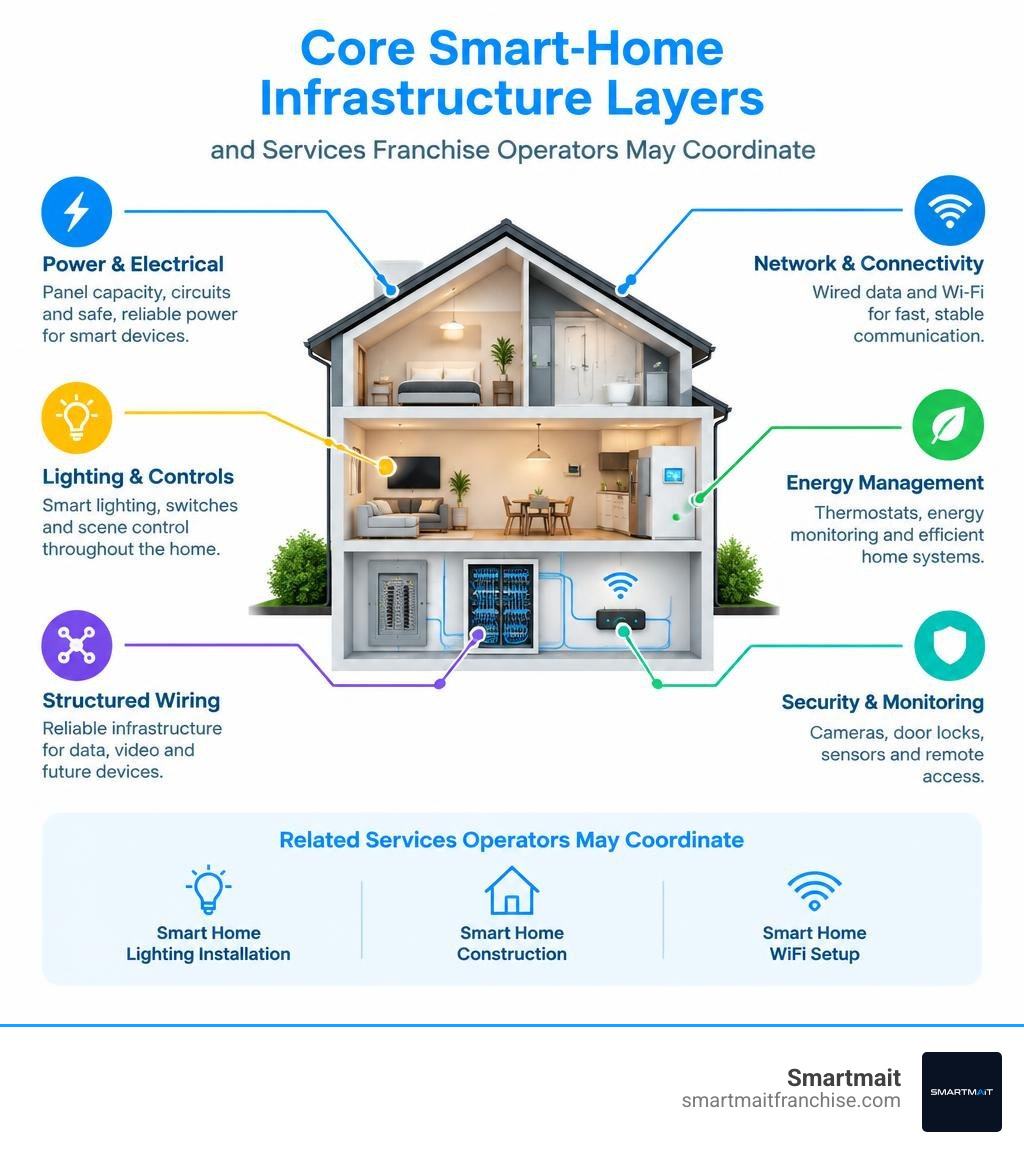
Essential smart home electrical installation terms:
Core Infrastructure and Wiring Services in a Smart-Home Franchise
For integration business owners and prospective franchisees evaluating the smart-building sector, understanding low-voltage infrastructure versus line-voltage power is critical for scoping projects accurately. A successful installation business relies on standardized scoping processes to evaluate client sites, organize technician workflows, and establish ongoing service agreements.
When scoping a project, operators encounter two distinct electrical tiers:
- Line-Voltage Systems (120V/240V AC): These supply power to primary appliances, branch circuits, outlets, and lighting loads. Line-voltage modifications—such as panel additions, new branch circuits, and line-voltage terminations—require coordination with licensed electrical subcontractors or qualified internal electricians depending on state licensing requirements.
- Low-Voltage and Communications Infrastructure (≤50V DC/AC): This encompasses the central data backbone, including structured cabling, Power over Ethernet (PoE) runs, sensor buses, and control wiring. These systems represent the primary domain of low-voltage systems integration and form the core of long-term system optimization and maintenance services.
A frequent technical hurdle in residential retrofits involves neutral-wire availability. Most modern connected light switches and smart dimmers require a dedicated neutral conductor in the switch box to maintain continuous standby power for their internal radios and microcontrollers. While properties built after the mid-1980s generally include neutral wires in switch boxes, older homes often route switch loops with only hot and switched-leg conductors. Identifying this during the initial assessment prevents scheduling delays and helps determine whether to run new cabling or deploy specialized solutions.
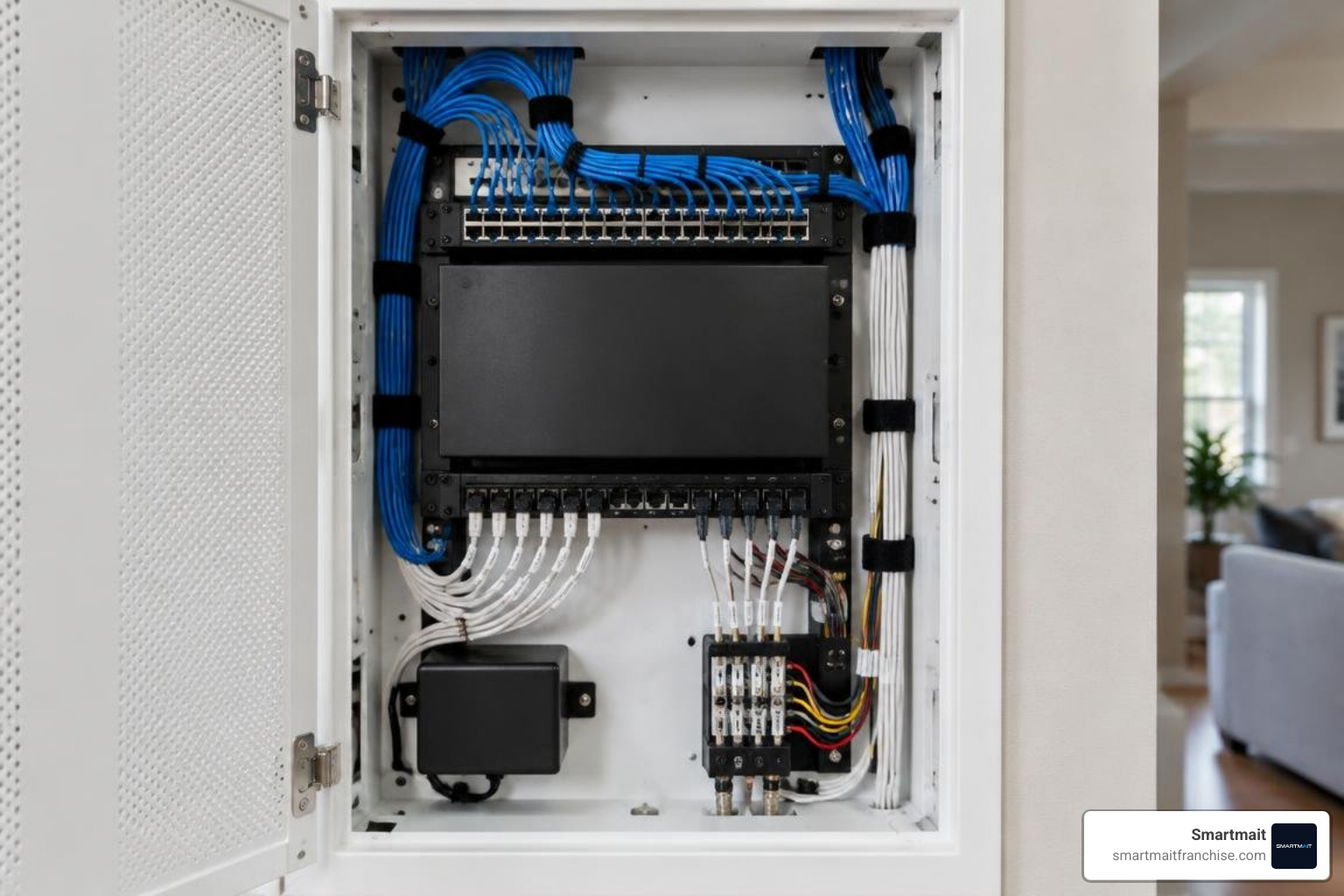
Central structured media enclosures organize these complex networks. By consolidating modems, routers, patch panels, PoE switches, network-attached storage (NAS), and smart hubs into a single ventilated, power-backed cabinet, our field technicians can cleanly troubleshoot, update, and optimize systems over time.
Cabling Categories Franchise Operators Should Recognize
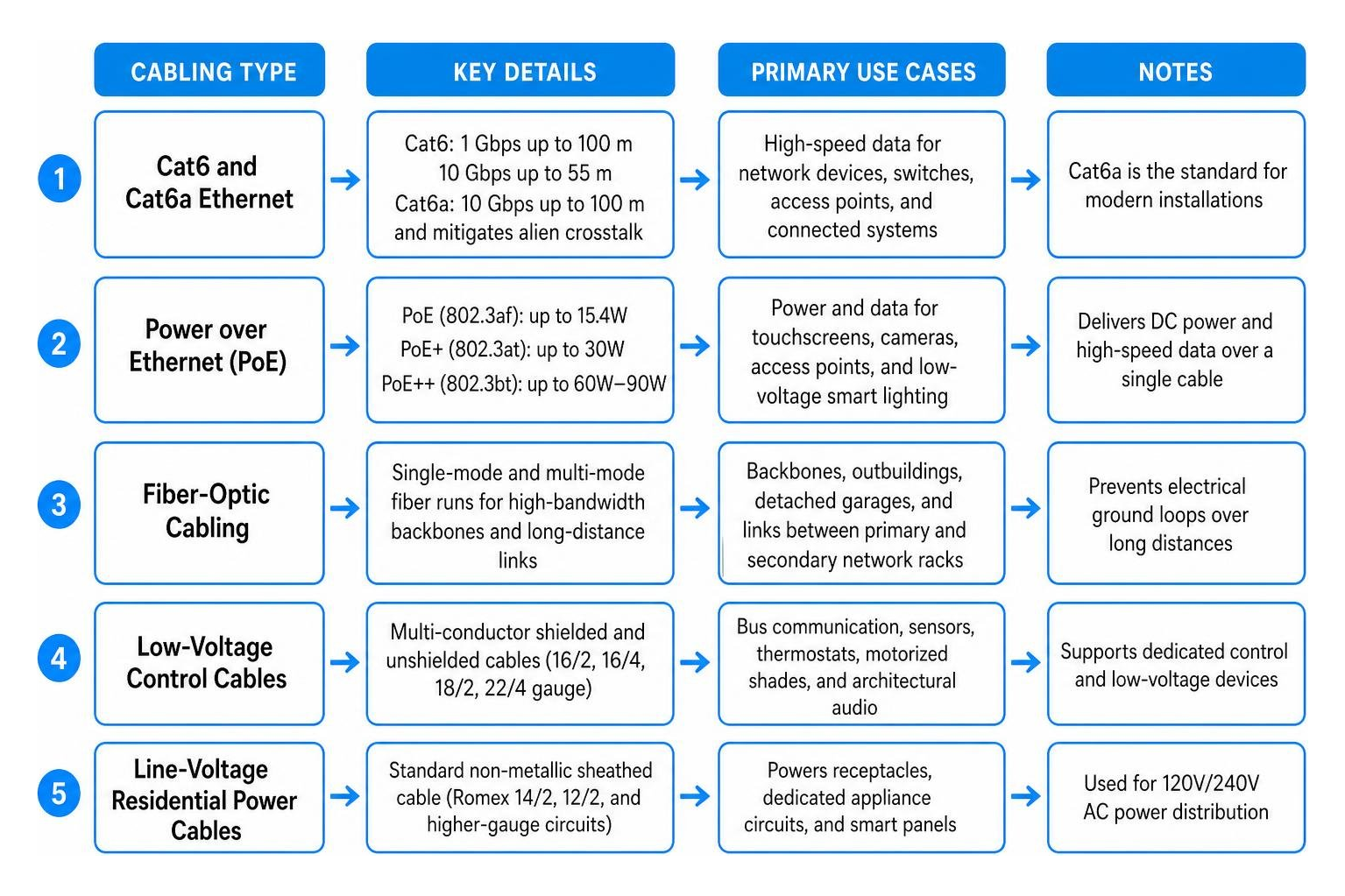
To scope projects effectively, operators must ensure their field teams recognize standard cabling categories and their specific deployment environments:
- Cat6 and Cat6a Ethernet: Cat6 supports 1 Gbps up to 100 meters and 10 Gbps up to 55 meters. Cat6a is the standard for modern installations, supporting 10 Gbps data rates across full 100-meter runs while mitigating alien crosstalk.
- Power over Ethernet (PoE) Standards: Standards ranging from standard PoE (802.3af, up to 15.4W) and PoE+ (802.3at, up to 30W) to PoE++ (802.3bt, delivering up to 60W–90W) allow single-cable delivery of high-speed data and DC power to touchscreens, pan-tilt-zoom cameras, access points, and low-voltage smart lighting fixtures.
- Fiber-Optic Cabling: Single-mode and multi-mode fiber runs are utilized for high-bandwidth backbones, outbuildings, detached garages, and links between primary and secondary network racks to prevent electrical ground loops over long distances.
- Low-Voltage Control Cables: Multi-conductor shielded and unshielded cables (such as 16/2, 16/4, 18/2, and 22/4 gauge) support dedicated bus communication, hardwired sensors, smart thermostats, motorized shades, and architectural audio.
- Line-Voltage Residential Power Cables: Standard non-metallic sheathed cable (such as Romex 14/2, 12/2, and higher-gauge circuits) powers receptacles, dedicated appliance circuits, and smart panels.
Understanding these cabling formats enables operators to design reliable client solutions that support long-term service agreements, regular network audits, and structured firmware maintenance plans.
Scoping New-Build and Retrofit Opportunities
Project scoping differs significantly between new construction and existing-home retrofits. In new builds, rough-in scheduling allows integration teams to pull structured cabling, install dedicated conduits, and set deep back-boxes before insulation and drywall are placed. Integrators can plan dedicated home runs to a central media closet, position wireless access points in ceiling locations, and pre-wire all exterior entry points.
Retrofit environments require non-invasive diagnostic techniques. Technicians must evaluate wall cavities, accessible attic spaces, crawlspaces, and existing conduit runs. When retrofitting properties where pulling new wiring through finished walls would require costly drywall repairs, operators must balance hardwired drops for bandwidth-heavy equipment with reliable wireless protocols for distributed endpoints. Mastering both environments allows a franchise operator to capture diverse residential and light-commercial territory demand.
Understanding Wired and Wireless Smart-Home Systems
Franchise operators must guide clients through the structural differences between hardwired automation architectures and wireless mesh protocols. Both approaches provide unique operational advantages depending on project scope, property age, and client budget.
| System Characteristic | Wired Bus Systems (e.g., KNX, Proprietary Bus) | Wireless Mesh Networks (Matter, Thread, Zigbee, Z-Wave) |
|---|---|---|
| Physical Infrastructure | Dedicated low-voltage bus cabling alongside line-voltage power runs. | Relies on local AC power or battery endpoints; no extra control cabling. |
| Deployment Fit | New builds, extensive architectural renovations, luxury estates. | Retrofits, modular expansions, standard residential properties. |
| System Latency | Near-zero latency with deterministic command execution. | Low latency; depends on mesh density and local hub processing. |
| Interference Risk | Immune to radio frequency (RF) congestion and structural barriers. | Susceptible to RF interference, dense masonry, and metal framing. |
| Scalability | High; scales to hundreds of addressable nodes via line couplers. | Scales via repeaters; self-healing mesh improves with device density. |
| Maintenance Profile | Centralized panel testing, hardware diagnostics, long lifespan. | Periodic battery replacements, RF mapping, and firmware updates. |
Wired bus topologies connect physical sensors, keypads, and actuators directly to central control panels over dedicated communication wiring. This delivers exceptional reliability and deterministic response times, making it a staple of high-end architectural projects.
Conversely, modern wireless standards provide rapid deployment flexibility. Wireless protocols like Zigbee and Z-Wave create self-healing meshes where mains-powered devices act as signal repeaters. Thread introduces an IP-addressable, low-power mesh architecture that operates alongside Wi-Fi to form the wireless foundation for Matter.
Matter standardizes cross-platform device commissioning across major ecosystems, eliminating closed vendor silos. By understanding how these protocols route data, operators can deliver reliable smart home integration and design managed service packages that monitor network health, resolve RF dead zones, and optimize wireless traffic.
Electrical Capacity, Dedicated Circuits, and Smart-Energy Service Opportunities
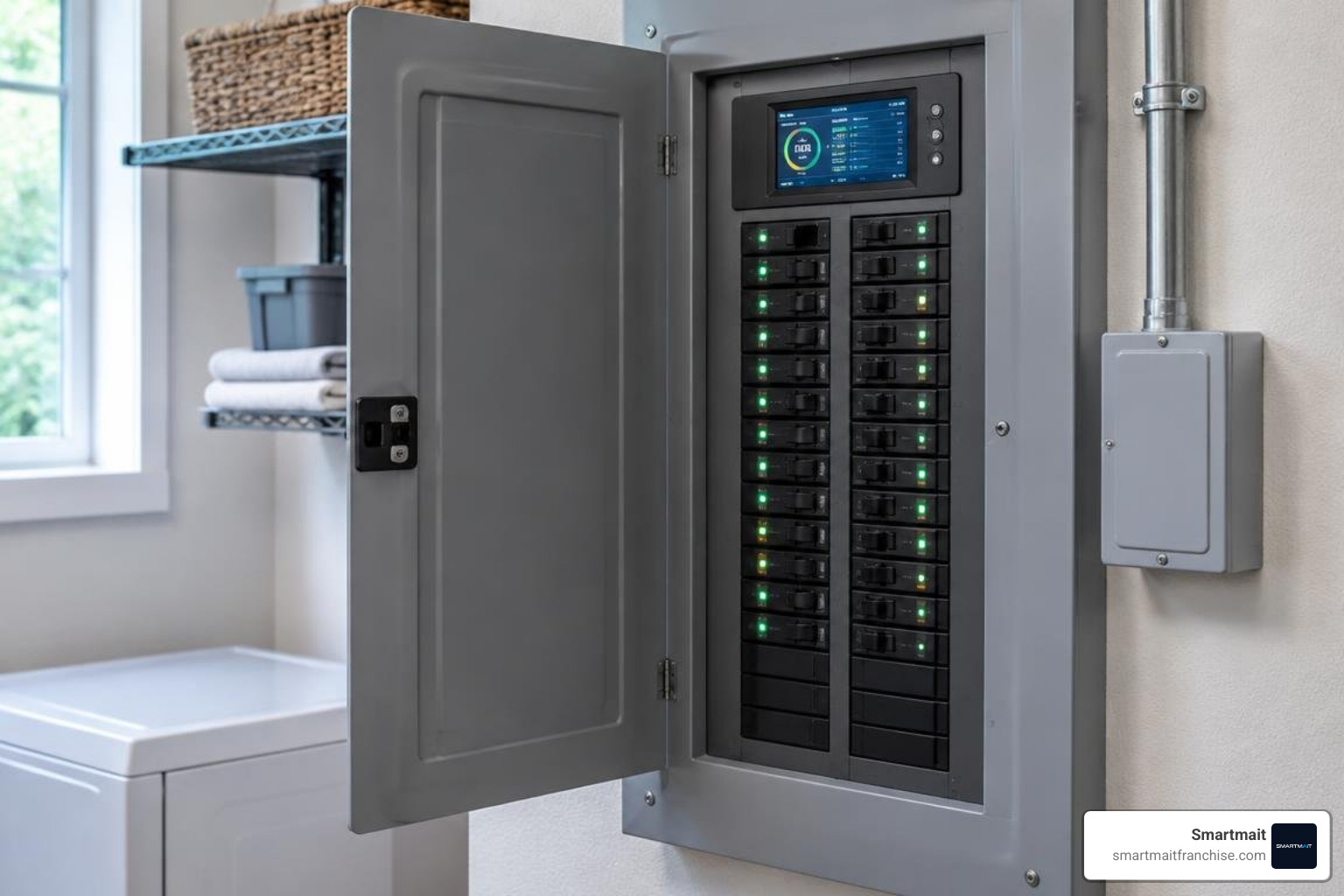
Modern residential properties are transitioning toward full electrification, creating demand for intelligent energy orchestration. Integration businesses frequently encounter properties where smart infrastructure overlaps with high-draw electrical additions, including Level 2 electric vehicle (EV) supply equipment, heat pumps, solar photovoltaic (PV) inverters, and battery storage.
A 200-amp service panel is standard for modern homes, but heavily electrified residences often require 320-amp or 400-amp service to manage simultaneous high-draw loads. When main service upgrades face utility lead times or physical constraints, smart electrical panels and dynamic load-shedding modules provide an effective alternative. These intelligent panels continuously monitor circuit-level consumption and automatically shed or throttle non-critical loads (like water heaters or EV chargers) when household demand approaches main breaker thresholds.
To ensure stability, connected homes require dedicated circuits for sensitive electronics:
- Central Network Enclosure: A dedicated 15-amp or 20-amp circuit powering the primary router, network switches, and security recording hardware, protected by an uninterruptible power supply (UPS).
- Automation Control Processors: Dedicated power to isolate central controllers from inductive motor noise generated by appliances or HVAC systems.
- Smart EV Supply Equipment: Dedicated 240V circuits configured for automated scheduling and off-peak utility rate optimization.
By offering comprehensive power audits and ongoing energy monitoring services, franchise operators turn one-time panel setups into lasting service relationships focused on system optimization and smart home power management.
Code Awareness, Surge Protection, and Safety Coordination
Operating a professional smart-home and smart-building franchise requires a thorough understanding of safety regulations and electrical codes. Integration operators must ensure their field teams maintain clear boundaries between low-voltage technical work and tasks requiring a licensed trade partner.
In the United States, installations must comply with the National Electrical Code (NEC):
- Arc-Fault Circuit-Interrupter (AFCI) and Ground-Fault Circuit-Interrupter (GFCI) Protection: NEC standards mandate AFCI protection for branch circuits supplying living areas to detect hazardous electrical arcing, along with expanded GFCI requirements for locations exposed to moisture.
- Low-Voltage and Communications Standards: NEC Article 725 governs Class 1, Class 2, and Class 3 remote-control and signaling circuits, while Article 800 governs communications circuits. Field teams must maintain required physical separation between low-voltage data cables and line-voltage conductors inside enclosures and wall cavities (typically keeping at least 2 inches of separation or running conductors across 90-degree angles) to prevent electromagnetic interference and dangerous voltage crossover.
- Whole-House Surge Protection: A single transient overvoltage event from utility grid switching or lightning can destroy sensitive connected microprocessors throughout a property. National codes mandate Type 1 or Type 2 surge protective devices (SPDs) compliant with UL 1449 at the main service panel, complemented by Type 3 point-of-use surge protection at sensitive equipment racks.
For integration operators, tracking safety compliance and industry technical requirements—such as those detailed in the National Electrical Contractors Association resources on Technology’s Impact on Electrical Codes and Standards—protects both the client’s property and the franchisee’s business reputation.
Frequently Asked Questions About Smart-Home Franchise Operations
How much wiring knowledge does a smart-home franchise operator need?
Franchise owners do not need to be master electricians to build a successful integration business. Operators need a clear conceptual understanding of system architectures, low-voltage cabling types, and project scoping rules so they can quote work accurately, manage technician teams, and coordinate with licensed electrical subcontractors when high-voltage modifications arise. Franchise training programs bridge technical gaps by providing structured field manuals, standard operating procedures, and ongoing operational support for complex integration challenges.
What kinds of projects can create recurring service opportunities?
System deployments create natural pathways to ongoing service and maintenance agreements. High-value recurring revenue services include:
- Managed network monitoring, remote device reboots, and automated bandwidth optimization.
- Proactive firmware updates, Matter ecosystem patch management, and cybersecurity audits.
- Smart energy management monitoring, load-shedding calibration, and seasonal automation adjustments.
- Routine battery replacement cycles, camera lens cleaning, sensor recalibration, and physical rack maintenance.
These service-membership programs improve customer retention, smooth out seasonal revenue fluctuations, and transition an integration company from a volatile project-to-project cycle into a predictable service business.
Can an existing integration or home-service business convert to a franchise model?
Independent integration businesses and home-service contractors frequently face operational hurdles, including owner-dependent workflows, technician recruitment challenges, and inconsistent project pipelines. Converting an established business to a franchise model allows owners to implement standardized operating software, take advantage of national brand equity, access enterprise training platforms, and implement proven client retention frameworks. This structured approach helps owners scale their field teams, transition out of daily field work, and build long-term enterprise value across exclusive operating territories.
Conclusion
Understanding smart-home electrical infrastructure and low-voltage cabling is essential for building a thriving, professional integration business. As connected environments become more sophisticated, clients require experienced teams that can plan, execute, and maintain their systems over the long term.
Smartmait offers prospective franchise owners and converting independent operators a proven path to scale in the growing U.S. smart-building and integration market. By combining professional installation standards with recurring service agreements, our franchise model helps business owners build stable operations that deliver lasting value to clients.
Ready to take the next step in business ownership? Explore smart home franchise and integration opportunities to connect with our franchise development team and request your comprehensive franchise information package today.