

How to Read Smart Home Franchise Financial Projections
To assess smart home franchise financial projections, start with the cash needed to open and operate until sales cover costs. Then forecast equipment sales, installation revenue, and ongoing maintenance income separately. Subtract labor, materials, overhead, royalties, and marketing fees to see when the unit may break even and whether it can earn a return on the full investment.
For a territory buyer or an integration business considering conversion, the key test is whether those numbers still work if sales grow more slowly than planned. A five-year forecast should show both that slower case and a stronger one, with assumptions tied to the local market. The U.S. Bureau of Labor Statistics provides useful context on employment and wage trends in electrical and electronics installation trades, which can help operators think through labor assumptions in their local territory.
I’m Dominic Hesano. My work in franchise development, sales, and local service operations informs how I approach smart home franchise financial projections, including the role of ongoing service in building repeat revenue.
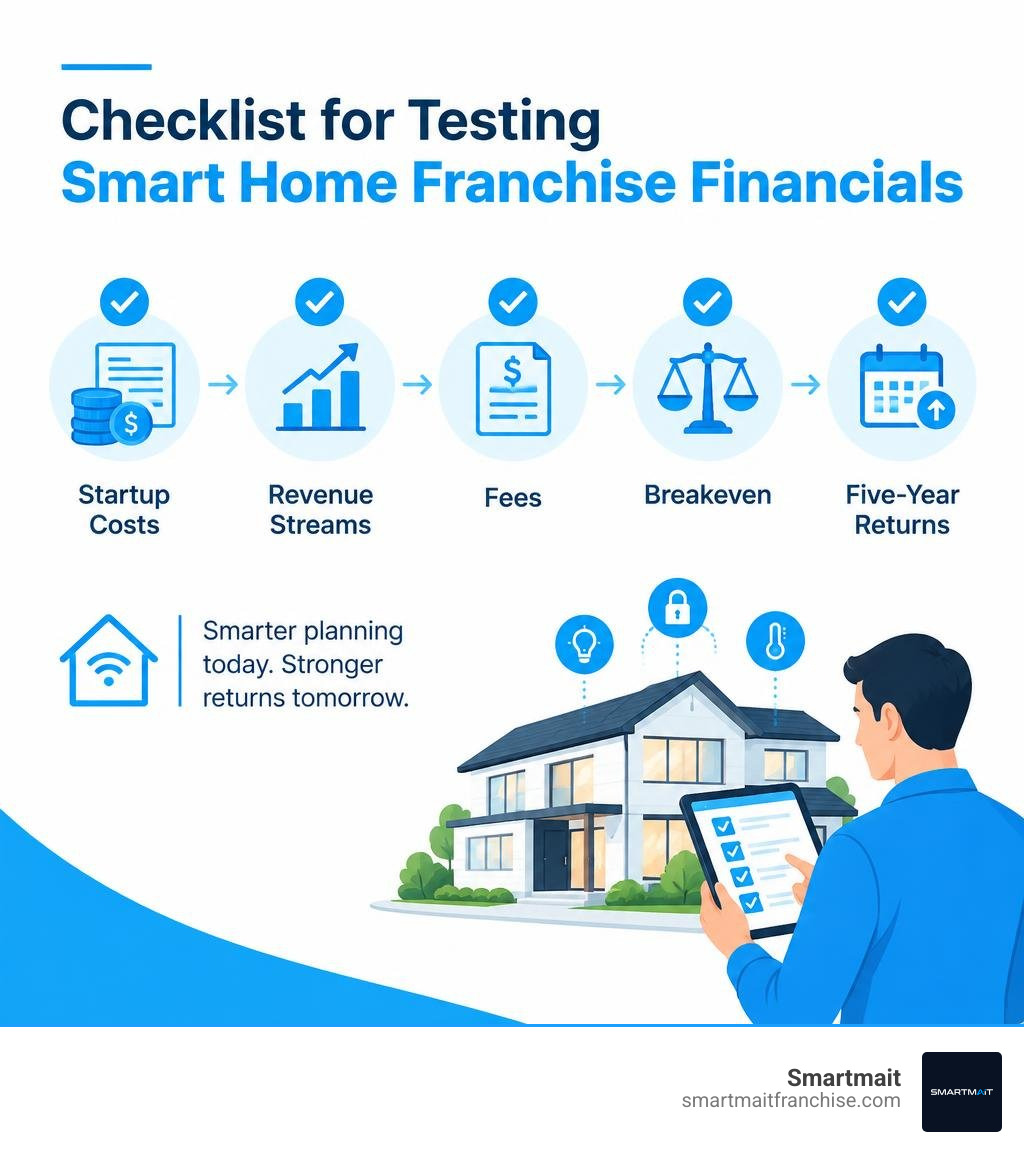
Quick look at smart home franchise financial projections:
- smart home franchise opportunity
- smart home franchise network
- smart home franchise exclusive territory
Core Components of Smart Home Franchise Financial Projections
Building an accurate operational forecast begins with understanding how capital flows into and out of an integration business. When prospective franchisees evaluate an opportunity, they often look solely at top-line equipment sales. However, true long-term enterprise value depends on how effectively you allocate startup capital, control overhead, and scale high-margin services.
Evaluating overall smart home franchise investment viability requires categorizing your budget into distinct capital buckets: initial franchise fees, facility or showroom buildouts, vehicle fleet outfitting, specialized low-voltage tooling, initial inventory, and working capital reserves.
| Capital Allocation Category | Primary Purpose | Impact on Breakeven |
|---|---|---|
| Initial Franchise Fee | Secures exclusive territory rights, onboarding, brand systems, and initial training | Upfront sunk cost; amortized over the franchise term |
| Facility & Leasehold Upgrades | Builds out the interactive design center, testing lab, and inventory staging area | Fixed upfront expense; drives showroom conversion rates |
| Fleet & Tooling Packages | Outfits mobile service vans, diagnostic meters, and low-voltage rigging gear | Direct operational necessity; dictates field technician efficiency |
| Inventory & Equipment Staging | Secures essential automation controllers, panels, networking hubs, and wiring | Working asset; requires disciplined cash flow management |
| Operational Working Capital | Covers technician payroll, facility lease, and marketing during the initial ramp | Protects cash runway until operational breakeven is reached |
Analyzing Startup Costs and Initial Capital Requirements
Every new territory launch demands a clear picture of liquidity. Beyond the initial franchise fee, which grants access to proprietary systems and brand power, capital outlays center on equipping your team for field execution.
A functional interactive design center or showroom allows prospective residential and commercial clients to experience automated environments firsthand. Outfitting this space alongside dedicated staging shelves ensures you can test equipment before bringing it to a customer site.
On the operational side, mobile service vehicles must be outfitted with specialized low-voltage termination tools, safety equipment, and secure storage racks. Maintaining a healthy working capital reserve is vital because it cushions payroll and overhead while your project pipeline matures.
Forecasting Recurring Revenue and High-Margin Service Mix
A common pitfall in independent contracting is relying entirely on one-off installations. When project installations slow down, cash flow dips. A resilient franchise model counters this by integrating steady service contracts, network monitoring, proactive maintenance agreements, and system optimization visits.
By examining the practical smart home service categories available to operators, franchisees can structure recurring revenue tiers. These recurring touchpoints create a predictable baseline of monthly cash flow, significantly reducing reliance on new construction starts and smoothing out seasonal fluctuations.
Key Unit Economics and Margin Drivers to Model
Understanding store-level unit economics helps you evaluate how day-to-day installation work translates into operational earnings. Tracking key metrics allows franchise operators to spot inefficiencies in field labor or lead generation before they affect the bottom line.
Evaluating Royalties, Marketing Fees, and Store-Level EBITDA
Franchise models incorporate ongoing brand support through structured royalty fees and centralized marketing fund contributions. When modeling your numbers, incorporate these fees directly into your cost of goods sold and operating expenses.
- Gross Margins: Generated by balancing equipment procurement discounts with structured billable labor rates.
- Brand and Marketing Fund: Centralized lead generation campaigns, national brand assets, and digital search marketing reduce the local cost of customer acquisition.
- Operating Expenses: Fixed overhead, facility leases, insurance, vehicle upkeep, and administrative staff.
- Store-Level EBITDA Yield: Operational earnings remaining after all direct job costs, franchise royalties, and fixed local overhead are accounted for.
By leveraging brand-negotiated vendor pricing and standardized operational playbooks, a franchise unit aims to offset ongoing royalty contributions through enhanced purchasing power and elevated field efficiency.
Critical Unit Economics Behind Smart Home Franchise Financial Projections
To accurately map growth, prospective owners must track several core metrics:
- Customer Acquisition Cost (CAC) to Lifetime Value (LTV): A healthy installation business keeps acquisition costs low relative to long-term client spend, driven by ongoing support packages and system expansions.
- Average Transaction Value (ATV): Tracking the blended revenue of whole-home automation packages, light-commercial deployments, and retrofits.
- Billable Efficiency Rate: Maximizing the percentage of technician hours billed directly to installations and service calls versus non-billable drive time.
- Recurring Service Attachment Rate: The percentage of installation clients who enroll in ongoing system health monitoring, routine recalibration, and remote troubleshooting plans, such as those modeled in commercial security installation returns.
Building a 5-Year Revenue Forecast and Breakeven Model
A five-year forecast acts as an operational roadmap. It outlines how your business transitions from an initial single-van launch into an organized, multi-crew operation supported by recurring maintenance retainers.
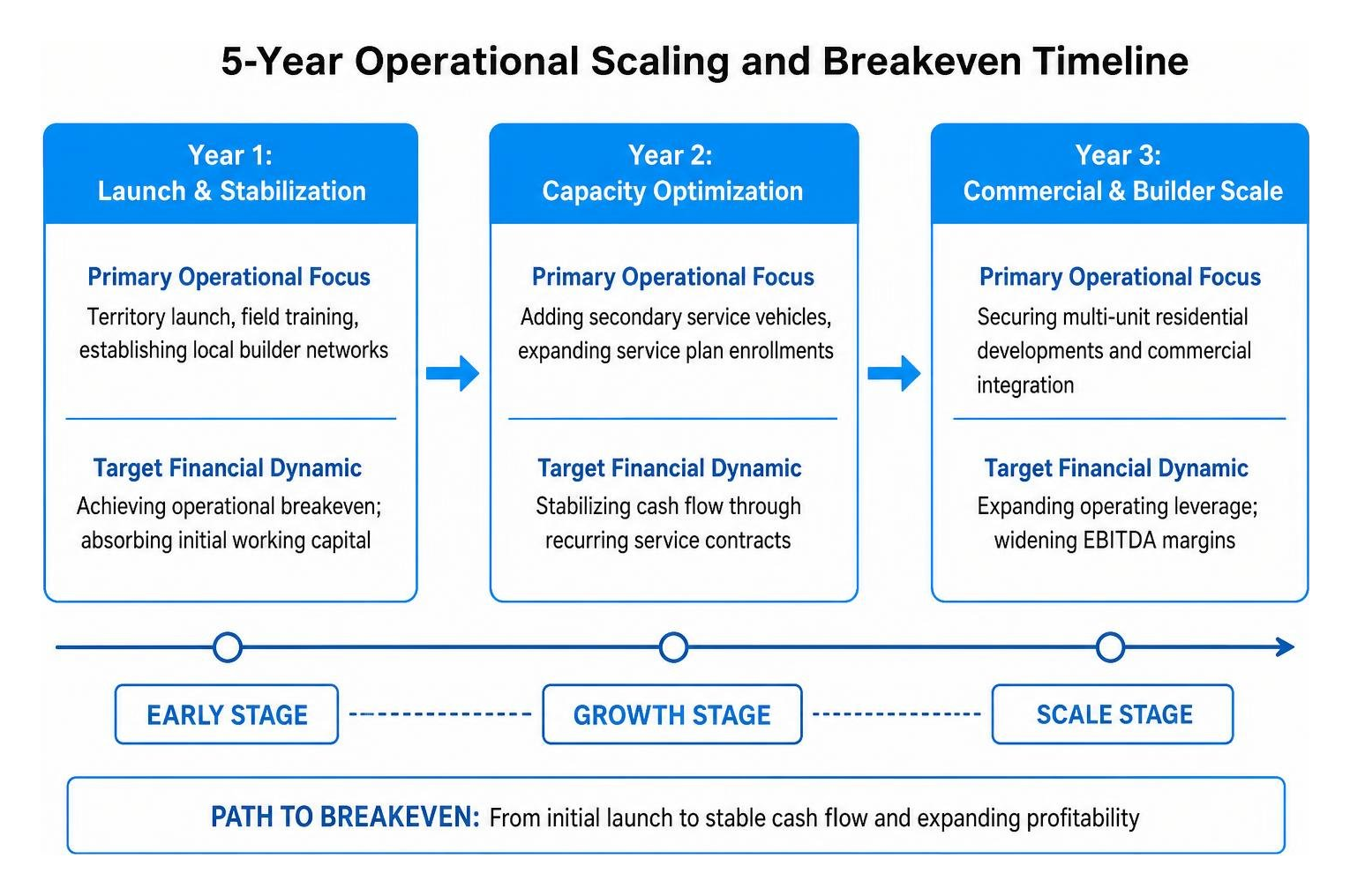
| Growth Milestone | Primary Operational Focus | Target Financial Dynamic |
|---|---|---|
| Year 1: Launch & Stabilization | Territory launch, field training, establishing local builder networks | Achieving operational breakeven; absorbing initial working capital |
| Year 2: Capacity Optimization | Adding secondary service vehicles, expanding service plan enrollments | Stabilizing cash flow through recurring service contracts |
| Year 3: Commercial & Builder Scale | Securing multi-unit residential developments and commercial integration | Expanding operating leverage; widening EBITDA margins |
| Year 4: Multi-Crew Maturity | Field supervisor leadership, dedicated maintenance and dispatch units | Maximizing technician utilization and billable efficiency |
| Year 5: Enterprise Valuation | Territory saturation, fleet optimization, high recurring client base | Substantial recurring baseline; strong exit or succession value |
Benchmarks for Year 1 Targets and Breakeven Timelines
During the first operating year, the primary objective is reaching operational breakeven—the point where monthly gross profit completely covers monthly overhead, payroll, and brand fees. Reaching this milestone efficiently requires rapid customer onboarding, strict scheduling discipline, and fast conversion of installation leads into active jobs.
Developing 5-Year Smart Home Franchise Financial Projections for Growth
As the business scales toward Year 5, top-line expansion is driven by adding service vans, deepening builder relationships, and compounding recurring memberships. Establishing consistent homebuilder automation partnerships creates a predictable flow of pre-wire and rough-in installations, while the residential retrofit market delivers higher immediate margins on hardware and custom programming.
Territory Sizing, Seasonality, and Risk Sensitivity Analysis
No financial model is complete without stress-testing assumptions against territory demographics, housing market shifts, and seasonal weather patterns.
Modeling Seasonal Demand and Market Cycles
Smart home installations often peak alongside seasonal real estate activity and new construction cycles in spring and summer. Conversely, winter months can see a deceleration in heavy construction rough-ins.
Franchisees hedge against these seasonal swings by pushing indoor retrofits, system upgrades, commercial facility optimization, and annual maintenance visits during traditionally slower months. The recurring revenue from proactive service memberships provides cash flow stability regardless of construction seasonality.
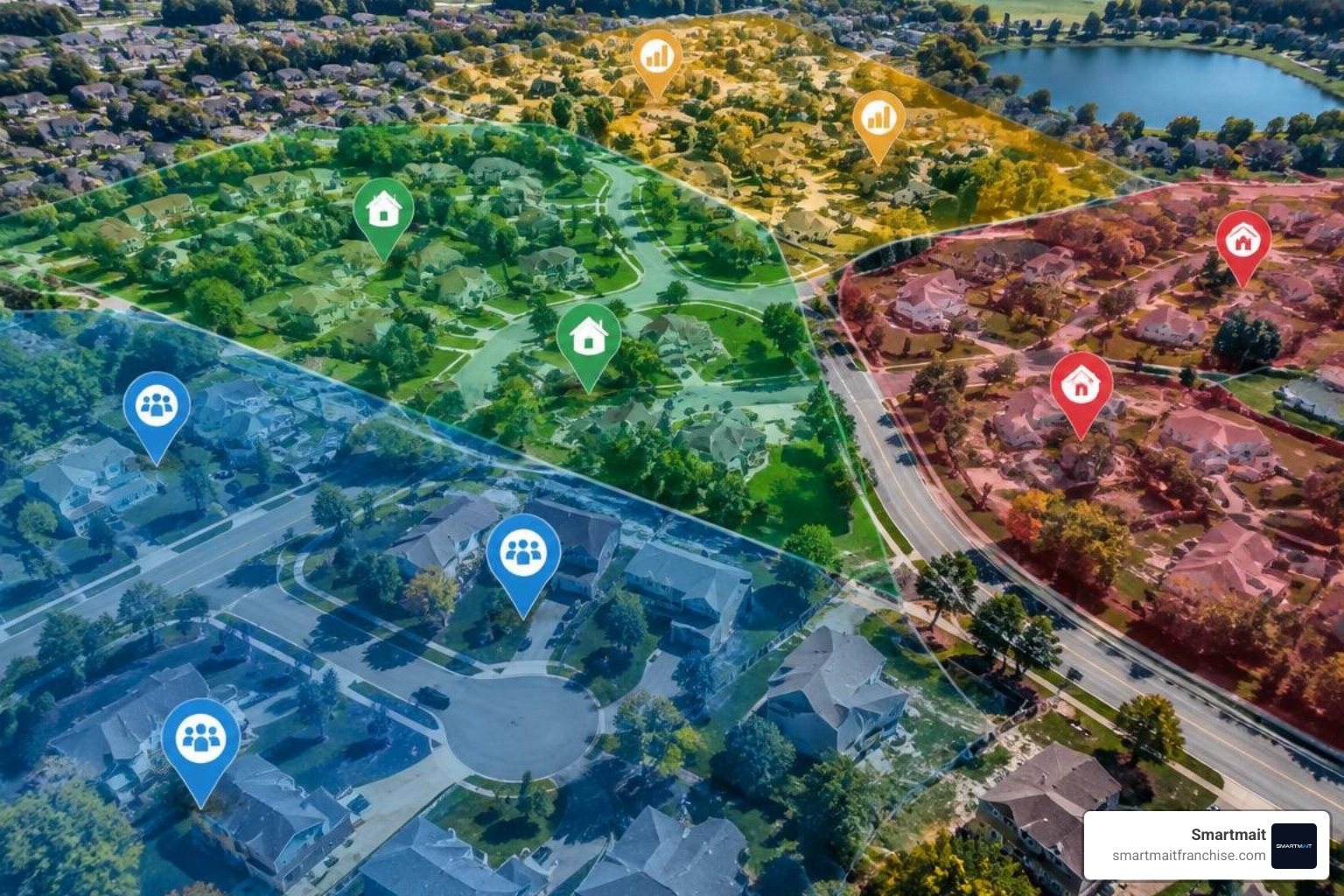
Adjusting Projections for Territory Scale and Local Demographics
The performance potential of an exclusive territory relies heavily on local demographic indicators:
- Affluent Household Density: Higher concentrations of discretionary income accelerate adoption of whole-home automation, smart lighting, and architectural audio.
- Active Housing Starts: A steady volume of single-family and multi-family residential construction fuels continuous low-voltage rough-in opportunities.
- Commercial & Office Density: Mixed-use developments, corporate boardrooms, and boutique retail spaces diversify revenue away from pure residential reliance.
- Conversion Advantages: Independent low-voltage contractors converting their existing enterprise to a franchise model can rapidly scale projections by plugging established client lists into structured recurring maintenance packages within their exclusive territory rights.
Frequently Asked Questions About Smart Home Franchise Financial Projections
What is the typical timeline to breakeven for a smart home franchise?
Operational breakeven depends on initial capital allocation, technician hiring speed, and local market sales execution. Operators who aggressively establish builder referral networks and prioritize recurring service attachments work to cover fixed monthly overhead as quickly as possible, preserving working capital for growth.
How much working capital is required beyond the initial franchise fee?
Working capital requirements vary based on facility choices, vehicle acquisition strategies, and local labor costs. Maintaining sufficient liquid reserves ensures uninterrupted payroll coverage, tool procurement, and marketing momentum while trade receivables and project milestone payments clear.
What EBITDA margins can a high-performing smart home franchise achieve?
Store-level EBITDA margins in low-voltage and smart building franchises are heavily dictated by service mix. Units with a high ratio of recurring service agreements, remote support contracts, and optimized field technician routing typically realize stronger operating margins than businesses reliant solely on competitive, one-time hardware bids.
Conclusion
Analyzing financial models provides the clarity needed to make an informed investment decision. Whether you are an entrepreneur looking to enter the smart building industry or an experienced low-voltage contractor seeking to scale beyond owner-dependence, evaluating your capital requirements, recurring revenue mix, and unit economics is the foundation of long-term success.
At Smartmait, we help franchise partners build scalable smart-home and smart-building integration businesses backed by proven systems, structured recurring maintenance frameworks, and comprehensive operational training.
If you are ready to evaluate territory opportunities and explore how our platform can support your business goals, visit the Smartmait Franchise Opportunity page and request our franchise information package today.