

Why a Smart Home Franchise Exclusive Territory Can Make or Break Your Business
A smart home franchise exclusive territory gives you the legal right to be the only franchisee of a brand operating in a defined geographic area. Here is a quick overview of what that means and why it matters:
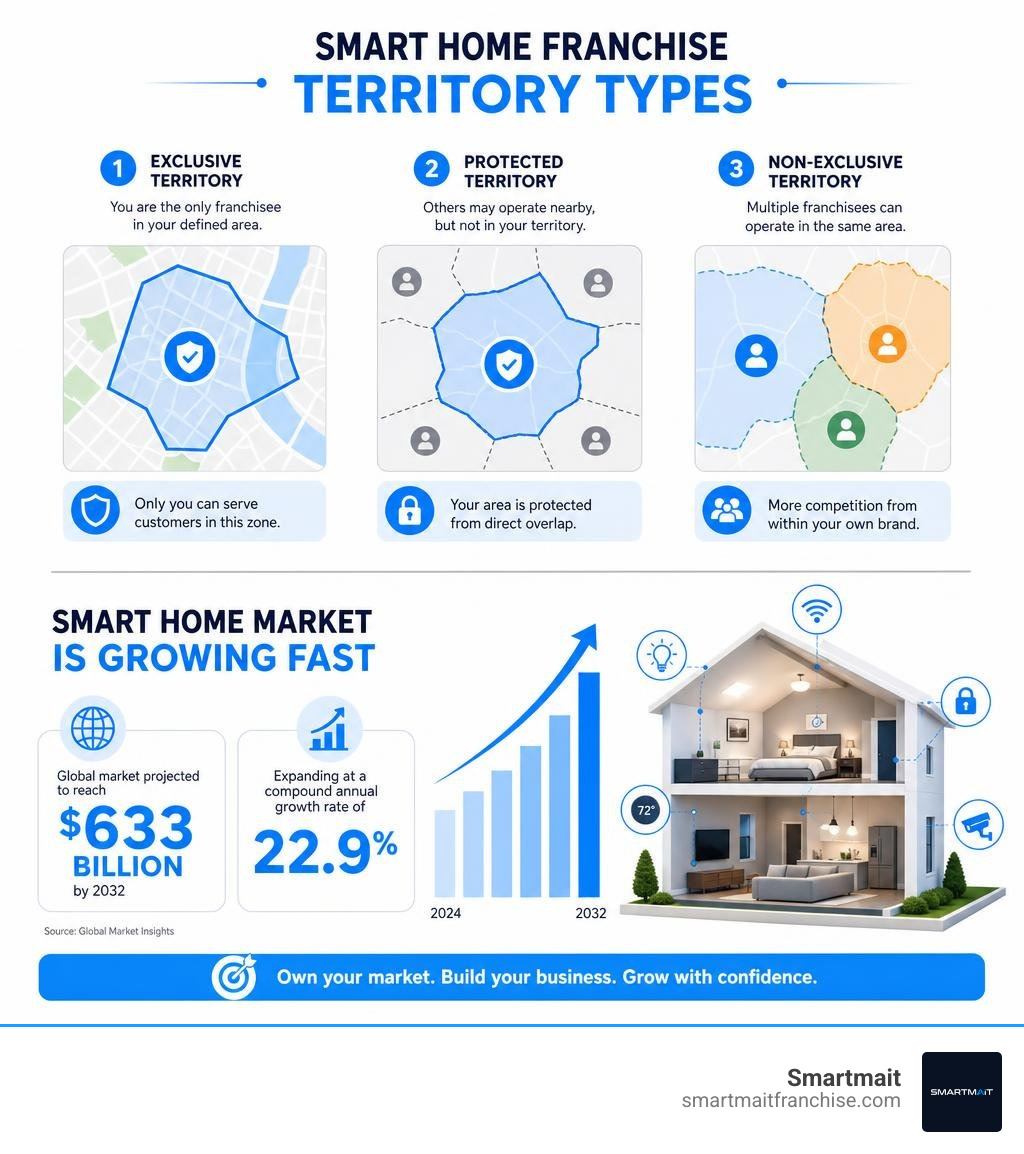
- Exclusive territory — Only you can serve customers in that zone. No other franchisee from the same brand can compete there.
- Protected territory — Similar, but the franchisor may allow nearby franchisees as long as they do not directly overlap.
- Non-exclusive territory — Multiple franchisees can operate in the same area, which creates internal competition.
The smart home industry is growing fast. The global market is projected to reach $633 billion by 2032, expanding at a compound annual growth rate of 22.9%. That kind of growth attracts investors — and with more franchisees entering the market every year, where you operate and whether your territory is protected matters more than ever.
Without a clearly defined exclusive territory, you risk losing customers to a franchisee from your own brand. With one, you own your market and can build a real, scalable business.
I’m Dominic Hesano, a franchise development professional building Smartmait — a smart home and automation franchise designed around the principle that franchisees deserve a real, protected stake in their local market, including a smart home franchise exclusive territory that supports long-term growth. My background in franchising, local service operations, and smart technology gives me a practical view of what separates a franchise investment that builds equity from one that simply creates competition within its own network.
Understanding the Smart Home Franchise Exclusive Territory
When you invest in a franchise, you are not just buying a brand name and a set of operational manuals; you are purchasing a market opportunity. In the home services and technology integration sectors, your geographic boundary defines your business’s ceiling. A smart home franchise exclusive territory is the foundational asset that ensures your hard work, local marketing, and customer relationships belong entirely to you.
Exclusive vs. Protected vs. Non-Exclusive Territories
To make an informed investment, you must understand how franchisors define geographic boundaries. These terms are often used interchangeably in casual conversations, but they have vastly different legal and operational meanings in a Franchise Disclosure Document (FDD).
| Territory Type | Level of Protection | Can Other Franchisees Open a Location Here? | Can Other Franchisees Advertise Here? |
|---|---|---|---|
| Exclusive Territory | Absolute — The franchisor guarantees that no other franchise or corporate location will be established within your boundaries. | No | No (Direct marketing is restricted to your own zone) |
| Protected Territory | Conditional — The franchisor will not place another physical unit in your zone, but may reserve the right to deliver services through alternative channels (e.g., national accounts, online sales). | No | Sometimes (Depending on cross-boundary marketing rules) |
| Non-Exclusive Territory | None — The market is open. Multiple franchisees can operate, market, and establish bases of operation in the same city or ZIP codes. | Yes | Yes |
In the smart home industry, where services are delivered directly inside the customer’s home, a non-exclusive model can quickly lead to operational chaos. If three different technicians from the same brand are driving wrapped vans down the same residential street to bid on the same home automation project, the brand loses credibility, and the franchisees lose margin.
Risks of Operating Without a Smart Home Franchise Exclusive Territory
Operating a mobile, tech-heavy business without territory protection is like building a house on a foundation of sand. Here are the primary risks you face:
- Internal Price Wars: If another franchisee can bid on jobs in your neighborhood, you will inevitably end up competing on price rather than value. This drives down your profitability and devalues the brand as a whole.
- Wasted Advertising Spend: Imagine spending thousands of dollars on local Google Ads or direct mail campaigns, only for a neighboring franchisee to reap the benefits because they happened to answer a lead first. Without clear boundaries, localized marketing becomes highly inefficient.
- Customer Confusion: Customers expect a seamless, professional experience. If they receive conflicting quotes or different service standards from two different operators representing the same brand, it damages trust.
- Market Saturation: Without territory limits, a franchisor could theoretically sell as many licenses as possible in a single metropolitan area to maximize their upfront franchise fee revenue, leaving individual owners with customer bases too small to sustain a business.
Why Territory Exclusivity is Critical in the Growing Smart Home Market
The smart home sector is undergoing a massive shift. What was once a luxury playground for early adopters is now a mainstream consumer expectation. From automated lighting and climate control to integrated security and energy management, homeowners want connected systems that work seamlessly.
Because we are in the middle of this rapid expansion, claiming your geographic market early is a massive competitive advantage.

Preventing Internal Competition and Fostering System Stability
A healthy franchise system relies on collaboration, not internal combat. When franchisees have exclusive territories, they stop viewing their peers as competitors and start viewing them as allies.
For example, in a system with exclusive territories, if a franchisee in a neighboring city receives a lead from a commercial client with properties in your zone, they will naturally refer that business to you. This cooperative network strengthens the brand’s national footprint. It also allows for shared learning, joint regional marketing initiatives, and operational harmony. You can focus 100% of your energy on defeating independent local competitors rather than worrying about friendly fire from within your own network.
Enhancing Franchisee Satisfaction and Long-Term Resale Value
Your franchise is not just a job; it is an asset you are building to sell one day. When a prospective buyer looks at your smart home business, they want to see predictable cash flow, a loyal customer base, and protected room to grow.
An exclusive territory acts as a protective moat around your business equity. When it comes time to exit, a buyer will pay a premium for a business that owns the exclusive rights to a high-income, high-growth market. If your territory is non-exclusive, a buyer knows that a competitor could set up shop next door the day after the sale closes, instantly slashing the value of their acquisition.
Key Factors That Determine Territory Size and Boundaries
Franchisors do not simply draw random circles on a map. Territory mapping is a data-driven science designed to ensure each territory contains enough qualified customers to support a highly profitable business.
Demographic Data and Household Density
Smart home technology is highly correlated with specific demographic markers. When mapping out territories, we analyze several key metrics to ensure viability:
- Dwelling Counts: A standard home services territory typically requires a minimum number of residential dwellings. While some home improvement brands look for 35,000 households, premium service models often target designated market areas containing between 50,000 and 80,000 dwellings.
- Household Income: Smart home systems, custom installations, and ongoing maintenance packages require disposable income. We map territories to include a high concentration of households meeting or exceeding median income thresholds.
- Homeownership Rates: Owner-occupied homes are far more likely to invest in permanent smart home integrations (like automated lighting, smart power panels, and climate control) than rental properties.
Drive-Time Mapping and Service Logistics for Integrators
A common mistake in territory design is using a simple radius (e.g., “a 10-mile circle around a central point”). A 10-mile radius in a rural area takes 12 minutes to traverse; in a congested metropolitan area, it could take an hour and a half.
For professional Integrators, drive-time mapping is the gold standard. We design territories based on actual travel times and local traffic patterns. This logistical planning ensures that your service vans spend more time on-site installing systems and less time stuck in traffic wasting fuel. Efficient routing directly impacts your bottom line, allowing your technicians to complete more service calls per day and keeping your labor costs optimized.
How Exclusivity Drives Marketing, Scaling, and Recurring Revenue
An exclusive territory does not just protect you from competition; it completely changes how you market your business and build long-term wealth.

Targeted Local Marketing and Customer Acquisition
When you own a smart home franchise exclusive territory, every dollar you invest in local marketing stays in your ecosystem. You can confidently build relationships with local home builders, interior designers, and real estate agents, knowing that any leads generated from those professional networks belong entirely to you.
Localized SEO also becomes incredibly powerful. You can optimize your digital presence for the exact cities, neighborhoods, and ZIP codes within your boundaries. You do not have to worry about bidding against other franchisees for the same local search keywords, which keeps your customer acquisition costs low and your marketing ROI high.
Building Recurring Revenue in a Home-Based Smart Home Franchise Exclusive Territory
The traditional smart home installation model has a major flaw: a technician installs a system, collects a one-time check, and leaves. If the system stops working or needs an update, the customer is left frustrated, and the business has to constantly hunt for new clients to survive.
At Smartmait, we solved this by bridging tech installation with ongoing, proactive maintenance. Our franchise model is built around service memberships that provide clients with regular system check-ups, remote troubleshooting, and software updates.
This model is incredibly powerful within an exclusive territory. Because you own the geographic market, every installation you perform is an opportunity to secure a lifetime customer. Over time, these recurring service memberships build a predictable, monthly recurring revenue stream that covers your overhead and ensures business stability. For more insights on how to keep your clients engaged over the long haul, check out our guide on Smart Home Customer Retention Strategies That Actually Work.
Legal Protections and FDD Requirements for Franchise Territories
Before you sign any franchise agreement, you must verify that the verbal promises made during the sales process are legally backed up in writing. This is where the Franchise Disclosure Document (FDD) comes into play.
Demystifying Item 12 of the Franchise Disclosure Document (FDD)
Item 12 is the specific section of the FDD dedicated to territories. It is one of the most heavily scrutinized sections by franchise attorneys and state regulators. Under the FTC Franchise Rule, the franchisor must explicitly disclose:
- Whether the territory is exclusive or non-exclusive.
- The exact geographic boundaries (defined by ZIP codes, county lines, streets, or municipal borders).
- Whether the franchisor retains the right to sell products or services within your territory through alternative channels (such as e-commerce, national retail partnerships, or direct corporate sales).
- The conditions under which your territory rights could be modified or revoked (e.g., failing to meet minimum sales quotas).
- Whether you have a right of first refusal for adjacent territories that become available.
If a franchisor claims to offer an “exclusive” territory, but Item 12 contains clauses allowing them to sell directly to consumers in your area via their website without compensating you, then your territory is not truly exclusive. Always read the fine print.
Essential Questions to Ask Before Signing a Franchise Agreement
To perform proper due diligence, you should interview current franchisees and ask the franchisor highly specific questions about territory management. Here are a few critical questions to get you started:
- How are territory boundaries calculated and updated as ZIP codes grow or split?
- What is the dispute resolution process if another franchisee accidentally services a client inside my territory?
- Are there minimum performance quotas I must meet to maintain my exclusive territory rights?
- Can I purchase adjacent territories at a discount if I want to scale my business in the future?
- How does the brand handle commercial or national accounts that have locations spanning multiple territories?
If you want to discuss how we map out our markets and protect our franchise partners, you can always reach out and Contact a franchise advisor directly.
Frequently Asked Questions about Smart Home Territories
What is the average size of a smart home franchise territory?
Territory sizes vary depending on the business model. In the home services space, a protected territory typically starts at a minimum of 35,000 households. For premium smart home integration models, territories are often mapped using Designated Market Areas (DMAs) containing between 50,000 and 80,000 residential dwellings. This size ensures a deep pool of middle-to-high-income homeowners to support both your initial installation business and your long-term recurring maintenance memberships.
Can a franchisor sell products online inside my exclusive territory?
This depends entirely on the language in Item 12 of the FDD. Some franchisors reserve the right to sell hardware or DIY smart home kits directly to consumers online. However, because professional smart home systems require expert physical installation, programming, and ongoing service, online sales rarely compete directly with your core on-site integration services. A supportive franchisor will often route local installation leads generated from their corporate website directly to the franchisee who owns that territory.
How do home-based smart home franchises handle territory mapping?
Home-based models—like Smartmait—are highly efficient because they do not require expensive retail storefronts or warehouses to start. Franchisees can operate out of a home office with a small, secure storage space for inventory and a wrapped service vehicle. Because the business is mobile, territory mapping focuses entirely on service delivery zones. You get the benefit of a massive, exclusive territory with extremely low overhead, allowing you to scale your fleet of technicians as your customer base grows.
Conclusion
Investing in a smart home franchise is an incredible opportunity to enter a booming, high-margin industry. However, your technical skills and work ethic will only take you so far if you are constantly fighting internal competition or operating in an unprotected market.
A smart home franchise exclusive territory is the single most important legal protection you can secure as a business owner. It gives you the peace of mind to invest in local marketing, build lasting community relationships, and establish a highly valuable recurring revenue stream through service memberships.
At Smartmait, we are committed to the long-term success of our franchise partners. We combine a low-overhead, home-based business model with robust training, proprietary tools, and—most importantly—clearly defined, exclusive territories designed for maximum scalability.
If you are ready to take control of your financial future and own the smart home market in your city, Explore Smartmait Franchise Opportunities today.