

Why Most Homeowners Are One Missed Repair Away From a Costly Disaster
Hiring a home maintenance company is one of the smartest decisions a homeowner can make — especially if you want to stop reacting to problems and start preventing them.
Here’s what a home maintenance company typically does for you:
| Service Type | What’s Included |
|---|---|
| Preventive Maintenance | Seasonal inspections, filter changes, dryer vent cleaning |
| Routine Handyman Work | Repairs, installations, paint touch-ups, plumbing fixtures |
| Emergency Response | Same-day or priority service for urgent issues |
| Smart Home Support | Sensor setup, automation, security, and connected device care |
| Specialized Services | Aging-in-place modifications, commercial property upkeep |
The numbers tell a hard story. Homeowners spend up to $6,000 per year on repairs and maintenance — and that number nearly doubled in just one year. Meanwhile, 68% of homeowners say they feel overwhelmed by home upkeep, and 65% report struggling to find a repair professional they can actually trust.
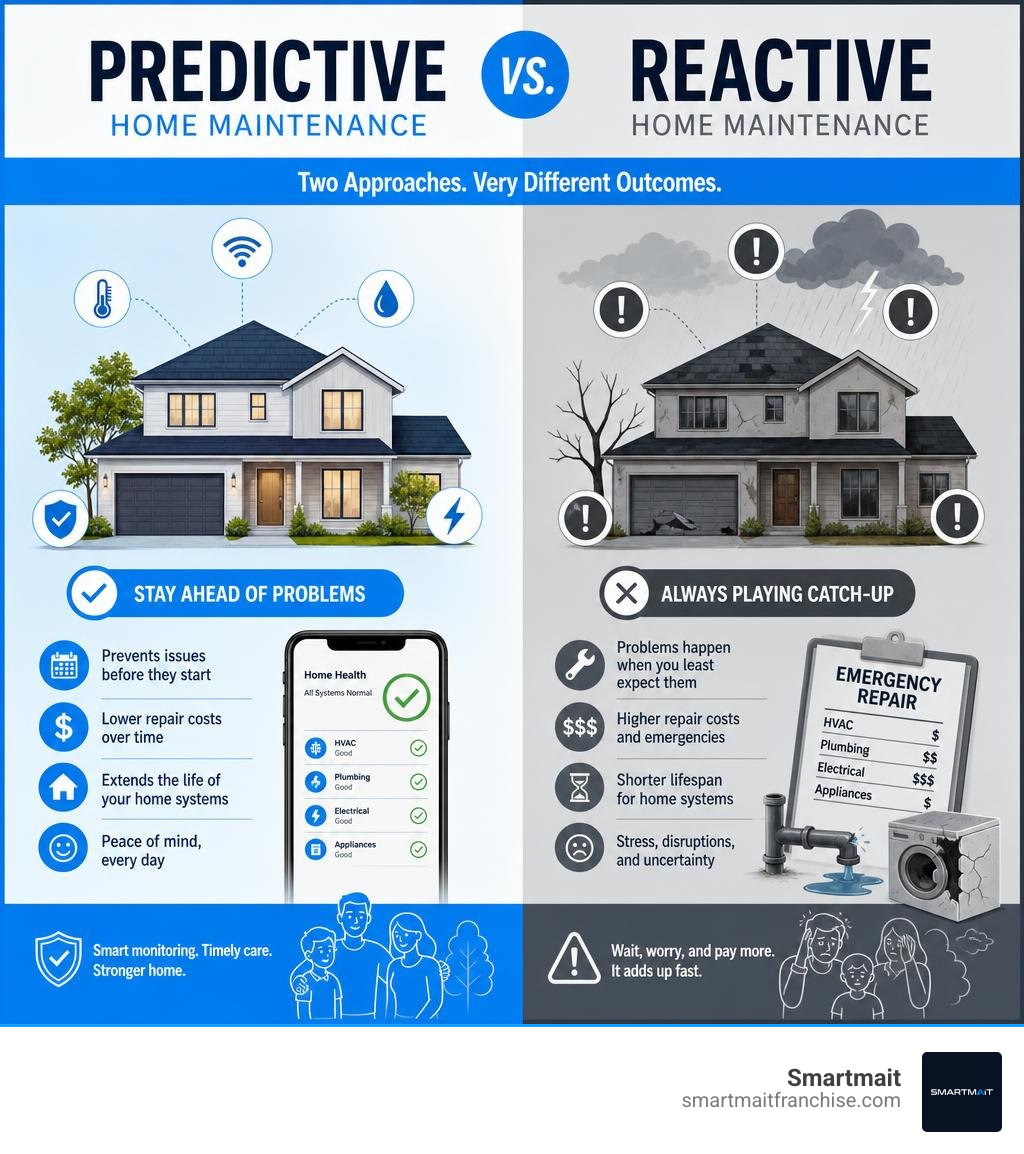
That stress is real. And it compounds fast when small problems — a clogged dryer vent, a slow leak, a neglected HVAC filter — quietly turn into expensive emergencies. According to dryer and washing machine fire safety guidance from the National Fire Protection Association, failure to clean dryers is a major contributor to home dryer fires. Over 15,000 house fires each year start from clogged dryer vents alone.
The good news? A new generation of home maintenance providers is solving this with smarter models: dedicated technicians, subscription plans, and apps that track everything in one place.
I’m Dominic Hesano, a franchise development professional and the builder behind Smartmait — a smart home and automation franchise focused on bringing reliable, tech-forward maintenance to residential and commercial customers. My work sits squarely at the intersection of franchising and the home maintenance company space, where I’ve seen how the right systems and the right provider can transform a frustrating experience into a seamless one. In this guide, I’ll walk you through exactly how to choose the right provider, what predictive maintenance actually means in practice, and how smart technology is changing what home care looks like in 2026.
Why Hire a Professional Home Maintenance Company?

We have all been there. You spend your Saturday morning staring at a leaking sink, a broken smart lock, or a gutter that has decided to double as a hanging garden. You tell yourself, “I can fix this. I’ll just watch a quick video online.” Three hours, two trips to the hardware store, and one minor plumbing flood later, you are frustrated, exhausted, and calling an emergency technician anyway.
While the DIY spirit is admirable, managing home maintenance yourself comes with significant hidden risks. Unprofessional repairs can lead to code violations, voided appliance warranties, and serious safety hazards. Moreover, the sheer volume of tasks required to keep a modern home running efficiently is staggering. From checking the water heater pressure relief valve to calibrating smart thermostats, the list is endless. To get a sense of just how much goes into keeping a property in peak shape, you can check out our comprehensive guide: Your Complete Home Maintenance Services List and Printable Checklist.
When you partner with a professional home maintenance company, you are not just paying for labor; you are buying back your time and securing peace of mind. Professional technicians bring the right tools, the correct certifications, and the trained eyes necessary to catch minor issues before they spiral into catastrophic failures. For busy families, working professionals, and those managing multiple properties, outsourcing these tasks is a game-changer. In fact, in high-cost-of-living areas like San Francisco, residents will pay $400 a month just to outsource household tasks to reliable experts.
By combining traditional handyman skills with smart-home optimization, a modern maintenance provider ensures your home remains safe, efficient, and highly functional without you ever having to lift a finger.
The Cost of Neglect: Why Reactive Repairs Double Your Expenses
Deferred maintenance is a silent budget killer. When we ignore routine tasks, we aren’t saving money; we are simply taking out a high-interest loan against our home’s equity. Over time, neglected homes suffer from rapid asset depreciation, which can drastically lower their market value.
Consider the financial reality of reactive repairs:
- The Boiler Dilemma: A professional boiler tune-up and inspection costs roughly $185. If you skip this routine upkeep, a complete system failure and subsequent boiler replacement can easily run you $8,000.
- The Leaky Pipe: A slow, undetected leak under a bathroom vanity might cost $150 to repair early on. Left unaddressed, it can rot the subfloor, ruin the cabinetry, and foster toxic mold growth, resulting in a restoration bill that climbs into the thousands.
- Emergency Premium Fees: When systems break down on a freezing winter night or a scorching summer weekend, emergency dispatch fees and holiday labor rates can easily double or triple the standard repair costs.
With home maintenance costs almost doubling in a single year, staying ahead of the curve through proactive inspections is the only sustainable way to protect your physical and financial investment.
Finding a Trustworthy Home Maintenance Company in 2026
Finding a reliable partner to care for your home has historically been a major pain point. As the statistics show, 65% of homeowners find it incredibly difficult to secure a trustworthy repair professional. In 2026, however, the industry has evolved. Homeowners no longer have to rely on sketchy classified ads or unvetted contractors.
When evaluating a home maintenance company, look for these key indicators of trust and quality:
- Vetting and Background Checks: Ensure the company employs its technicians directly and subjects them to rigorous background checks, rather than simply outsourcing jobs to unvetted third-party gig workers.
- Licensing and Insurance: A reputable provider must carry comprehensive general liability insurance and workers’ compensation. Furthermore, specific trades—like electrical, plumbing, and HVAC—require specialized state-issued licenses (such as journeyman or master licenses) and EPA certifications.
- Solid Guarantees: Look for companies that stand behind their work with a clear satisfaction guarantee, such as a 30-day warranty on repairs or arrival-time promises (e.g., receiving a discount if the technician is late).
- Tech-Forward Capabilities: A modern provider should offer digital scheduling, transparent estimates, and real-time tracking. Modern digital management platforms demonstrate how digital communication can streamline scheduling, showing how easy it is to manage your home care plan via a dedicated app.
Specialized Care: Smart Home Optimization and Commercial Needs
A great home maintenance company doesn’t just paint walls and clear gutters; it adapts to the unique, specialized needs of your household or business.
One of the fastest-growing sectors in home care is Aging-in-Place modifications. As our loved ones age, their safety and independence depend on making smart, physical updates to their living environments. Professional maintenance teams can install mobility ramps, accessibility lifts, grab bars, and execute complete bathroom accessibility remodels. Professional maintenance teams have spent decades perfecting these senior safety adaptations, helping families keep their elders safe at home.
Beyond senior safety, modern properties require high-level smart home optimization. This includes calibrating smart thermostats, installing connected security cameras, setting up automated lighting, and integrating smart water shutoff valves.
On the commercial side, office spaces, retail outlets, and property management firms require the same level of systematic care. Commercial property maintenance demands consistent facility inspections, rapid emergency support, and consolidated monthly invoicing to keep business operations running smoothly without interruption.
How Modern Providers Structure Services and Pricing
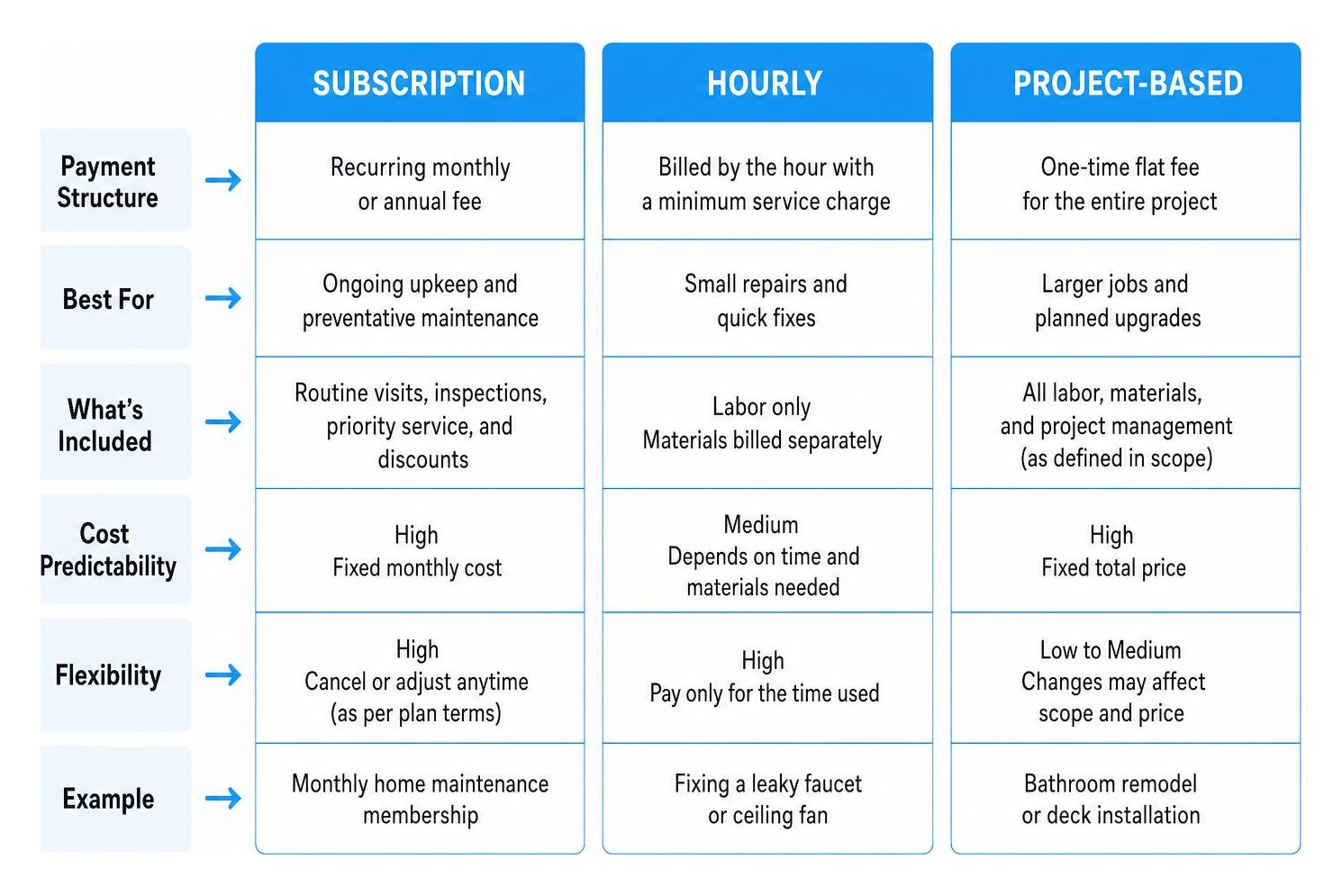
Understanding how home maintenance companies structure their pricing can help you choose the best plan for your budget and property size. Today, the industry has largely shifted away from confusing, unpredictable billing cycles toward transparent, structured models.
Subscription Memberships: The New Standard for a Home Maintenance Company
The rise of the subscription model has completely revolutionized how we care for our properties. Instead of waiting for something to break and scrambling to find a contractor, homeowners can now subscribe to ongoing care.
These subscription plans typically include:
- Dedicated Technicians: You are paired with a single, consistent professional who learns the exact layout, appliance history, and quirks of your home. This model ensures unmatched continuity and trust.
- Regular Preventative Visits: Scheduled quarterly or monthly visits to perform essential maintenance checklist items, such as replacing HVAC filters, cleaning dryer vents, checking fire detectors, and winterizing outdoor spigots.
- App Integration: Homeowners can maintain a digital “honey-do” list, upload photos of issues, and chat directly with their dedicated technician.
- Predictable Budgeting: With monthly plans starting as low as $59 per month (or structured seasonal packages), homeowners can easily budget for maintenance without fearing sudden, massive repair bills.
On-Demand and Project-Based Pricing
While subscription plans are fantastic for ongoing upkeep, there will always be a need for on-demand and project-based services. Whether you need to swap out a broken garbage disposal, mount a new 75-inch television, or handle an emergency plumbing leak, on-demand options provide the flexibility you need.
For one-time jobs, look for companies that offer transparent, upfront hourly rates or flat-rate project pricing. Leading national networks offer clear hourly rates starting at $99 per hour across dozens of trades.
When booking on-demand work, always insist on a written estimate before any labor begins. The provider should itemize parts and materials upfront and require your explicit digital approval before changing the scope of the project.
The Role of Smart Technology and Predictive Maintenance
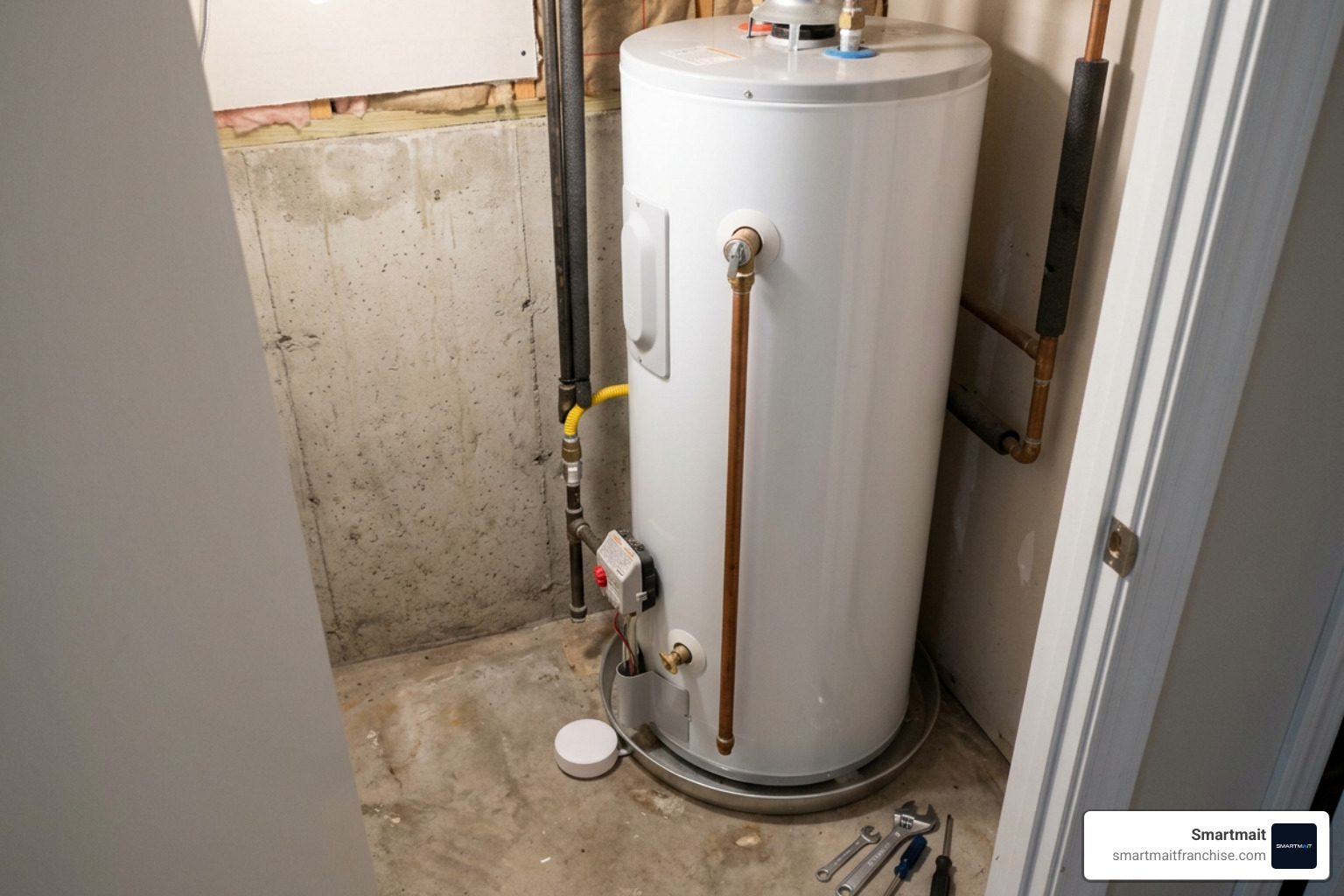
The future of home care lies in predictive maintenance—the practice of using smart technology and real-time data to identify and resolve issues before they cause physical damage. At Smartmait, we believe that your home should tell you when it needs help. By merging smart tech installation with ongoing professional maintenance, we help homeowners build a resilient, self-monitoring ecosystem.
This tech-forward approach is also the ultimate business driver. To understand how this model creates lasting relationships with property owners, read our analysis on How Smart Home Franchises Can Lock in Client Loyalty.
Preventing Disasters with IoT and Smart Sensors
Internet of Things (IoT) sensors act as the nervous system of a modern home. When strategically placed, they monitor environmental conditions 24/7 and send instant alerts to your phone—and your maintenance provider—the second something goes wrong.
- Smart Water Leak Detectors: Placed near high-risk areas like water heaters, washing machines, and under sinks, these sensors can detect a single drop of moisture. When paired with an automatic shutoff valve, they can instantly turn off the main water line, saving you from a $50,000 flood disaster.
- HVAC Monitoring Systems: Smart sensors can monitor temperature differentials, airflow pressure, and electrical draw on your heating and cooling systems. If the system detects that the compressor is drawing too much power or the airflow is restricted, it flags the issue before the system dies on a hot summer afternoon.
- Dryer Vent and Fire Safety: Smart smoke and carbon monoxide detectors, combined with thermal sensors in dryer transition ducts, protect your family from the devastating threat of residential fires.
Centralized Apps for Scheduling and Tracking
The days of keeping paper receipts in a kitchen drawer are over. Modern home maintenance companies utilize centralized mobile apps to give you complete visibility into your home’s health.
Through a single digital portal, you can:
- Access Your Digital Asset Registry: View the exact model numbers, serial numbers, and warranty details of every major appliance in your home.
- Track Service History: Review detailed logs of every repair, complete with before-and-after photos, technician notes, and itemized invoices.
- Live Vendor Tracking: See exactly when your technician is scheduled to arrive, complete with real-time GPS tracking.
- Manage Recurring Services: Easily schedule seasonal gutter cleanings, pool maintenance, or lawn care with a couple of taps.
For service providers, these digital touchpoints are crucial for building trust. You can explore these mechanics further in our guide on Smart Home Customer Retention Strategies That Actually Work.
Frequently Asked Questions About Home Maintenance Services
How much does the average homeowner spend on maintenance annually?
On average, homeowners spend between $3,000 and $6,000 per year on routine maintenance and emergency repairs. A common industry rule of thumb is the “1% to 2% rule,” which suggests setting aside 1% to 2% of your home’s total purchase price annually to cover ongoing upkeep. For a $500,000 home, this translates to a budget of $5,000 to $10,000 per year.
What is included in a typical preventive maintenance plan?
While plans vary by provider, a comprehensive seasonal preventive maintenance plan generally includes:
- HVAC Care: Replacing air filters, cleaning condenser coils, and checking condensate drain lines.
- Plumbing Inspections: Testing water pressure, checking for hidden leaks under cabinets, and inspecting water heater anodes.
- Safety Audits: Testing smoke and carbon monoxide detectors, replacing batteries, and checking fire extinguisher expiration dates.
- Exterior Upkeep: Clearing debris from gutters, checking downspouts, and inspecting window seals and weatherstripping.
- Appliance Checks: Cleaning dryer vents, checking refrigerator door seals, and running dishwasher cleaning cycles.
How do smart home sensors help lower insurance premiums?
Many major home insurance companies now offer premium discounts (sometimes up to 10% to 15%) for properties equipped with qualifying smart home technology. Because water damage and fire are the leading causes of non-weather-related homeowner claims, insurance providers actively incentivize the installation of smart water leak detectors, automatic shutoff valves, and monitored smoke/security systems. By proving your home is actively monitored, you lower the insurer’s risk—and they pass those savings on to you.
Conclusion
Your home is likely your most valuable financial asset, but keeping it in perfect condition shouldn’t feel like a second full-time job. The traditional, reactive approach to home care—waiting for an expensive system to fail and then frantically searching for a contractor—is outdated, stressful, and incredibly expensive.
By partnering with a modern, tech-forward home maintenance company, you can automate your property’s upkeep, protect your budget from emergency surprises, and enjoy the true peace of mind that homeownership is supposed to bring.
At Smartmait, we are proud to be leading this transition, combining state-of-the-art smart home installation with reliable, recurring maintenance. Whether you are looking to secure your family home, optimize a commercial space, or build a thriving business as a franchise partner, the future of property care is smart, predictive, and completely worry-free.