
Why a Basic CCTV System Matters to a Service Business
A basic CCTV system has cameras that capture video, a recorder that manages footage, storage that keeps it, and cables and power that connect the parts. Some systems also offer remote viewing and alerts. For a prospective franchise buyer or integration business owner, those parts are more than an equipment list: they help define what a CCTV service line may need to support over time.
An installation can lead to ongoing work, such as system checks, maintenance, and changes as customer needs evolve. That may create an opportunity for service memberships and lasting customer relationships, but it takes clear service terms and a plan to deliver the work.
I’m Dominic Hesano. My background in franchising, operations, and building Smartmait informs how I look at a basic CCTV system: as one potential service category within a broader low-voltage business.
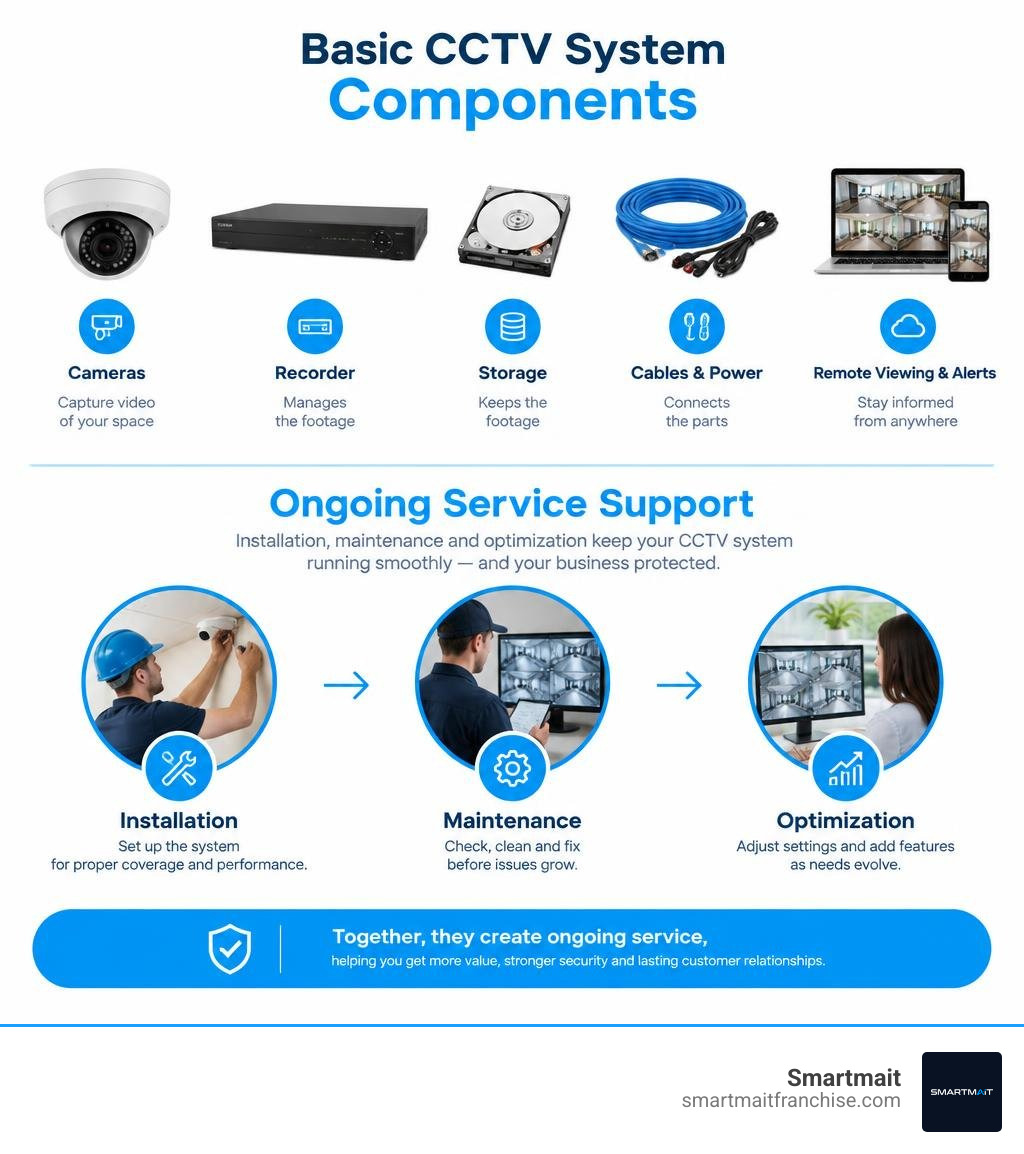
Common basic cctv system vocab:
For broader context on how the U.S. security camera market is evolving, the Security Industry Association publishes research and standards that can help prospective franchise owners evaluate the smart-building and low-voltage integration sector.
Understanding CCTV as a Low-Voltage Service Category

When entering the low-voltage integration sector, viewing video security through the lens of one-off hardware sales limits long-term growth. Instead, established operators and prospective franchise owners treat surveillance infrastructure as an ongoing service category. Cameras, recording appliances, network backbones, and local storage units require structured lifecycle management. Understanding how to manage these assets enables low-voltage businesses to build durable client relationships. To see how these components stack up technically across varied property configurations, review an essential guide to comparing video surveillance systems.
CCTV Basics for Business Owners
At its foundation, every video system operates around three interconnected layers:
- Image Capture: Fixed-lens or varifocal optical sensors capture video within a specific field of view (such as 76.9° horizontal coverage) and convert optical photons into electronic video signals.
- Signal Transmission and Power: Physical cabling delivers power and video data. In analog architectures, coaxial cables (BNC) pair with dedicated power lines. In modern digital networks, single Category Ethernet cables deliver both data and direct current using Power over Ethernet (PoE).
- Processing and Retention: Recording appliances aggregate multi-channel feeds, encode video streams (leveraging compression standards like H.265+ to optimize throughput), manage local storage hard drives, and execute detection analytics.
Understanding these fundamentals allows business owners to design standardized operating procedures for their technicians, ensuring clean deployments across residential and commercial accounts.
The Business Case for Ongoing Service
The traditional integration model often suffers from the “install-and-disappear” trap. An operator completes a complex project, collects a final check, and leaves the client to navigate technical maintenance alone. Over time, environmental wear, weather exposure, firmware vulnerabilities, and storage drive degradation cause failures.
By packaging post-installation support into structured service memberships, businesses can convert project-based revenue into recurring maintenance agreements. These recurring service packages include routine lens cleaning, focus adjustments, physical connection testing, weather seal validation, firmware patch deployment, and drive health diagnostics. This proactive approach elevates customer satisfaction and creates a stable foundation for retaining technicians year-round.
Evaluating Technology and Service-Line Opportunities
Choosing which technologies to standardize within an integration business affects everything from technician onboarding to inventory carrying costs. Integration operators must evaluate the operational trade-offs between legacy-compatible analog infrastructure and scalable network IP architecture.
| Evaluation Metric | Analog HD (HD-TVI / CVI / AHD) Architecture | IP / Power over Ethernet (PoE) Architecture |
|---|---|---|
| Primary Cable Infrastructure | Coaxial cable (RG59/BNC) with separate 12V/24V power supply lines | Single Category Ethernet run (Cat5e/Cat6) carrying data and DC power |
| Maximum Direct Transmission Distance | Up to several hundred feet depending on coaxial copper gauge | Standard 300-foot (100-meter) direct run without inline extenders or switches |
| Recording Appliance | Digital Video Recorder (DVR) performing on-box analog-to-digital encoding | Network Video Recorder (NVR) receiving pre-encoded digital streams |
| Service Complexity | Simpler hardware troubleshooting, physical cable focus, manual channel configuration | Network routing, IP addressing, subnet management, switch port allocation |
| System Scalability | Fixed channel limits per DVR (e.g., 4, 8, or 16 physical BNC inputs) | Highly modular; expandable via managed PoE switches and network bridge links |
| Field Technician Skill Requirements | Basic low-voltage terminations, mechanical mounting, analog testing | Network fundamentals, IP configuration, bandwidth calculation, firmware management |
System Types and Their Business Implications
Analog HD systems—utilizing multi-format 4-in-1 technologies like TVI, CVI, AHD, and CVBS—remain practical when retrofitting buildings with existing coaxial wiring. A DVR processes uncompressed video signals at the central unit, simplifying field hardware.
Conversely, IP and PoE systems process and compress video directly at the camera edge before transmitting packets to an NVR. Because a single Ethernet run delivers power and two-way data up to 300 feet from the NVR, field labor hours drop significantly.
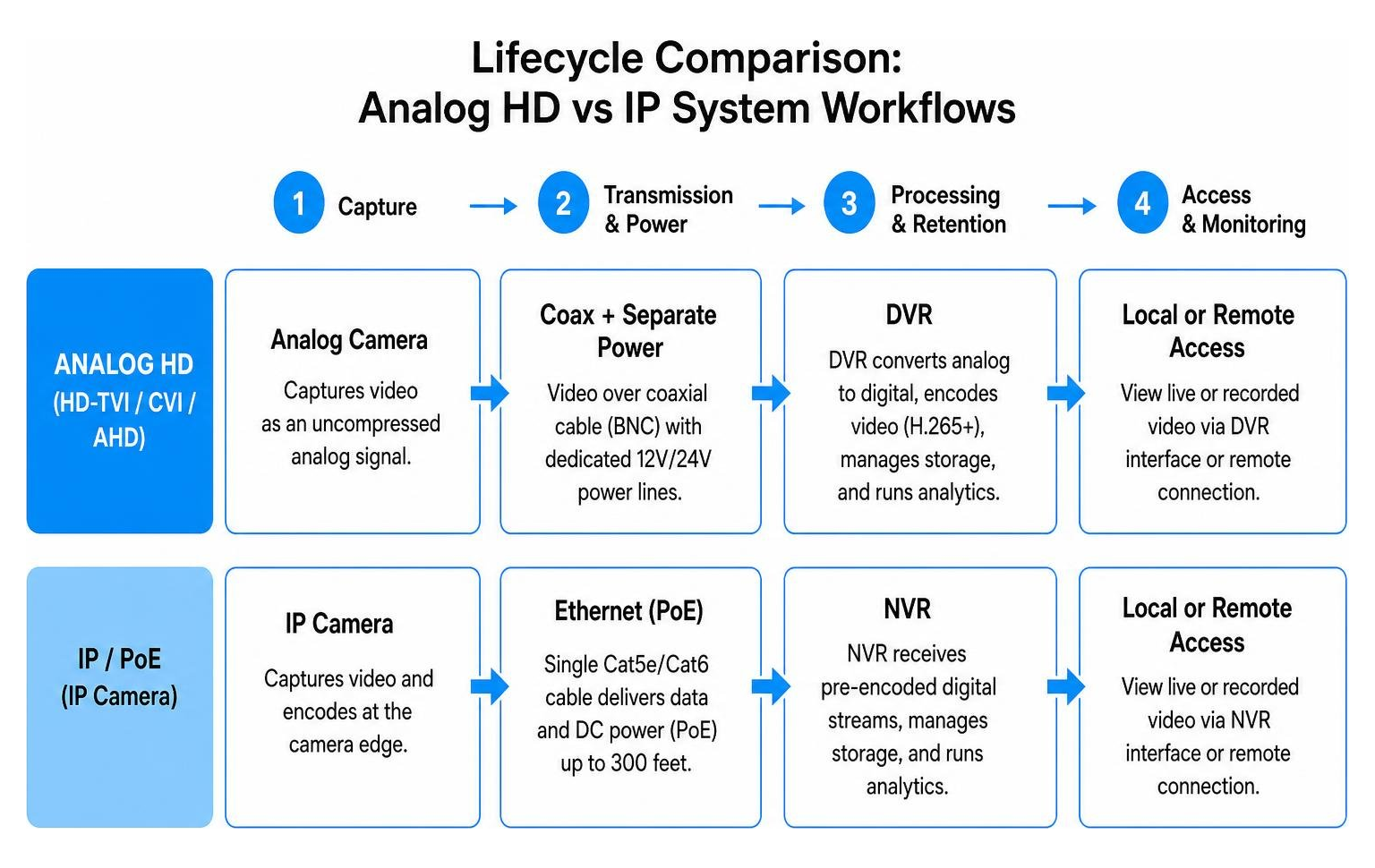
For a business owner, standardized IP deployments reduce physical cabling confusion while expanding service capabilities to include advanced perimeter analytics and network health monitoring.
Planning for Evolving Customer Needs
Security requirements change as client properties grow. A customer who initially requires basic entry-point coverage may later need off-grid perimeter monitoring or specialized internal visibility.
Integrators who master both standard local configurations and specialized setups—such as off-grid 4G CCTV camera solutions for remote commercial assets—can serve broader client profiles. Ensuring your team understands how to bridge local video operations with cloud connectivity without compromising local recording guarantees long-term operational resilience.
Industry Trends and Operator Readiness

Consumer expectations around physical security have shifted. Property owners expect smart detection, rapid notifications, and zero system downtime. For integration business owners, staying ahead of these demands requires aligning service offerings with wider smart-building automation trends.
Technology Trends to Understand
To maintain market competitiveness, integration business owners must track key engineering advancements:
- Edge-Based AI Analytics: On-device machine learning filters out environmental noise, focusing recording triggers specifically on humans and vehicles without requiring costly third-party cloud processing subscriptions.
- Advanced Optical Sensors: Modern low-light sensors, wide dynamic range (WDR), and digital noise reduction (DNR) ensure clear identification across demanding lighting conditions.
- Storage Compression Optimization: Advanced codecs like H.265+ reduce bandwidth overhead and hard drive consumption by up to 50% compared to legacy H.264 formats, allowing multi-terabyte drives (expandable to 16TB or more) to retain weeks of continuous recording.
- Unified Smart-Building Ecosystems: Video feeds increasingly integrate with access control, smart lighting, environmental sensors, and remote management dashboards.
Training and Certification Considerations
Deploying high-performance video systems requires disciplined field technicians. Business operators must establish structured training pathways covering:
- Low-voltage cabling standards, safe pathway creation, and structural fire-stopping codes.
- Weatherproof installations (understanding ingress protection such as IP66 and IP67 ratings, which ensure hardware operates in temperatures ranging from -40°F to 140°F).
- Networking essentials, including subnetting, VLAN isolation for video traffic, and cybersecurity hardening of edge devices.
- Diagnostic testing, such as identifying infrared reflection off nearby surfaces or locating ground loops on analog runs.
For business owners evaluating franchise conversion or territory acquisition, having access to established operational playbooks, technician training modules, and standardized installation standards accelerates workforce readiness.
Assessing Fit With an Existing Business
Independent low-voltage contractors often struggle with operational bottlenecks, including unpredictable project pipelines, technician turnover, and an over-reliance on the business owner for day-to-day troubleshooting. Integrating video surveillance into a formalized service model allows business owners to cross-sell to existing commercial or residential clients.
Operators evaluating expansion can review the best CCTV for small business strategies to align technical operations with structured B2B service agreements.
Building a Sustainable Service Model
A sustainable systems integration business relies on repeatable operational workflows. Structuring your post-installation service model ensures high customer retention and reliable operational schedules.
Designing Recurring-Revenue Services
To build long-term value, integration companies structure proactive service tier agreements. These agreements outline routine maintenance tasks:
- Quarterly/Bi-Annual System Health Audits: Inspecting lens surfaces, validating moisture seals on IP67 junction boxes, and confirming camera angles remain aligned.
- Storage Integrity Checks: Verifying surveillance-grade hard drive health, testing sector write-speeds, and confirming continuous 24/7 overwrite loops work smoothly.
- Firmware and Security Updates: Patching network devices to safeguard against emerging vulnerabilities.
- Priority Response Windows: Offering dedicated service response times for clients enrolled in ongoing service memberships.
Operating and Scaling a Service Line
Scaling an integration business requires decoupling growth from owner oversight. Standardizing operational workflows ensures every technician delivers consistent service quality across every territory.
Technicians should follow an ultimate checklist for security camera installation on every job site. Standardized deployment protocols eliminate costly callback visits, ensure proper cable management, and protect the company’s reputation across the local market.
Common Business Planning Gaps to Avoid
Integration business owners often encounter preventable operational pitfalls when expanding their low-voltage service lines:
- Underestimating Field Skill Requirements: Failing to train technicians on network fundamentals leads to improper bandwidth allocation and frequent connection dropouts.
- Vague Service Level Agreements: Failing to define what is included in maintenance visits leads to scope creep and unprofitable customer relationships.
- Neglecting Local Environmental Demands: Using indoor-rated hardware in outdoor settings or failing to account for extreme weather swings leads to premature component failure.
- Inconsistent Quality Control: Allowing individual technicians to invent their own installation methods creates service headaches when different team members perform follow-up maintenance.
Frequently Asked Questions for Business Owners
Can a CCTV service offering fit an existing integration business?
Yes. Video surveillance services integrate naturally into low-voltage, smart-home, electrical, and commercial integration businesses. Adding video surveillance enables operators to offer end-to-end building technology solutions while creating ongoing touchpoints with their existing customer base.
How can ongoing service support recurring revenue?
Ongoing service shifts the business model from one-off installation projects to continuous customer relationships. By providing routine maintenance, camera lens cleaning, firmware patching, storage diagnostics, and priority support through tiered service memberships, integration businesses build predictable recurring revenue streams.
What should owners consider before adding a low-voltage service category?
Business owners must evaluate technician training requirements, standardized vendor sourcing, service agreement frameworks, and local commercial demand. Operators should also assess whether building these systems independently or partnering with an established franchise brand provides a faster, more reliable path to scaling operations.
Conclusion
Video surveillance represents a vital service category within the expanding low-voltage and smart-building integration sector. By understanding hardware fundamentals, network architecture, and lifecycle maintenance requirements, integration operators can move beyond one-off projects and build resilient, service-based businesses.
Smartmait offers a comprehensive franchise model designed for prospective entrepreneurs entering the trade sector and established low-voltage integrators seeking to scale beyond owner-dependence. By providing standardized operational frameworks, continuous technical training, service-membership architectures, and system installation protocols—such as those detailed in our guide to video surveillance system installation—we help business owners build scalable, multi-territory operations.
If you are an established integration business owner evaluating a franchise conversion model, or an entrepreneur exploring available franchise opportunities in the smart-building and low-voltage trades, reach out to our development team today to request franchise information and evaluate available territories.