

Why Discreet Camera Services Matter for Smart-Home Franchise Operators
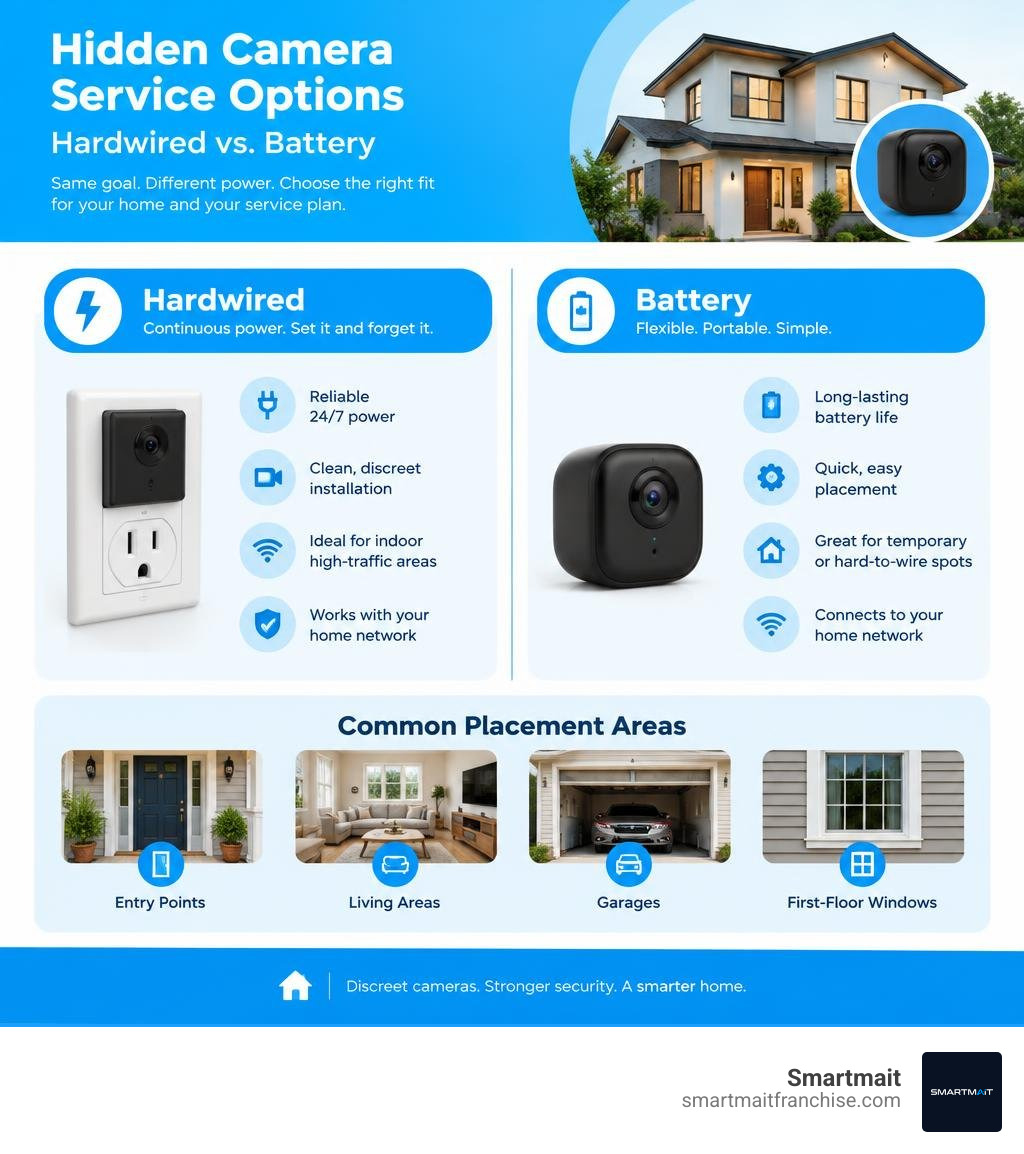
For a professional low-voltage franchise operator, the strongest discreet monitoring service lines combine clear video, a useful field of view, reliable power, local or secure remote storage, and privacy-conscious placement. Hardwired outlet and surge-strip modules suit continuous indoor monitoring, while compact battery cameras work better for temporary or hard-to-wire locations.
Discreet monitoring is a growing service opportunity within a broader smart-home franchise offering. Homeowners often want coverage at entry points, living areas, garages, and first-floor windows without filling a space with obvious hardware. That concern is grounded in real risk: 34% of burglars enter through front doors, while 23% use first-floor windows.
For franchise buyers and established integrators, the value is not in selling a single covert device. It is in designing a lawful, dependable system, connecting it to the home’s network and storage plan, documenting customer approvals, and providing ongoing maintenance. When prospective clients evaluate the best hidden cameras for house deployments, low-voltage franchise technicians can deliver tailored home security configurations. Hidden-camera requests can create recurring work around Wi-Fi support, firmware updates, storage checks, battery service, and privacy-focused system reviews.
I am Dominic Hesano, a franchise development professional and business operator building Smartmait around smart-home, security, networking, and low-voltage integration services. My experience evaluating service models helps prospective franchise owners understand how discreet monitoring can fit into a scalable, support-driven franchise offering.
Top Service Categories and Franchise Opportunities for Discreet Monitoring
For low-voltage and custom integration franchise owners, discreet monitoring is rarely an isolated request. Homeowners often ask for unobtrusive monitoring to watch high-traffic common areas, verify deliveries, or monitor interior entryways without cluttering finished decor with bulky industrial cameras. Understanding the diverse service categories available in the market allows franchise operators to assess service complexity, visual integration, and recurring maintenance potential across their territory.
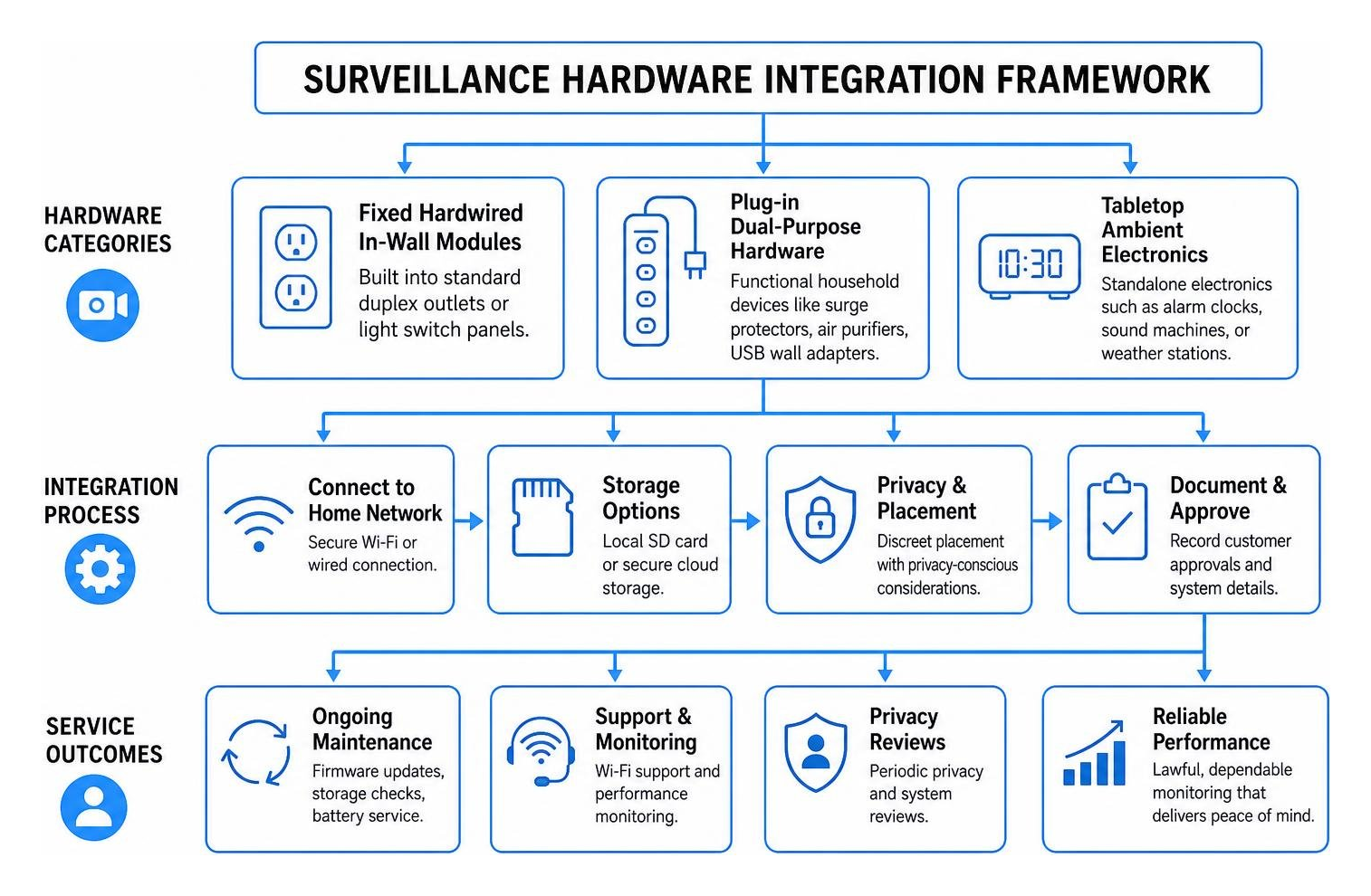
When evaluating covert service categories, smart-home franchise businesses typically encounter three core service models:
- Fixed Hardwired In-Wall Integration: Services built around devices installed directly into standard duplex wall outlets or light switch panels.
- Plug-in Dual-Purpose Integration: Services involving functional household appliances and utility devices such as multi-outlet surge protectors, air purifiers, and USB wall adapters.
- Tabletop Ambient Electronics Integration: Services involving standalone functional electronics such as digital alarm clocks, ambient sound machines, or weather stations.
Offering integration services for these categories requires evaluating technician competency, electrical safety protocols, and data privacy safeguards. Integrating high-performance discreet optics alongside indoor CCTV cameras allows franchise businesses to provide tailored security packages that respect homeowner aesthetics while maintaining complete perimeter and interior coverage.
Criteria for Evaluating Discreet-Camera Services for a Smart-Home Franchise
To build a sustainable service line, franchise operators evaluate discreet hardware against strict technical criteria. Miniature pinhole lenses must balance concealment with optical performance. A low-profile pinhole lens requires precision placement to maintain an adequate field of view—typically between 80 degrees and 150 degrees—without suffering from edge distortion or glare from interior ambient lighting.
Technicians must be trained to verify motion detection sensitivity, configure dual-band (2.4 GHz and 5 GHz) network connectivity, and validate onboard video compression codecs such as H.265. Evaluating manufacturer build quality, firmware update stability, and remote streaming security ensures that deployed systems do not create cybersecurity vulnerabilities on client networks.
Hardwired Receptacles and Surge Strip Service Modules
Hardwired wall receptacles represent one of the cleanest methods for permanent, long-term covert surveillance. These units directly replace a standard residential NEMA-type A/B wall outlet, drawing continuous power from 100–125V AC residential lines. Because these units operate continuously, they eliminate battery management issues while offering multi-angle lens configurations (upward, level, or downward) to compensate for low receptacle heights near floorboards.
Similarly, functional surge protectors deliver 4K streaming over a wide 120-degree field of view. Because every outlet remains operational, these units blend seamlessly into home offices and living rooms, presenting franchise operators with low-voltage wiring, network segmentation, and periodic electrical inspection service opportunities.
Disguised Tabletop Clocks and Ambient Sensor Services
Tabletop hardware provides flexible placement on nightstands, bookshelves, and fireplace mantels. These devices provide 2K/4K resolution, 150-degree wide-angle coverage, and integrated backup batteries supporting up to seven hours of recording during outages.
For advanced installations where local Wi-Fi networks may be unreliable or absent, cellular-backed devices offer direct 4K live streaming over 4G LTE cellular data. Disguised ambient sensors, including functional smoke detectors and carbon monoxide alarms, provide high-angle downward room coverage while requiring strict adherence to local safety codes and two-party audio recording regulations.
Essential Business and Performance Considerations for Discreet Service Models
When structuring a professional franchise service model, integration operators must compare the functional trade-offs between battery-operated and hardwired platforms.
| Feature / Metric | AC-Powered Hardwired Modules | Battery-Powered Covert Cameras |
|---|---|---|
| Power Source | 100–125V AC Continuous Line | Rechargeable Lithium Battery |
| Runtime / Standby | Unlimited continuous operation | 60–90 min active / up to 100 days PIR standby |
| Video Resolution | 1080p, 2K, up to 4K streaming | 1080p to 4K snapshots |
| Field of View | 80° to 120° fixed / pre-angled | 90° to 150° wide-angle |
| Installation Complexity | Moderate to High (electrical box mounting) | Low (surface or tabletop placement) |
| Maintenance Profile | Low physical touch; firmware/network focused | Regular battery cycling or physical swap |
| Service Contract Value | High (ongoing network & power inspection) | Moderate (battery replacements & seasonal checkups) |
Video Resolution and Non-Glowing Infrared Night Vision
Discreet cameras rely on advanced image sensors to capture identifiable facial features in low-light environments without alerting occupants. While standard night-vision cameras use 850nm infrared LEDs that emit a visible, faint red glow, covert installations require 940nm non-visible infrared LEDs.

A 940nm wavelength is invisible to the human eye, allowing total stealth in pitch darkness up to 16 to 30 feet. Franchise operators must ensure technicians select camera hardware capable of capturing crisp 1080p or 4K detail, referencing the best night vision CCTV camera guidelines to balance optical clarity against infrared range and sensor noise.
Continuous Power Versus Standby Battery Longevity
Power architecture dictates service intervals and client satisfaction. Dedicated battery cameras leverage deep-sleep PIR (Passive Infrared) motion sensors to achieve up to 100 days of standby battery life on a single charge.
Conversely, compact models provide two to three hours of continuous onboard battery operation, designed primarily for temporary monitoring or short power interruptions. Franchise businesses can bundle battery maintenance, routine recharging visits, and power bank expansions into recurring service plans.
Local MicroSD Storage Versus Secure Transmission
Covert video storage architecture involves balancing local privacy against remote access requirements. Most covert hardware utilizes onboard microSD card storage (supporting 32GB to 256GB capacities) with automatic loop recording, eliminating mandatory monthly cloud subscription costs for clients.
For real-time security alerts, systems transmit video over 2.4 GHz Wi-Fi or local RTSP (Real-Time Streaming Protocol) streams integrated into a central Network Video Recorder (NVR). Ensuring proper bandwidth allocation, robust local encryption, and seamless network handoffs is critical when comparing video surveillance systems for residential estates.
Top Factors in Evaluating a Discreet-Camera Franchise Service Offering
Structuring a professional surveillance franchise offering requires evaluating site-specific vulnerabilities, entry points, and structural constraints across residential properties. Franchise operators map high-risk zones using established security checklists before specifying covert versus overt equipment.
Evaluating Discreet-Camera Demand for House Entryways and Outdoor Points
External residential security requires durable hardware and strategic concealment. With 34% of residential break-ins occurring at the front door, 23% through first-floor windows, 22% via back doors, and 9% through garages, outdoor covert surveillance provides critical backup footage if primary cameras are bypassed or disabled.
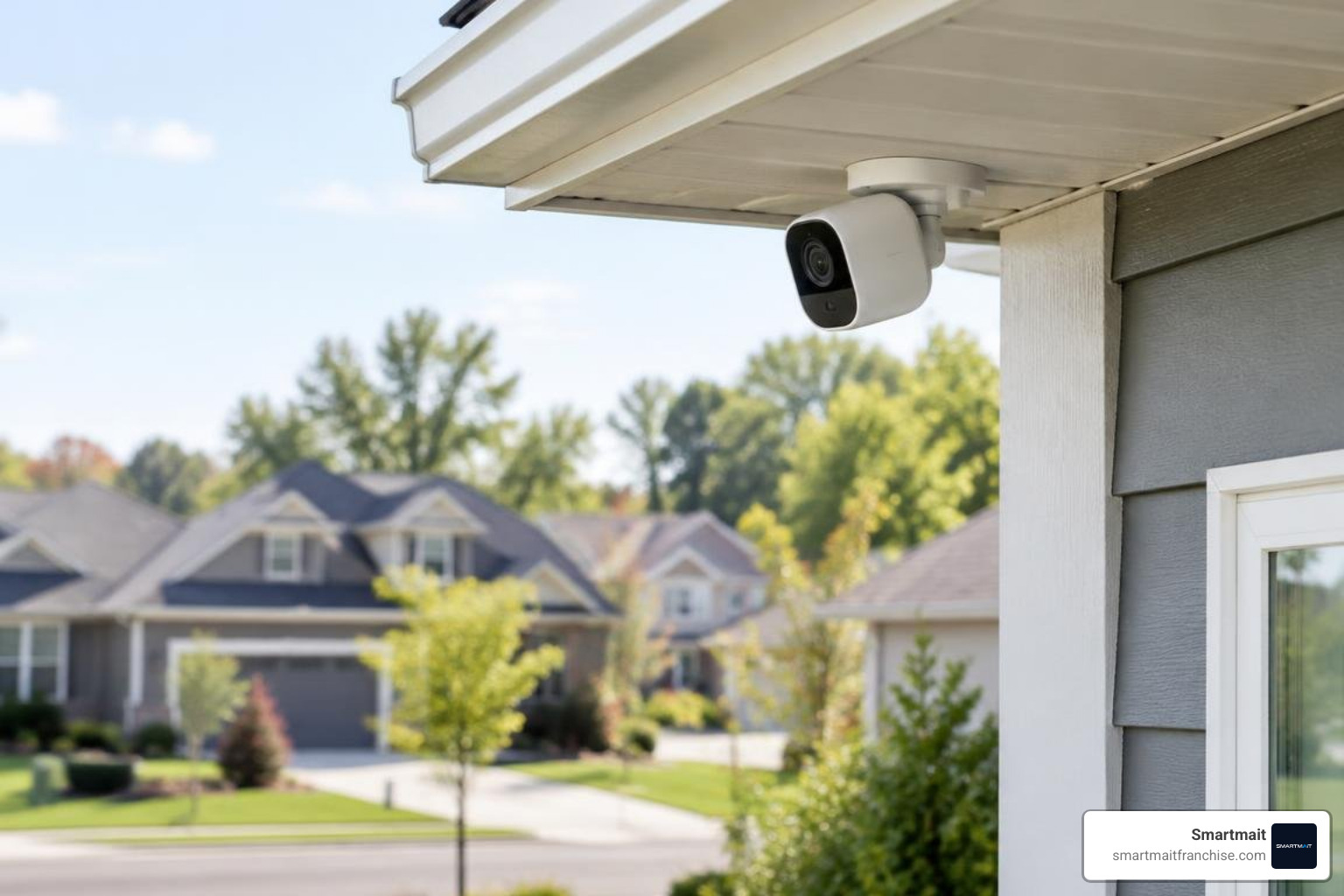
Outdoor installations demand weather-resistant housings rated at IP65 or higher. Technicians can integrate small wireless cameras beneath exterior roof eaves, soffits, or within decorative porch elements. For extensive estates, following an outdoor video surveillance installation guide ensures proper wire routing, lightning protection, and glare mitigation against low-angle sunlight.
Evaluating Indoor Concealment and Integration Services
Indoor placement demands high-level craftsmanship to blend security optics with home decor. Franchise technicians conceal wiring behind baseboards, through wall cavities, or inside functional carpentry such as fireplace mantels, custom bookshelves, and media consoles.
Technicians must systematically execute a security camera installation checklist to confirm power delivery, verify network signal attenuation behind drywall, and position lenses to avoid room reflections. By standardizing these physical installation workflows, franchise operators can streamline DIY and professional camera setups into consistent, high-margin service calls.
Legal Compliance and Privacy Considerations
Legal liability is paramount in covert surveillance. In the United States, video recording is generally permitted on private residential property for security purposes, provided cameras are not placed in areas where individuals have a “reasonable expectation of privacy,” such as bathrooms, guest bedrooms, and changing areas.
Audio recording carries far stricter legal hurdles than video capture. Federal and state wiretapping laws govern sound recording; over a dozen states require two-party (all-party) consent before conversations can be captured. Professional franchise companies mitigate liability by disabling onboard microphones on covert devices by default and requiring signed client acknowledgment agreements prior to commissioning systems.
Covert Device Detection and Counter-Surveillance as a Franchise Service Opportunity
An adjacent and rapidly growing service category for smart-home low-voltage franchise operators is Technical Surveillance Countermeasures (TSCM) and covert device detection. High-net-worth homeowners, corporate executives working remotely, and frequent short-term rental guests increasingly request sweeps of their private residences, home offices, and guest suites to ensure unauthorized recording devices are not present.
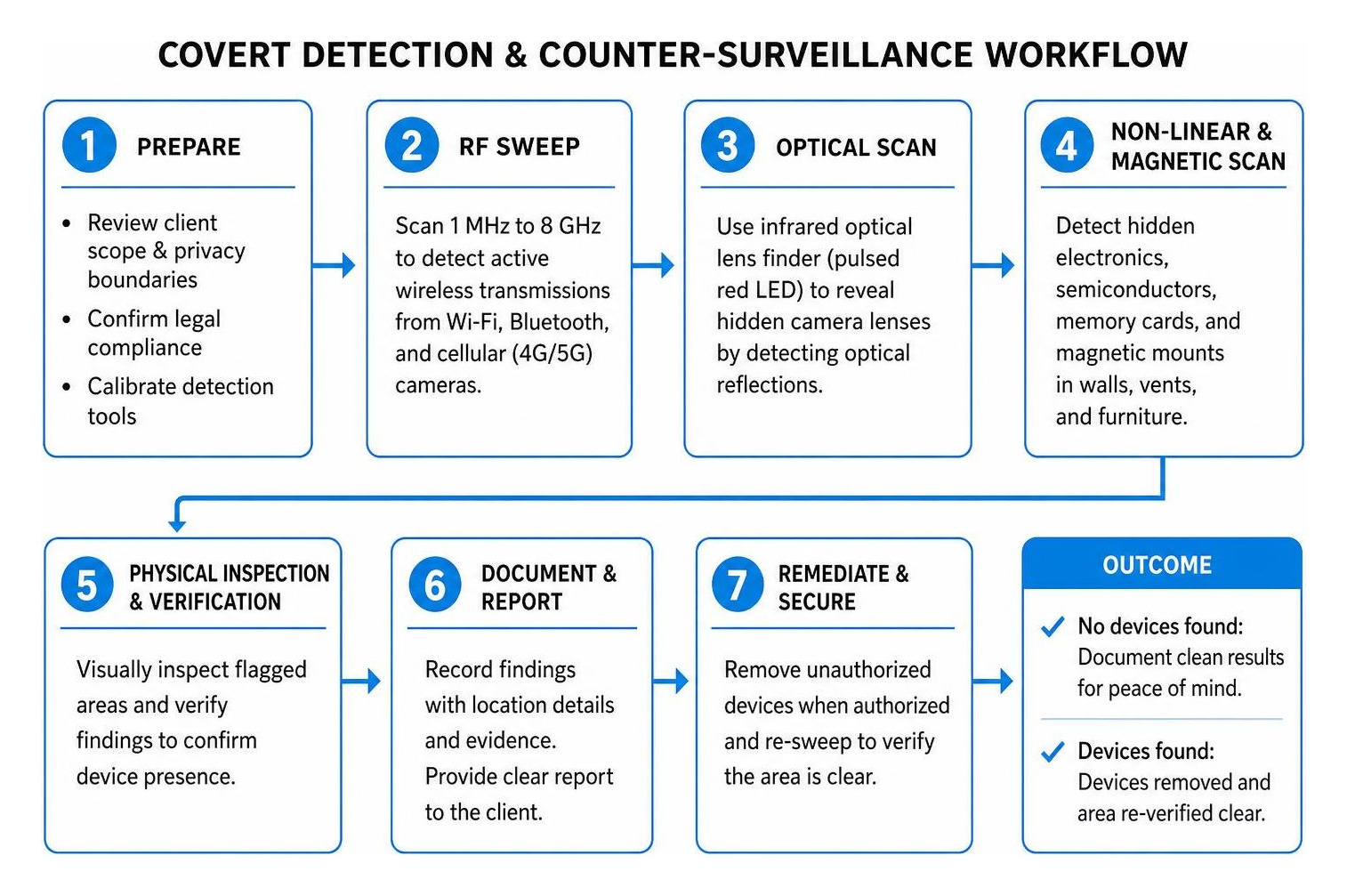
Franchise technicians equipped with professional-grade detection tools can identify covert surveillance devices across multiple physical and wireless vectors:
- Radio Frequency (RF) Bug Detectors: Scan local spectrum bands (1 MHz to 8 GHz) to pinpoint active wireless transmissions from Wi-Fi, Bluetooth, and cellular (4G/5G) transmitting cameras.
- Infrared Optical Lens Finders: Utilize high-intensity pulsed red LED rings to expose hidden pinhole camera lenses by detecting the physical optical reflection off the camera’s internal sensor, even if the device is powered off.
- Non-Linear Junction Detectors & Magnetic Scanners: Detect hidden semiconductors, solid-state memory cards, and magnetic camera mounts concealed within drywall, air vents, or hollow furniture.
- Network Protocol Scanners: Analyze local Wi-Fi router tables, ARP caches, and MAC address registries to detect unauthorized IP cameras streaming on client subnets.
Adding counter-surveillance sweeps and periodic privacy audits to residential service menus allows franchise businesses to differentiate their brand, capture premium hourly diagnostic rates, and cross-sell secure automated home security systems designed to protect homeowner data end-to-end.
Frequently Asked Questions about Discreet-Camera Franchise Service Opportunities
What is the difference between a spy camera and a standard security camera?
Standard residential security cameras are built with visible, weatherized enclosures intended to act as a visual deterrent to trespassers while offering wide-angle coverage and overt deterrence features like floodlights or sirens. Covert spy cameras utilize micro-pinhole lenses concealed inside everyday functional objects (such as wall outlets, power strips, or alarm clocks) designed to monitor spaces unobtrusively without altering the aesthetic profile of the room. For franchise operators, this distinction shapes service positioning, technician training, and client compliance conversations.
Where is it legally prohibited to install a hidden camera?
Hidden surveillance cameras are strictly illegal in any residential or commercial area where occupants have a legal expectation of privacy. Prohibited zones include bathrooms, restrooms, locker rooms, guest bedrooms, and dedicated dressing rooms. Franchise operators must implement strict compliance guidelines and verify that customers adhere to state and local privacy laws when commissioning systems.
Can mobile devices reliably detect concealed surveillance lenses?
While smartphone cameras can occasionally detect the purple glare of standard 850nm infrared LEDs in total darkness, they cannot reliably locate 940nm non-visible infrared illuminators or passive cameras recording locally to SD cards. Comprehensive detection requires specialized counter-surveillance equipment, including optical lens finders, RF bug detectors, and spectrum analyzers. This creates a recurring service opportunity for franchise owners who invest in technician training and detection tools.
Conclusion: Expanding Your Integration Business with Smartmait
Building a successful low-voltage integration franchise requires more than just installing hardware—it demands a systematic approach that combines premium installation craftsmanship, rigorous legal compliance, and ongoing service relationships. As consumer demand for discreet home surveillance, robust network management, and smart-building automation continues to accelerate across the United States, independent operators face the challenge of managing complex vendor relationships, technical training, and client retention on their own.
At Smartmait, we empower integration professionals and aspiring business owners through our proven smart-home and smart-building franchise model. We combine professional technology installations with recurring maintenance memberships, structured technician training, and comprehensive operational playbooks that turn one-time installations into predictable, recurring service revenue.
Whether you are looking to scale an existing low-voltage business or launch a new integration territory backed by a national brand, explore our comprehensive guide to smart home franchise opportunities and request your franchise information kit today.