

Residential Home Automation as a Franchise Opportunity
Residential home automation links home systems such as lighting, climate, and security so they can respond to schedules or sensor activity. For a prospective franchise owner, the business opportunity goes beyond installation. Integrating those systems and maintaining them over time can support repeat service and customer retention.
This guide looks at the service model, the skills an operator needs, and what to review before buying a U.S. franchise territory or converting an existing integration business.
I’m Dominic Hesano, a franchise development professional and business operator involved in building Smartmait. My background in franchising, sales, and operations shapes how I evaluate residential home automation as an installation and ongoing-service business.
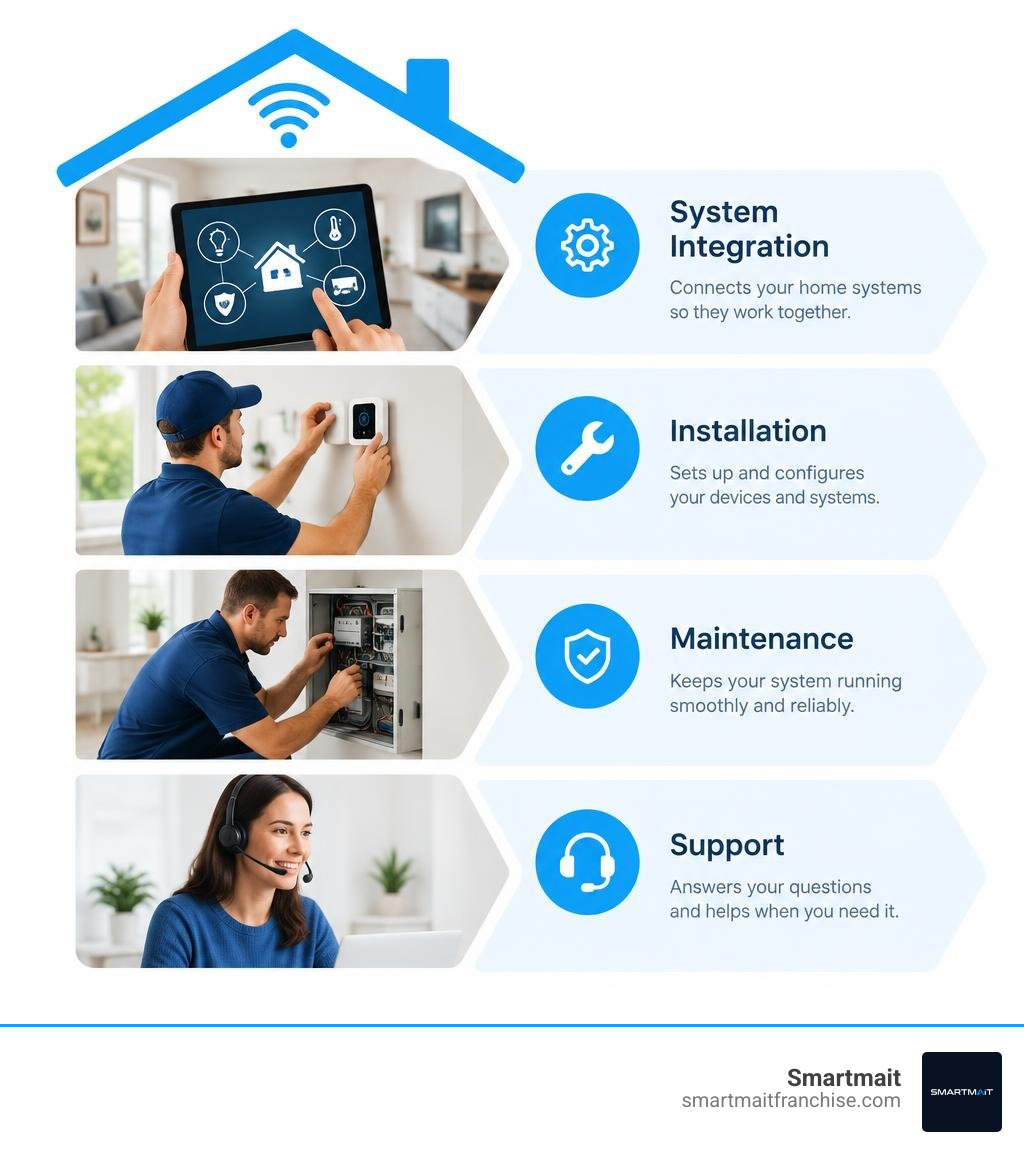
Residential home automation glossary:
The Core Foundations of a Residential Home Automation Franchise
The connected-living industry has evolved rapidly over the past few decades. By 2012, approximately 1.5 million automation systems were installed in United States residences. That foundation expanded quickly as connected hardware matured, passing 45 million devices in American residences by 2018. Between 2018 and 2023, the number of connected homes across the nation grew at a rate of 10.2% annually, reaching 63.43 million residences. Backed by broader technological shifts, the overall automation market expanded from $64 billion in 2022 and is projected to surpass $163 billion by 2028.
For prospective franchise owners and established trades professionals, this expansion presents a clear operational opening. Historically, the trade focused primarily on one-time hardware deployments. Today, the modern business model combines technical system deployment with ongoing support and proactive maintenance memberships.
At Smartmait, we approach the sector by combining skilled low-voltage deployment with structured, recurring maintenance programs. Instead of finishing a job and never speaking with the client again, our franchise partners build lasting operational relationships. A franchise operator oversees field technicians, manages local client relationships, coordinates schedule dispatching, and ensures quality standards across every installation. Master protocols like home automation depend on clean execution, making structured operating systems essential for long-term reliability.
Smart Homes vs. Home Automation as a Business Opportunity
Understanding the distinction between isolated connected gadgets and unified automation is crucial when evaluating a business opportunity in this sector.
- Connected or Smart Devices: Standalone products that allow remote app control or basic manual voice prompts. They often operate in silos and require constant user input.
- True Home Automation: Interconnected systems that act autonomously through sensor triggers, logic conditions, schedules, and occupancy states without requiring ongoing manual commands.
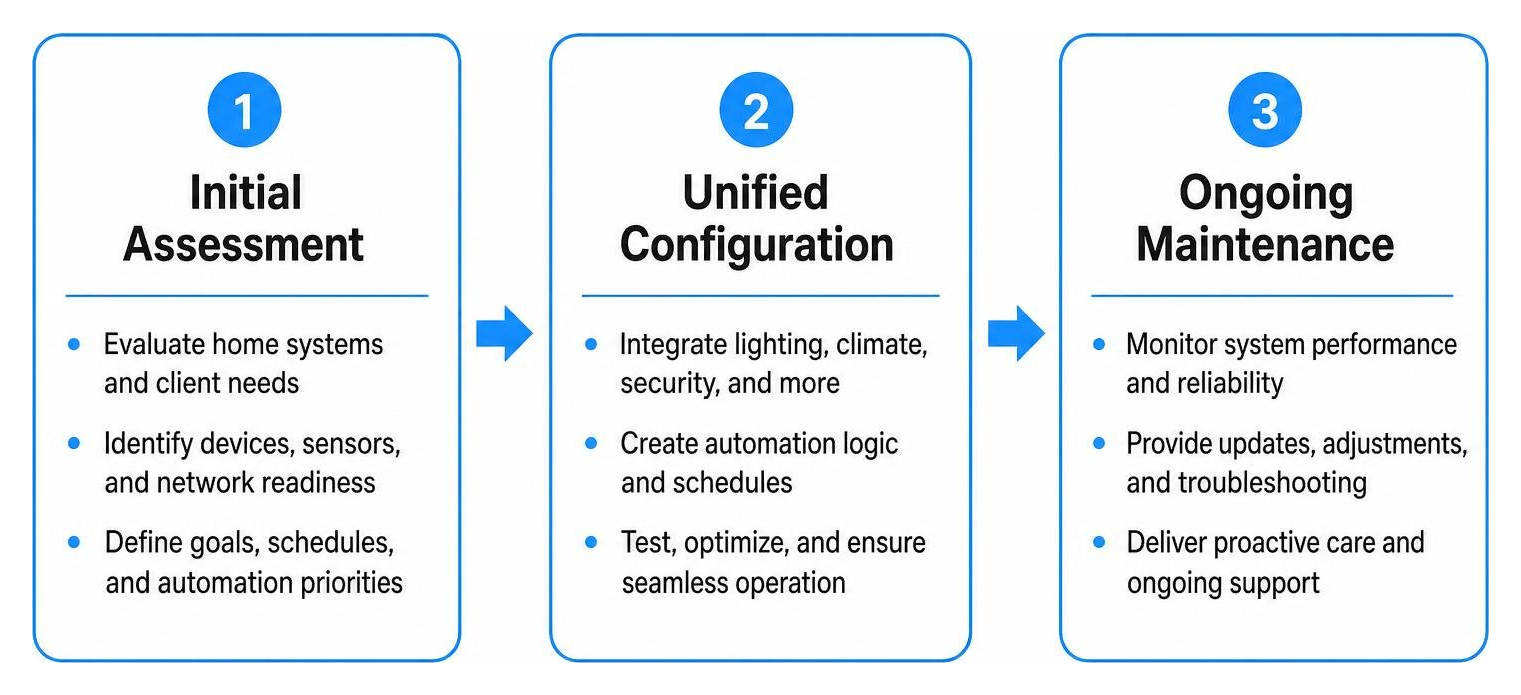
When homeowners attempt piecemeal DIY installations, they frequently run into platform fragmentation and network stability bottlenecks. This friction creates substantial commercial demand for reliable smart home integration. Professional integration bridges the gap between isolated gadgets and an intuitive whole-home system.
By delivering unified setups alongside recurring service memberships, franchise operators solve everyday client frustration while establishing a consistent baseline of customer retention and long-term service relationships.
Technology Knowledge and Interoperability
Operating a successful territory requires a firm grasp of how disparate low-voltage ecosystems communicate. Modern residential environments often mix multiple communication standards across high-bandwidth and low-power devices:
- Wi-Fi & Ethernet: Ideal for high-bandwidth endpoints such as surveillance cameras and primary streaming interfaces, though prone to congestion if unmanaged.
- Zigbee & Z-Wave: Dedicated low-power mesh networks that allow sensors, switches, and locks to communicate locally without bogging down household Wi-Fi.
- Thread: A low-latency, IP-based mesh networking layer designed specifically for responsive device-to-device communication.
- Matter: A unifying application layer protocol supported by major industry stakeholders to standardize cross-brand device communication.
Franchise operators do not need an engineering background to lead a team, but they must ensure their technical staff follows standardized integration procedures. A robust franchise system provides comprehensive onboarding and continuous technical education, enabling technicians to handle complex multi-protocol environments cleanly.
Networking Standards as an Industry Trend
Connectivity standards are continuously advancing. With thousands of certified products adopting modern interoperability frameworks, the industry is moving away from isolated walled gardens and toward unified local communication.
These industry shifts highlight why independent business owners often seek franchise systems. Keeping up with protocol revisions, firmware standards, and networking configurations requires continuous curriculum development. Structured franchise networks centralize this technical research, giving field teams the exact operational workflows needed to deliver consistent residential deployments without guesswork.
Business Opportunities and Recurring-Revenue Services
Modern service businesses thrive when they move beyond transactional, one-off projects. In the low-voltage integration sector, client relationships expand significantly after the initial hardware setup.

By pairing clean installation with recurring service memberships, operators can deliver routine checkups, firmware management, network health monitoring, and priority support. This ongoing relationship transforms standard installations into continuous service partnerships, generating strong brand loyalty across the community.
Lighting, Climate, and Energy Management as Service Categories
Subsystems that manage daily comfort and efficiency represent standard offerings within a franchisee’s service mix. Integrating these utilities into automated routines provides tangible property benefits:
- Automated Lighting Systems: Coordinated scenes that balance natural daylight, enhance architectural spaces, and streamline bedtime routines. Setting up smart controls through structured lighting installation practices provides clients with both aesthetic comfort and manual switch fallbacks.
- Intelligent Climate Control: Occupancy-based scheduling and multi-zone climate management that adjust temperatures based on activity, helping homeowners reduce unnecessary utility waste.
- Power Management: Monitoring power loads to manage continuous phantom energy drain from idle electronics. Exploring structured power management strategies allows field teams to advise clients on whole-home electrical efficiency.
These systems require periodic calibration, schedule updates, and system tune-ups, creating a natural framework for annual service agreements.
Security, Access, and Environmental Monitoring Services
Protective infrastructure is a primary driver of residential demand. Property owners place high value on integrated security controls, smart entry management, and proactive environmental sensors.
- Access Control: Keyless entry locks, video doorbells, and automated garage integration that deliver scheduled access and activity history.
- Surveillance Integration: High-definition camera systems and perimeter sensors integrated with lighting routines to deter property crime.
- Environmental Protection: Early-warning sensors for moisture detection, automated main-line water shutoff valves, smoke detectors, and carbon monoxide monitors.
Because environmental and security devices protect core property value, homeowners view regular testing and battery maintenance as essential. Offering comprehensive preventative maintenance plans ensures these critical safety systems remain fully operational year-round.
Franchise Investment, Territory Selection, and Implementation Strategy
Entering the integration sector through a franchise model provides a structured framework for both new entrepreneurs and established independent business owners.
| Consideration Category | Franchise Startup Pathway | Independent Conversion Pathway |
|---|---|---|
| Primary Focus | Establishing territory operations, recruiting certified staff, and launching brand presence | Integrating standardized operating procedures and converting existing client base |
| Operational Systems | Turnkey business platforms, dispatch software, and centralized training programs | Upgrading legacy systems to structured service workflows and membership tools |
| Service Model | Launching with paired installation and recurring maintenance memberships | Layering recurring service tiers onto an existing base of one-time installations |
| Market Strategy | Developing territory builder networks and residential marketing channels | Rebranding existing local reputation under an established national brand identity |
Evaluating a Residential Home Automation Franchise Opportunity
When evaluating a franchise offering, prospective business owners should carefully review all legal disclosures, operational manuals, and territory structures.
Key non-financial areas to evaluate include:
- The Franchise Disclosure Document (FDD): Thoroughly examine the operational requirements, franchisor support commitments, training obligations, and territory parameters detailed throughout the document.
- Technical & Operational Training: Assess the depth of initial onboarding for owners and technicians, as well as ongoing technical education for emerging low-voltage standards.
- Territory Boundaries: Review demographic profiles, housing density, construction rates, and market exclusivity terms defined in the franchise agreement.
- Operational Software & Tools: Confirm that the brand provides centralized systems for customer relationship management, field scheduling, service tier billing, and technical ticketing.
Prospective operators can explore smart home franchise opportunities to understand how structured systems simplify operations compared to running an unassisted business.
Starting a Franchise or Converting an Existing Integration Business
For established low-voltage integrators, electricians, and home-service contractors, converting an existing business into a franchise network addresses common growth hurdles:
- Moving Beyond Owner-Dependence: Independent trade businesses often stall because the founder handles sales, system design, field installations, and customer service personally. A franchise framework introduces repeatable roles and standardized processes that allow the business to run smoothly.
- Technician Recruitment and Retention: Structured certification tracks, defined career progression, and professional brand recognition make it easier to attract and retain talented field technicians.
- Scaling Operations: Expanding into adjacent territories requires proven dispatch protocols, marketing assets, and back-office management.
- Exit and Succession Planning: A standardized franchise operation with documented processes and predictable recurring service memberships often presents a cleaner operational profile for future leadership transitions than an informal trade company.
Owners evaluating their market position can examine solutions franchise viability to assess whether joining a larger system fits their long-term business goals.
Operational Challenges, Cybersecurity, and Service Quality
Building a reputable residential integration business requires an unwavering commitment to network safety, data privacy, and professional workmanship.
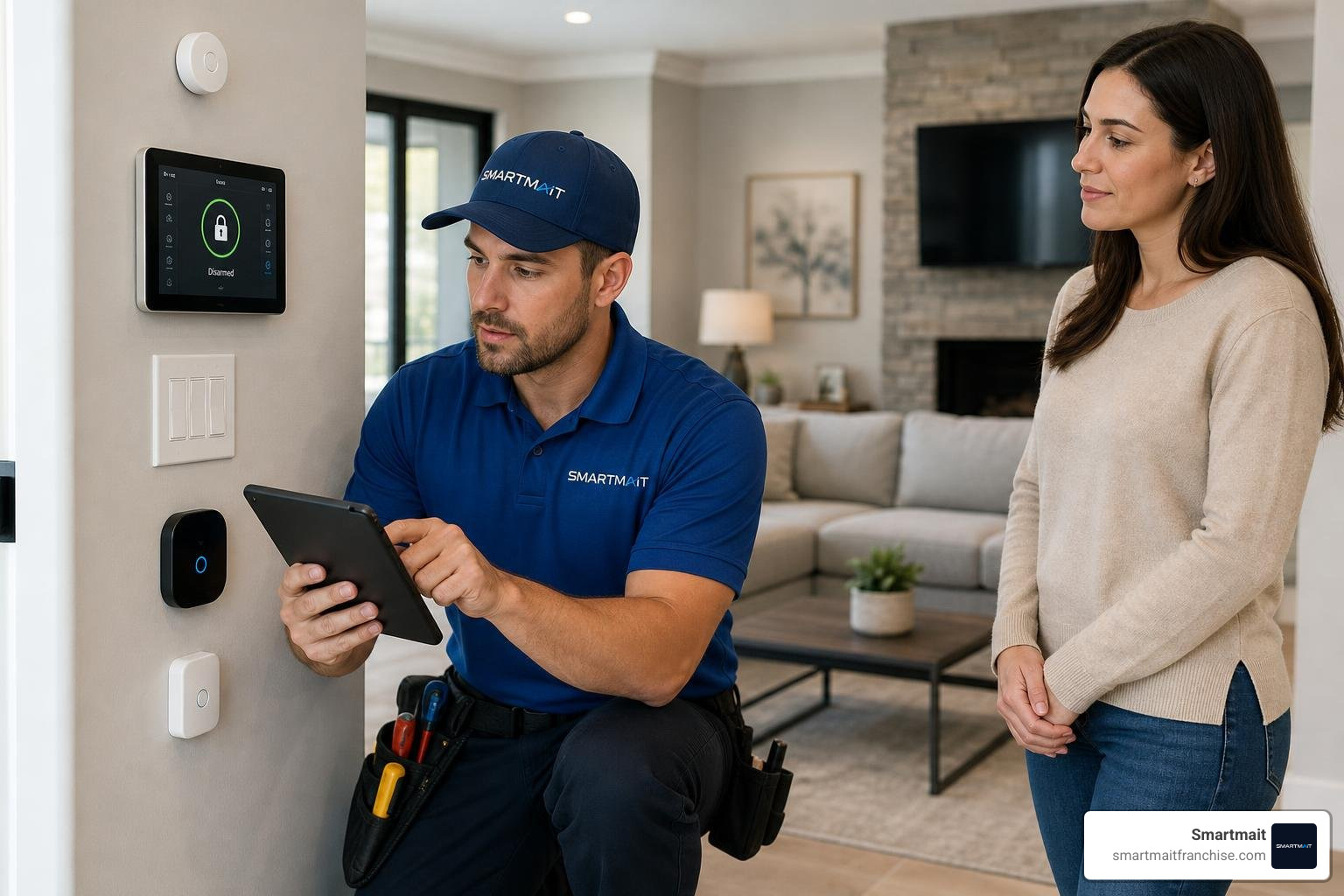
Because more than 87% of active IoT devices across the broader market are vulnerable due to missed patches and outdated firmware, professional oversight is essential. Integration businesses must lead with strict digital hygiene practices to safeguard client networks against unauthorized access and cyber threats.
Building Responsible Security and Privacy Practices
Franchise systems establish standardized security protocols that every field technician and staff member must follow:
- Credential Management: Ensuring default manufacturer passwords are changed immediately during onboarding, using unique, complex passphrases for all local network components.
- Network Segmentation: Configuring dedicated local virtual local area networks (VLANs) or isolated guest networks for connected hardware, keeping automation traffic separate from client computers and personal devices.
- Firmware Maintenance Workflows: Implementing regular patch management routines through proactive service visits to address known software vulnerabilities.
- Access Control Administration: Instructing clients on multi-factor authentication (MFA) setup and ensuring staff follow strict protocols regarding administrative access.
- Staff Privacy Training: Training field personnel on respectful on-site conduct, confidential handling of household floorplans, and secure management of camera and sensor data.
By adhering to these operational protocols, franchise operators protect their clients’ homes while establishing a reputation for uncompromising service quality.
Frequently Asked Questions About Residential Home Automation Franchising
What should I review when evaluating a home automation franchise?
Prospective franchise owners should review the full Franchise Disclosure Document (FDD), the scope of technical and business training provided, the software tools used to manage operations, territory market demographics, and the franchisor’s processes for supporting recurring service memberships.
Can an existing integration or home-service business convert to a franchise model?
Yes. Established low-voltage integrators, audiovisual technicians, electricians, and home-service contractors frequently convert their existing companies into franchise operations to implement proven business operating systems, access structured technician training tracks, and transition transactional revenue into recurring service models.
How can recurring service memberships support a franchise business?
Recurring service agreements provide scheduled preventative maintenance, remote network diagnostics, regular firmware updates, and preferred support response times for homeowners. This approach supports predictable operational planning, improves field technician scheduling, and strengthens client retention over the life of the system.
Conclusion
The residential automation and connected-building sector continues to expand across the United States, driven by homeowner demand for reliable comfort, intuitive control, and comprehensive property protection. Success in this industry relies on moving past isolated gadget installations and delivering unified system integration backed by ongoing, reliable service.
Smartmait offers franchise territories across the U.S. smart-building and low-voltage integration market. Our business model combines professional installation with ongoing maintenance memberships, providing franchise partners with structured operating systems, technical training paths, and comprehensive operational support.
If you are an entrepreneur exploring business ownership or an established integrator looking to scale beyond owner-dependence, explore available territories and review our brand systems.
Request Smartmait franchise information today to speak with our franchise development team and take the next step in evaluating your market opportunity.