
Why Smart Home Performance Monitoring Matters
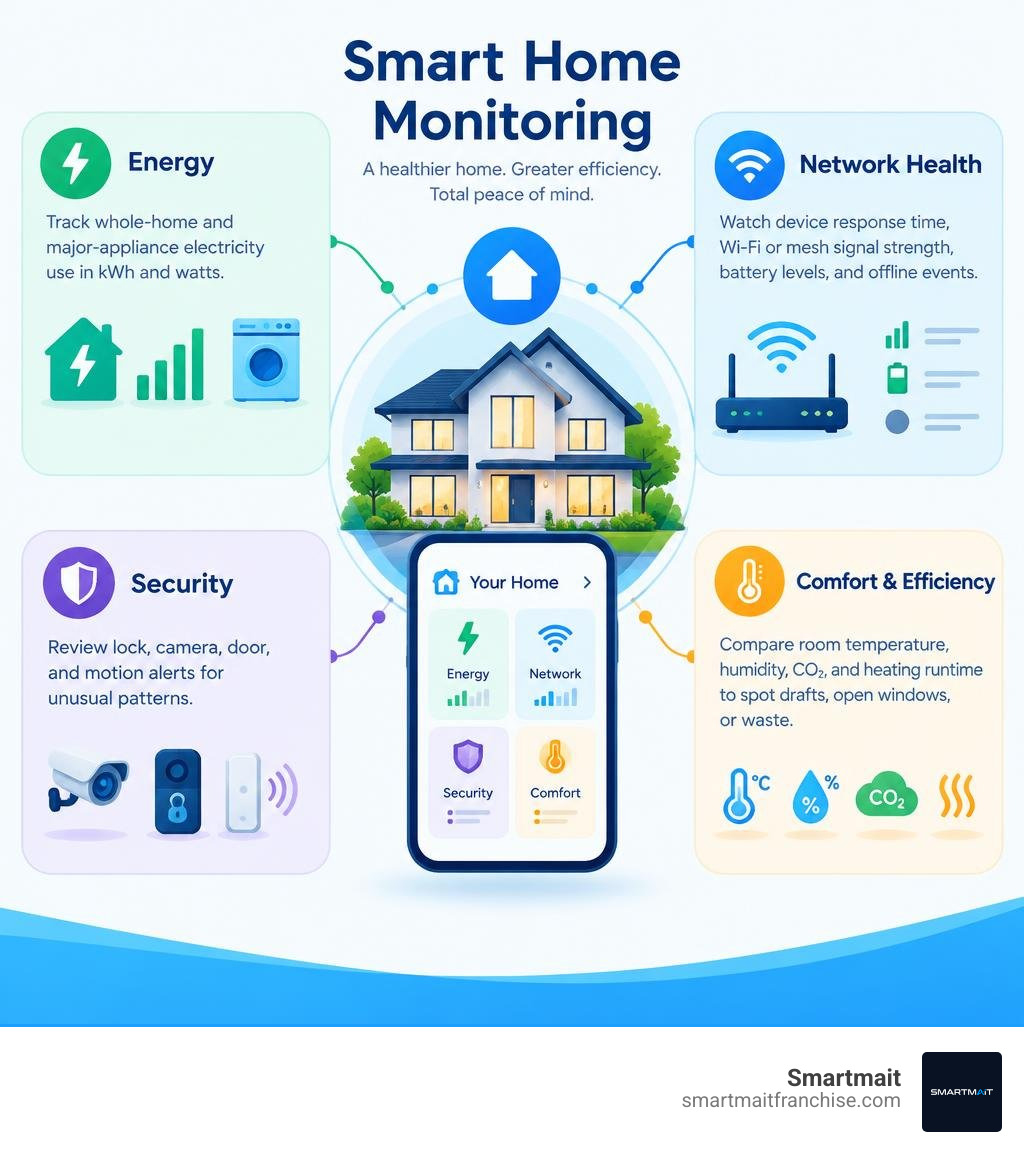
Smart home performance monitoring helps you track whether your system is saving energy, responding quickly, staying connected, and protecting your property. Start by putting the most useful data in one dashboard:
- Energy use: Track whole-home and major-appliance electricity use in kWh and watts.
- System health: Watch device response time, Wi-Fi or mesh signal strength, battery levels, and offline events.
- Security activity: Review lock, camera, door, and motion alerts for unusual patterns.
- Comfort and efficiency: Compare room temperature, humidity, CO2, and heating runtime to spot drafts, open windows, or waste.
A smart home should do more than turn lights on from an app. It should reveal problems before they become expensive frustrations: a weak network signal, an appliance drawing abnormal power, a lock with a low battery, or a room losing heat faster than the rest of the home.
The best monitoring systems combine local sensors, reliable networking, and clear alerts. That gives you a practical view of your home’s health without forcing you to check dozens of separate apps.
I am Dominic Hesano, a home and business automation professional building SmartMait around connected systems, security, networking, lighting, and ongoing technology support. My work in smart home performance monitoring focuses on helping owners turn complex device data into reliable, useful action.
Simple smart home performance monitoring glossary:
Core Metrics and Benchmarks in Smart Home Performance Monitoring
Tracking a smart home requires balancing physical comfort, electrical efficiency, and digital reliability. Instead of looking at vanity numbers like how many times an automation runs, we focus on measurable telemetry that impacts operational costs and system longevity.
| Performance Metric | Ideal Benchmark | Collection Frequency | Primary Diagnostics Role |
|---|---|---|---|
| K-Coefficient (Thermal Loss) | Lower is better (Room-dependent) | 7-day rolling average | Identifies insulation degradation and draft points |
| Appliance Power Draw | Baseline ±10% rated wattage | Real-time (1 Hz to 10s) | Detects mechanical wear and motor failure |
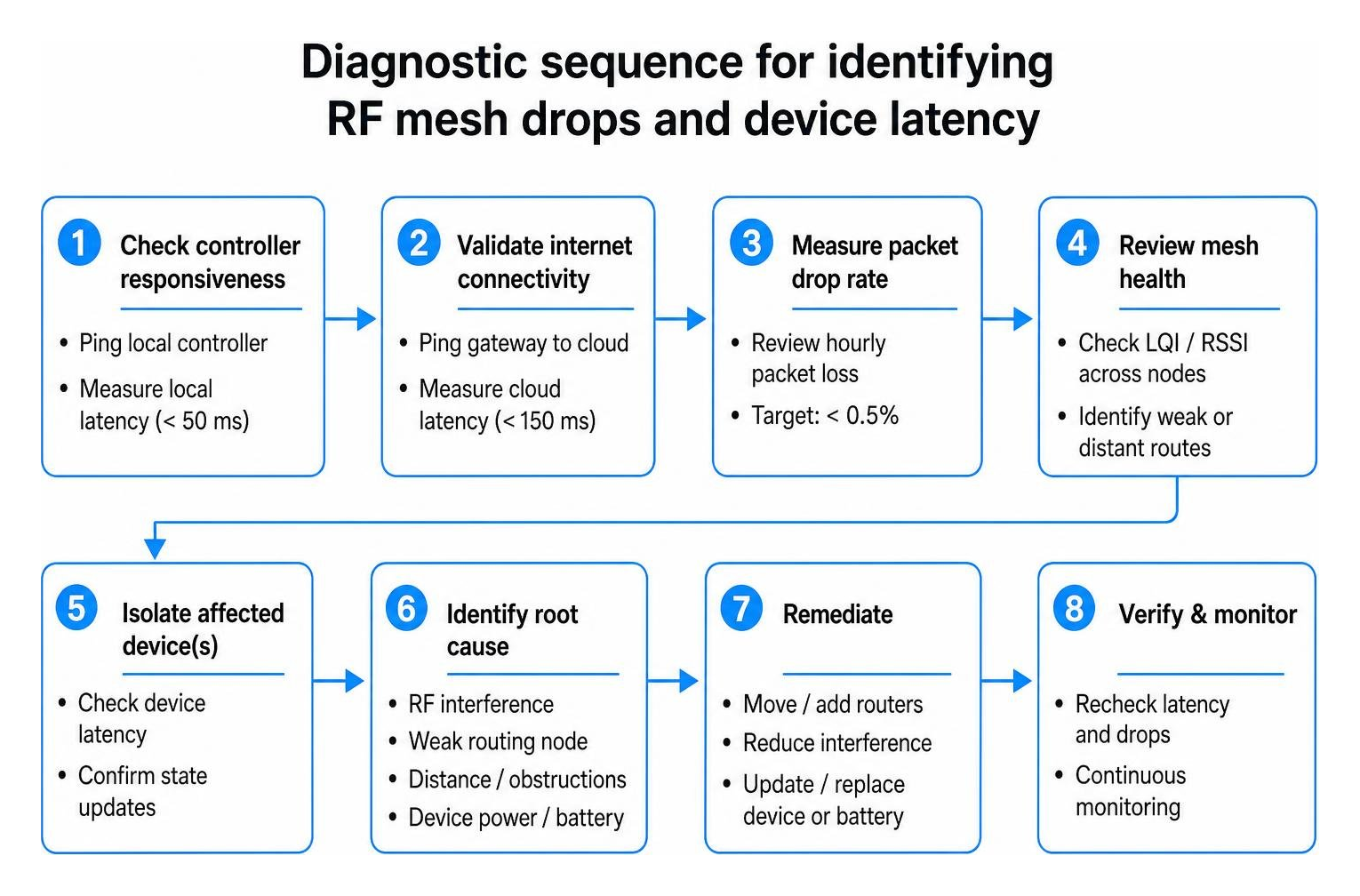
| Network Latency | < 50 ms (Local), < 150 ms (Cloud) | Continuous polling | Pinpoints RF interference and weak routing nodes |
| Packet Drop Rate | < 0.5% | Hourly summary | Highlights mesh instability across Zigbee/Z-Wave/Thread |
| Battery Discharge Rate | Predictable linear curve | Daily polling | Prevents sudden peripheral lockouts |
| CO2 / VOC Levels | < 800 ppm CO2, < 250 ppb VOC | 1-minute intervals | Guides occupancy-driven ventilation cycles |
Thermal Loss and Empirical Insulation Tracking
Traditional building assessments rely on theoretical Energy Performance Certificate (EPC) calculations derived from architectural blueprints and static material ratings (U-values). However, real-world construction often hides air infiltration, thermal bridging, and degraded wall insulation. Empirical thermal monitoring bridges this gap.
Using empirical thermal calculation frameworks, we calculate the actual heat loss coefficient ($K$) in Watts per degree Celsius ($text{W}/^circtext{C}$):
$$K = frac{text{Energy Supplied (Wh)}}{Delta T times text{Duration (Hours)}}$$
Where $Delta T$ represents the real-time difference between indoor and outdoor temperatures. A room maintaining temperature with minimal active heating earns an optimal insulation rating, while a spiking $K$-coefficient reveals active thermal loss.
When you configure home automation basics inside a local automation ecosystem, multi-zone temperature analysis automatically flags anomalies. If a window is left cracked during winter, a steep drop in temperature paired with a heating spike triggers an immediate notification, preventing wasted energy. Maintaining a continuous 7-day rolling average smooths out temporary environmental spikes from human activity or cooking, giving homeowners an undeniable baseline of structural efficiency.
Device Latency, Reliability, and Network Uptime
Smart devices cannot protect or automate a home if their wireless control path drops. High telemetry latency causes lag when turning on lights, while packet loss causes automations to miss state changes entirely.
To maintain high availability:
- Zigbee and Z-Wave Telemetry: We track Link Quality Indicator (LQI) and Received Signal Strength Indicator (RSSI) across all routing nodes.
- Mesh Topology Monitoring: Dynamic routing maps pinpoint battery-powered endpoints routing through weak, distant repeating plugs rather than adjacent hardwired switches.
- Network Uptime Diagnostics: Knowing how to troubleshoot smart home issues starts with isolating local controller responsiveness from broad ISP outages.
Hardware and Infrastructure: From Micro-Modules to Cloud Storage
Deploying an enterprise-grade monitoring system requires robust embedded silicon at the edge and high-throughput data processing in the back end.
Hardware Architecture for Smart Home Performance Monitoring
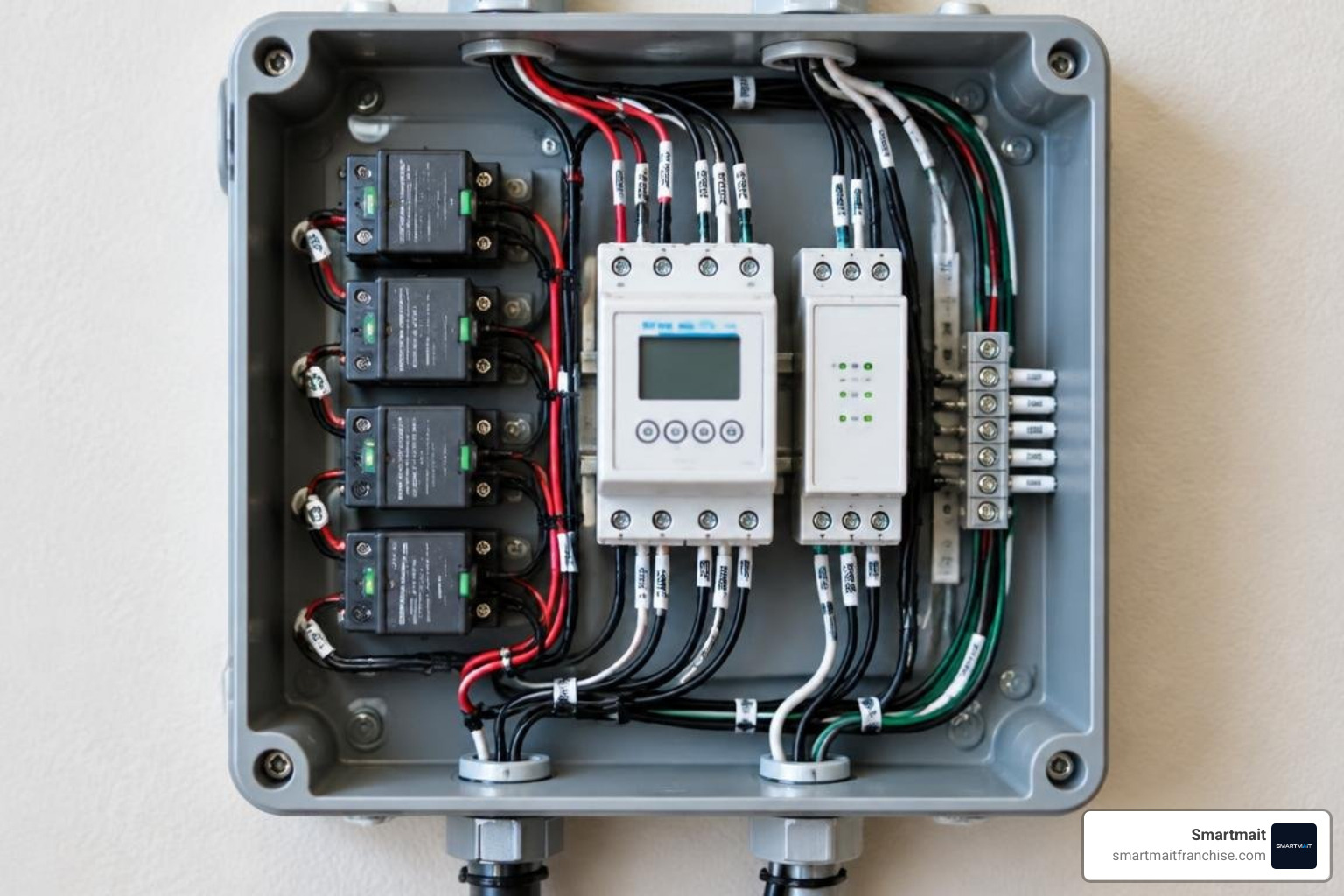
Modern energy monitoring relies on ultra-compact micro-modules installed directly behind switches or inside breaker panels. Compact inline power meters measure up to 16A or 8A loads within tiny enclosures, delivering sub-watt precision over local Wi-Fi without proprietary hubs. These devices double as Bluetooth Low Energy (BLE) range extenders, bridging peripheral sensors throughout the building.
At the silicon level, industrial hardware pioneers develop advanced wireless communication modules, Wi-Fi 6 hardware, and System-in-Package (SiP) IoT solutions that handle heavy edge computation without overheating. Their automotive and industrial engineering breakthroughs—such as embedding silicon carbide (SiC) dies into multilayer ABF substrates and adopting Single-Side Copper Exposed (SSC) module packaging—deliver exceptional thermal management and power density. These hardware advancements ensure sub-metering nodes run continuously for decades inside harsh electrical enclosures. Applying these enterprise hardware principles directly supports comprehensive smart home power management across high-draw residential circuits.
Edge Processing vs Enterprise Cloud Storage
Handling millions of continuous telemetry data points across temperature, power, and security sensors presents a clear architectural choice: local edge execution versus scalable cloud retention.
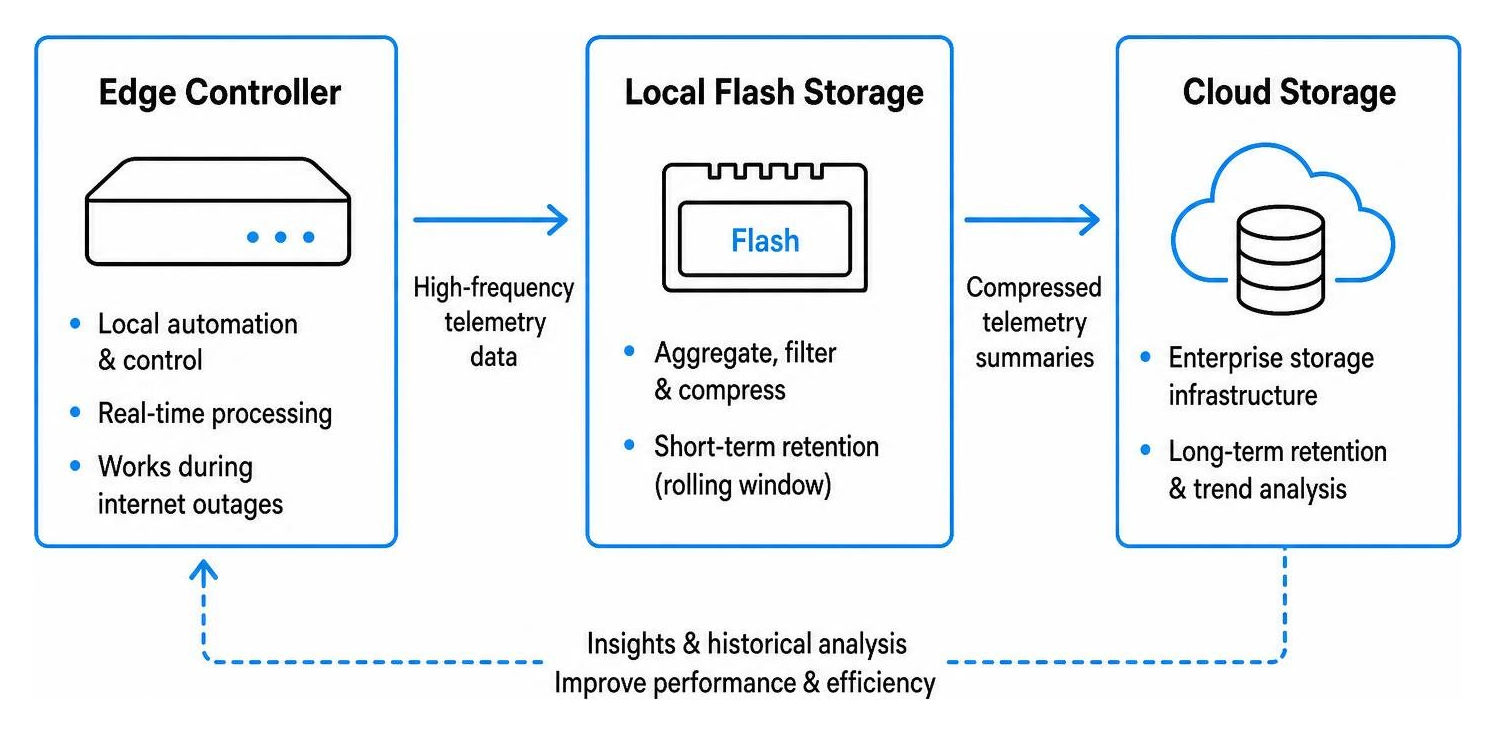
- Edge-First Controllers: Central automation engines—such as dedicated local servers or a home energy management system—process mission-critical automation routines locally. This guarantees that lighting, security trips, and peak load shedding execute instantly even during complete internet outages.
- Local Telemetry Aggregation: High-frequency electrical metrics (e.g., 1 Hz voltage harmonics) are filtered and compressed locally on solid-state storage.
- Enterprise Long-Term Retention: Compressed summaries migrate to enterprise-grade server infrastructure utilizing SAS, SATA enterprise arrays, 10Gb Ethernet backbones, and optical transceivers. This high-throughput storage tier allows multi-year trend analysis, letting us compare seasonal heating performance, verify post-renovation efficiency gains, and build historical health baselines without slowing local smart home hubs.
Integrating Access Control, Occupancy Dynamics, and Predictive HVAC
Optimizing energy usage requires understanding exactly how and when a home is occupied. Integrating precision access hardware with indoor environmental telemetry transforms static heating schedules into dynamic, occupancy-aware systems.

Security Hardware and Access Telemetry
Access hardware serves as the first trigger for occupancy-based automations. Precision-engineered smart deadbolts integrate discreet, high-torque gearboxes directly inside the door borehole while maintaining strict ANSI/BHMA AAA security ratings.
Beyond digital keys and mobile access credentials, lock telemetry delivers critical operational data:
- Lock Activity Timestamps: Distinguishes between manual interior turns and external authenticated entries to instantly arm or disarm HVAC zones.
- Battery Voltage Depletion: Continuous telemetry monitoring ensures batteries are replaced long before physical motor stalls occur.
- Automated Setbacks: Locking the deadbolt from the exterior when all household members depart instantly shifts thermostats into eco-mode, aligns battery storage optimization priorities, and closes motorized shading.
Occupant Behavior and Wearable Sensor Integration
Static scheduling often fails because human routines change daily. Integrating wearable solutions and connected devices allows homes to anticipate occupant needs.
Coupling wearable presence detection with real-time indoor air quality sensors unlocks advanced HVAC optimization. Research into occupancy dynamics demonstrates that tracking fluctuating carbon dioxide ($text{CO}_2$) spikes provides a direct proxy for room population density. Instead of running ventilation fans on rigid timers, predictive algorithms evaluate $text{CO}_2$ accumulation curves alongside wearable location telemetry. The system dynamically boosts fresh air circulation to occupied living spaces while throttling airflow in empty rooms, maintaining pristine indoor air quality while reducing compressor runtime.
Predictive Diagnostics and Sustainability Frameworks
Modern performance monitoring shifts homeowners from reactive repairs to predictive maintenance. By catching subtle equipment degradation early, we prevent costly emergency replacements and lower whole-home environmental impact.
Advanced Diagnostics and Smart Home Performance Monitoring Protocols
Electrical motors, compressors, and pumps rarely fail without warning; they signal distress through acoustic changes and electrical current fluctuations weeks prior to breakdown.
- Acoustic and Vibration Analysis: High-frequency audio and vibration sensors placed on heat pump compressors or furnace blowers identify worn bearings before mechanical seizure occurs.
- Current Signature Diagnostics: Inline power meters continuously track startup current spikes (inrush amps). A capacitor beginning to degrade draws extended inrush current, triggering an automated diagnostic ticket.
- Proactive Maintenance Execution: Implementing predictive maintenance technology protects major HVAC investments, ensuring systems operate at peak efficiency throughout their operational lifespan. When hardware reaches end-of-life, telemetry provides clear historical data to guide smart planning for smart home system upgrades.
Data Privacy and Multi-Device Aggregation Security
Collecting thousands of environmental, presence, and power data points introduces real privacy risks. A comprehensive monitoring system must be secure by design:
- Local-First Communication: Device communication should remain isolated on dedicated IoT Virtual LANs (VLANs) utilizing local APIs (MQTT, Matter, or local HTTP) rather than routing telemetry through unvetted third-party cloud servers.
- End-to-End Cryptographic Encryption: All inter-device telemetry—from BLE gateways to central controllers—must employ TLS 1.3 encryption and secure key management.
- Data Anonymization: Historical power and presence datasets exported for long-term predictive modeling should be stripped of personally identifiable metadata.
- Firmware Integrity: Automated tracking monitors device firmware versions, isolating unpatched hardware to protect local networks against known IoT vulnerabilities.
Aligning residential energy management with globally recognized sustainability metrics allows owners to monitor verified carbon reductions. Emulating enterprise ESG performance—such as earning top 5% placement in the S&P Global Corporate Sustainability Assessment and top distinction in the S&P Global Sustainability Yearbook—proves that rigorous, data-driven optimization drives measurable environmental stewardship.
Frequently Asked Questions About Smart Home Health
How does empirical thermal monitoring differ from theoretical EPC ratings?
Theoretical EPC ratings calculate expected heat loss based on standard building material tables, assuming flawless construction and perfect insulation fitting. Empirical thermal monitoring uses live sensor telemetry (indoor temperature, outdoor temperature, and exact heater wattage) to calculate the actual $K$-coefficient ($text{W}/^circtext{C}$). This real-world measurement captures hidden thermal bridges, leaking window gaskets, and draft points that theoretical lab ratings miss completely.
What communication modules are required for real-time telemetry?
High-speed, low-latency telemetry relies on dedicated Wi-Fi 6 modules, dual-mode Bluetooth Low Energy (BLE) gateways, and low-power sub-GHz transceivers. For high-density sensor networks, using industrial-grade IoT communication chips ensures zero packet drop, real-time power metering updates, and seamless bridging across disparate communication protocols.
Can smart home monitoring operate during an internet outage?
Yes, provided the system is built on a local-first control architecture. Edge controllers like local automation servers process sensor inputs, execute schedules, track thermal loss, and balance high-load appliances entirely over the local area network. When the internet goes down, real-time control continues uninterrupted, and long-term historical data caches locally until cloud connectivity is restored.
Conclusion
A high-performing smart home should run quietly, efficiently, and reliably in the background. By tracking empirical insulation ratings, sub-metering critical circuits, securing access points, and watching for early mechanical wear, smart home performance monitoring transforms home automation from simple convenience into long-term infrastructure health.
At Smartmait, we believe intelligent systems require continuous care. We combine expert installation with proactive maintenance and diagnostic monitoring to keep your connected home running smoothly year after year. Explore our professional smart home optimization services to build a resilient, efficient, and truly intelligent living space.