

Choose a Smart Electric Gate Opener That Fits Your Gate and Network
The right smart electric gate opener matches your gate’s movement, weight, length, power source, and connection range. Start by confirming whether your gate swings or slides, measure each gate leaf, check that it moves freely by hand, and choose an opener rated above its actual weight. Then plan safe controls: photo-eye sensors, obstacle reversal, manual release, and reliable app or remote access.
A smart system can make daily access simpler without making it complicated:
- Open and close the gate from an app, remote, keypad, or approved voice assistant.
- Give time-limited access to family, staff, guests, or delivery teams.
- Schedule opening and closing times and receive alerts when the gate is left open.
- Use battery backup or solar power where wiring is difficult or grid power is unreliable.
The best setup is not always the most feature-packed one. A heavy solid gate needs more motor capacity than a light tubular gate, and a gate far from the house may need an outdoor Wi-Fi access point, a wired connection, or mesh repeaters before remote control will be dependable. This guide walks through those choices, from sizing and power to safety, installation, and long-term care.
I am Dominic Hesano, a home and business automation professional building Smartmait around practical connected technology, networking, security, and ongoing support. My experience with smart electric gate opener planning and connected-property systems helps turn a frustrating access point into a reliable part of everyday security and convenience.
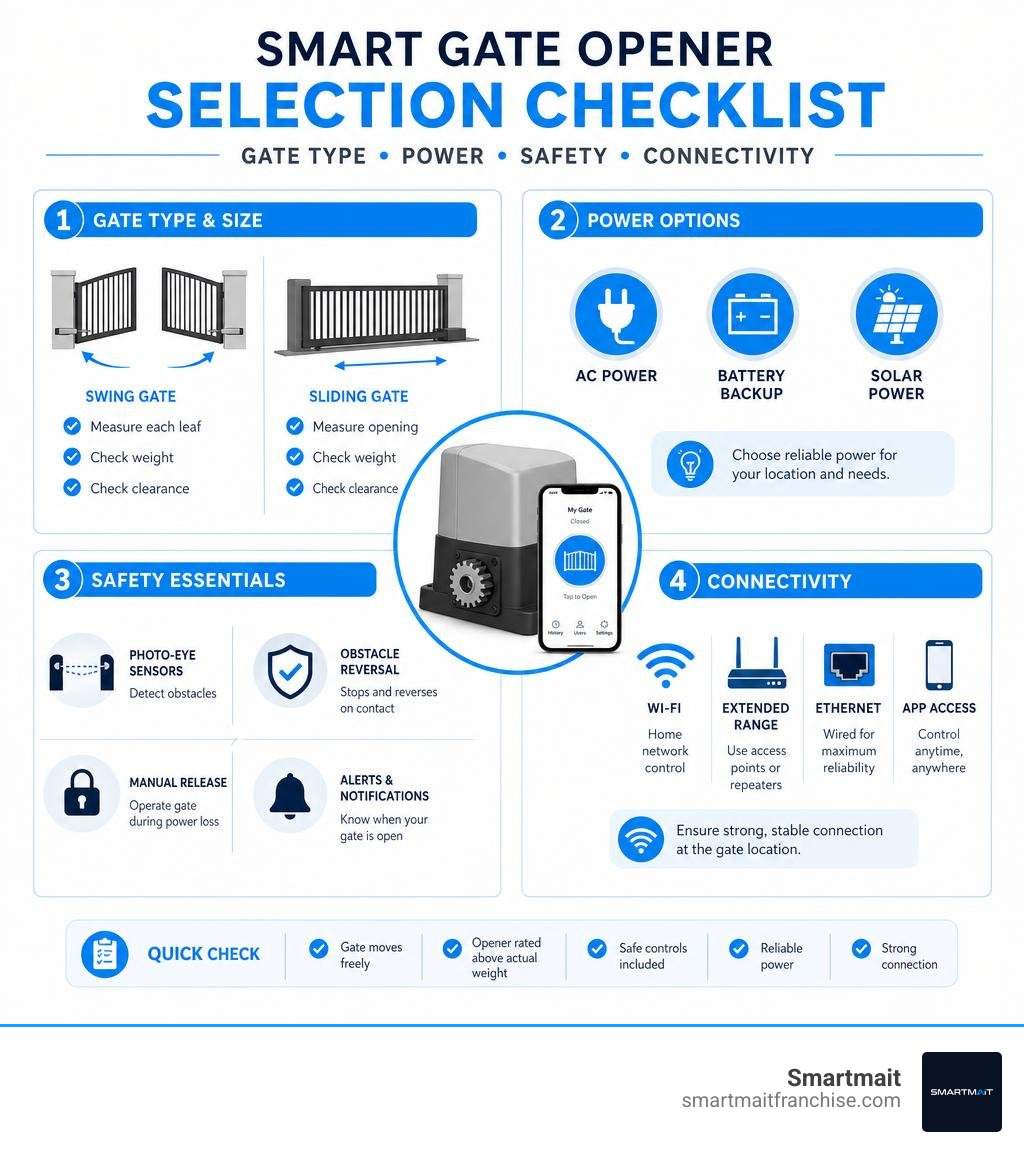
Simple guide to smart electric gate opener terms:
How to Choose the Right Smart Electric Gate Opener for Your Property
Selecting the best automated system begins with understanding the physical properties of your entryway. A mismatch between motor capacity and gate mechanics leads to premature hardware failure, slow operation, or erratic error codes. When matching hardware, consider the gate’s mechanical style, duty cycle, weight per leaf, and structural resistance.
| Gate System Type | Typical Leaf Length | Max Weight Capacity | Primary Drive Mechanism | Recommended Application |
|---|---|---|---|---|
| Single Swing (Light/Medium) | Up to 12–16 ft | 300–550 lbs | Linear Actuator Arm | Residential suburban driveways, light tubular ranch gates |
| Single Swing (Heavy Duty) | Up to 18 ft | 660–880 lbs | Heavy Linear Actuator | Solid wood, ornamental iron, or high-wind entryways |
| Dual Swing (Medium Duty) | Up to 18 ft per leaf | 660 lbs per leaf | Dual Linear Actuators | Wider residential entryways using medium-duty dual swing smart gate systems |
| Dual Swing (Heavy Duty) | Up to 18 ft per leaf | 880 lbs per leaf | Heavy Dual Actuators | Large commercial courtyards, ornamental double gates |
| Sliding Gate (Residential/Commercial) | 20–40 ft continuous | 1,000–2,000+ lbs | Rack-and-Pinion / Chain Drive | Steeply sloped driveways, tight clearance entryways |
Swing vs. Sliding Gate Mechanics
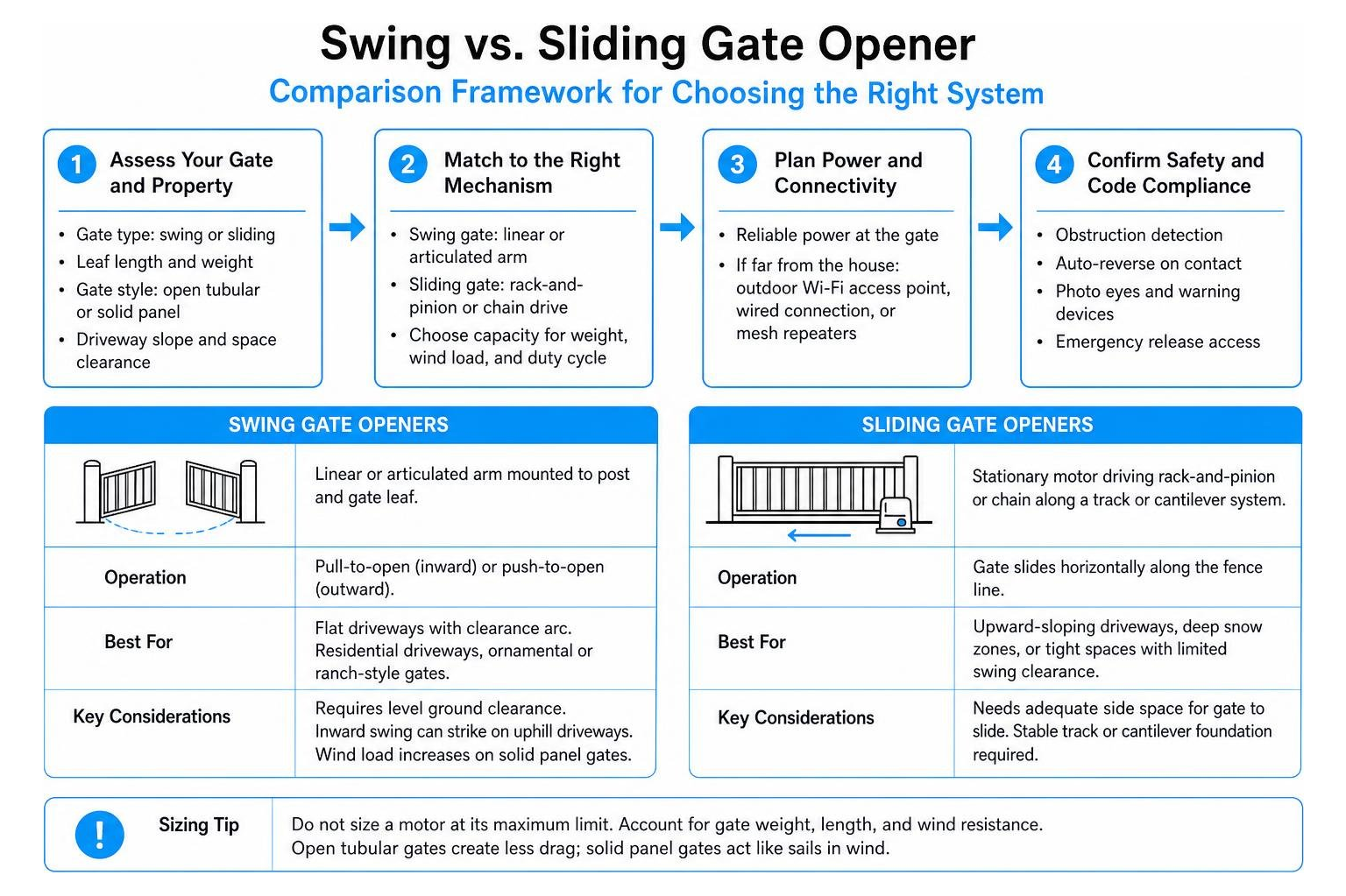
The choice between a swing and a sliding gate operator primarily depends on your property’s topography and available clearance:
- Swing Gate Openers: Utilize linear actuator arms or articulated arms mounted to the post and gate leaf. A pull-to-open configuration swings the gate inward toward the property, while a push-to-open bracket pivots the gate outward toward the street. Swing setups require a flat driveway clearance arc. If your driveway slopes upward toward your garage, an inward-swinging gate will strike the ground during its travel.
- Sliding Gate Openers: Utilize a stationary motor driving a continuous roller chain or rack-and-pinion track along a ground rail or cantilever system. Sliding systems are ideal for uphill driveways, deep snow zones, or tight courtyards where vehicles stop directly behind the entry line.
Weight, Length, and Wind Resistance Sizing
A gate opener motor should never operate at its absolute maximum theoretical threshold. Motor life expectancy depends heavily on managing static weight alongside dynamic wind load:
- Open Tubular vs. Solid Panel Gates: Open 5-bar tube gates allow wind to pass freely, creating minimal drag. In contrast, solid privacy gates or heavy tongue-and-groove wooden structures act like giant sails. A 40 mph crosswind against a solid 16-foot panel can double the effective force required to push or hold the gate open.
- The Weight vs. Length Trade-off: As a gate leaf gets longer, leverage decreases the motor’s effective capacity. An actuator rated for 880 lbs might support that weight on an 8-foot leaf, but its real-world safe rating drops to roughly 400–500 lbs on an extended 18-foot leaf.
- Motor Wattage & Duty Cycle: Standard residential 24V DC motors typically pull between 50W and 80W per arm. Sizing up to an 80W motor ensures continuous operation during gusty weather without triggering false obstruction alarms.
Power Options: AC Hardwire, Battery Backup, and Solar Kits
Automated gates operate under one of four primary electrical models: pure AC power, AC power with 12V/24V deep-cycle battery backup, standalone solar charging, or a hybrid configuration.

For properties with trenching access, running 110V/220V AC wiring directly to the control box provides consistent power for fast opening speeds and high-draw accessories like loop detectors. However, power outages can strand vehicles inside or outside the property unless an internal battery is present.
Deploying commercial-grade units certified to ETL Listed single swing gate operator standards ensures reliable dual-source switching. When managing power feeds across expansive landscapes, incorporating smart home power management for energy savings helps monitor overall energy draw and optimize backup reserves.
Sizing Solar Panels and Deep-Cycle Batteries
Solar setups eliminate the thousands of dollars required to trench conduit down long rural driveways. A well-designed solar configuration relies on balanced sizing:
- Solar Panel Wattage: Standard kits include between 10W and 60W of monocrystalline solar panels. A 10W panel is sufficient for 5–10 daily cycles under direct sun, while a 30W–60W solar array sustains dual-leaf gates running 25+ cycles daily even during cloudy winter months.
- Battery Chemistry and Lifespan: Sealed lead-acid (SLA) or AGM deep-cycle 24V batteries typically last 3 to 5 years under routine maintenance. Cleaning terminals and verifying solar charge controller voltage outputs annually prevents battery degradation.
- Low Standby Power Draw: Modern Wi-Fi and Bluetooth controllers run efficiently; premium controllers consume as little as 0.4 Watts in standard mode and 0.2 Watts in ultra-low power standby mode, preventing excessive battery drain overnight.
Essential Safety Standards and Access Control Features
A motorized gate is a powerful piece of machinery. The motor’s pulling force can cause serious property damage or injury if proper safety systems are not installed and calibrated.
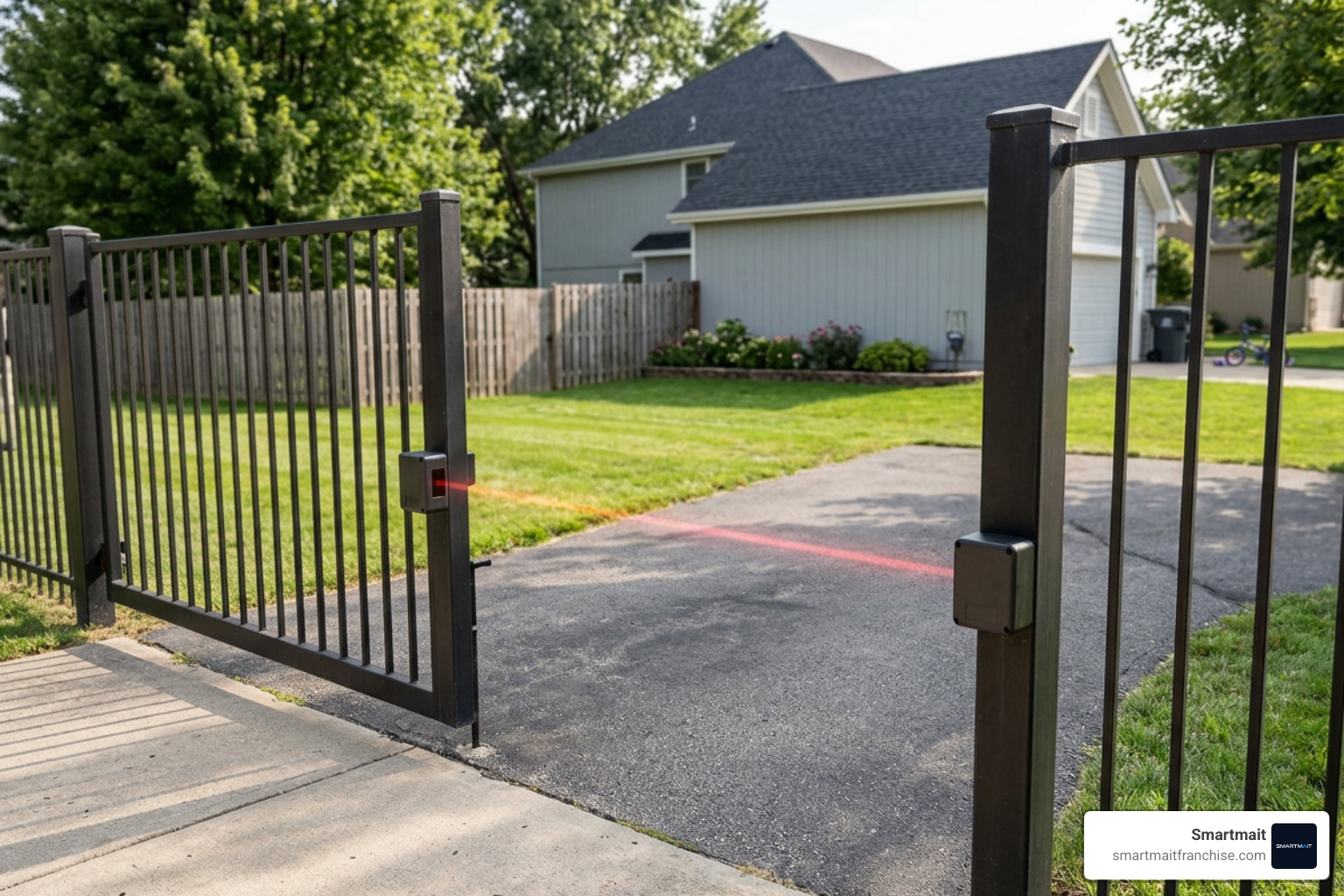
Every automated gate installation should meet rigorous UL 325 safety standards. This framework requires primary and secondary entrapment prevention devices to protect pedestrians, pets, and vehicles. When tying external access points into your main residence, following proven strategies for home security system integration ensures your perimeter, cameras, and gate sensors operate as a unified defense network.
Safety Sensors and Anti-Entrapment Mechanisms
- Photo-Eye Infrared Sensors: Mounted 12 to 24 inches above the driveway grade on both sides of the gate posts. If a vehicle, pet, or child breaks the invisible infrared beam while the gate is closing, the control board immediately halts motion and reverses travel back to the fully open position.
- Inherent Obstruction Detection: Modern DC motors monitor electrical amperage. If an arm meets resistance (such as a forgotten trash bin or snowdrift), the sudden current spike prompts an automatic stop and reverse cycle.
- Electromagnetic Limit Switches: Physical or magnetic limit switches establish the precise open and closed travel boundaries, preventing mechanical strain on the hinges and motor arms.
- Rolling-Code Radio Remotes: To prevent wireless code-grabbing attacks, modern remote controls use 433.92 MHz rolling-code encryption, generating an entirely new digital handshake key every time the transmitter button is pressed.
- Manual Emergency Release: Every actuator features a keyed release pin or mechanical clutch. If the electrical system completely loses power, turning the physical emergency key frees the arm, allowing the gate to swing open by hand.
Smart Home Integration and Long-Distance Connectivity Solutions
Transitioning from a basic RF remote to an IoT-enabled smart gate introduces powerful management capabilities. Smart controllers interface with your home network via Wi-Fi, Bluetooth, Zigbee, or Z-Wave, translating mobile app commands into relay pulses that trigger the gate board.
A comprehensive smart controller upgrades basic driveways into intelligent entry points:
- Granular Access Control: Create time-bound digital guest passes via temporary web links or QR codes, granting access to landscapers, house cleaners, or delivery drivers only on designated days and hours.
- 7-Day Activity Logging: Monitor real-time entry and exit timestamps with bank-grade 256-bit encryption, reviewing who opened the gate and through which specific trigger (remote, keypad, or app).
- Push Notifications: Receive instant smartphone alerts whenever the gate is triggered or if it remains open past a designated duration threshold (e.g., open for longer than 3 minutes).
Selecting the correct wireless transmission architecture is critical to avoid offline drops. For an in-depth breakdown of networking protocols, review our guide to choosing a smart home connectivity solution.
Integrating Voice Control and Automation Ecosystems
Smart controllers seamlessly tie into platforms like Amazon Alexa, Google Assistant, Apple HomeKit/Siri Shortcuts, and Hubitat.
By grouping connected exterior lighting, motorized entryways, and voice commands, homeowners can issue hands-free voice routines directly from their vehicle’s dashboard. You can easily trigger perimeter paths using smart home voice commands like, “Alexa, open the main driveway gate.” For added security, voice opening commands can be configured to require a spoken 4-digit security PIN to prevent unauthorized opening from outdoor smart speakers.
Solving Long-Distance Wireless Range to the Gate
The most common issue with smart gate openers is wireless signal drop. Driveway gates are often located 100 to 500+ feet away from the home’s indoor router. Because standard indoor 2.4 GHz Wi-Fi degrades rapidly over distance and through exterior masonry walls, long-range installations require dedicated networking hardware:
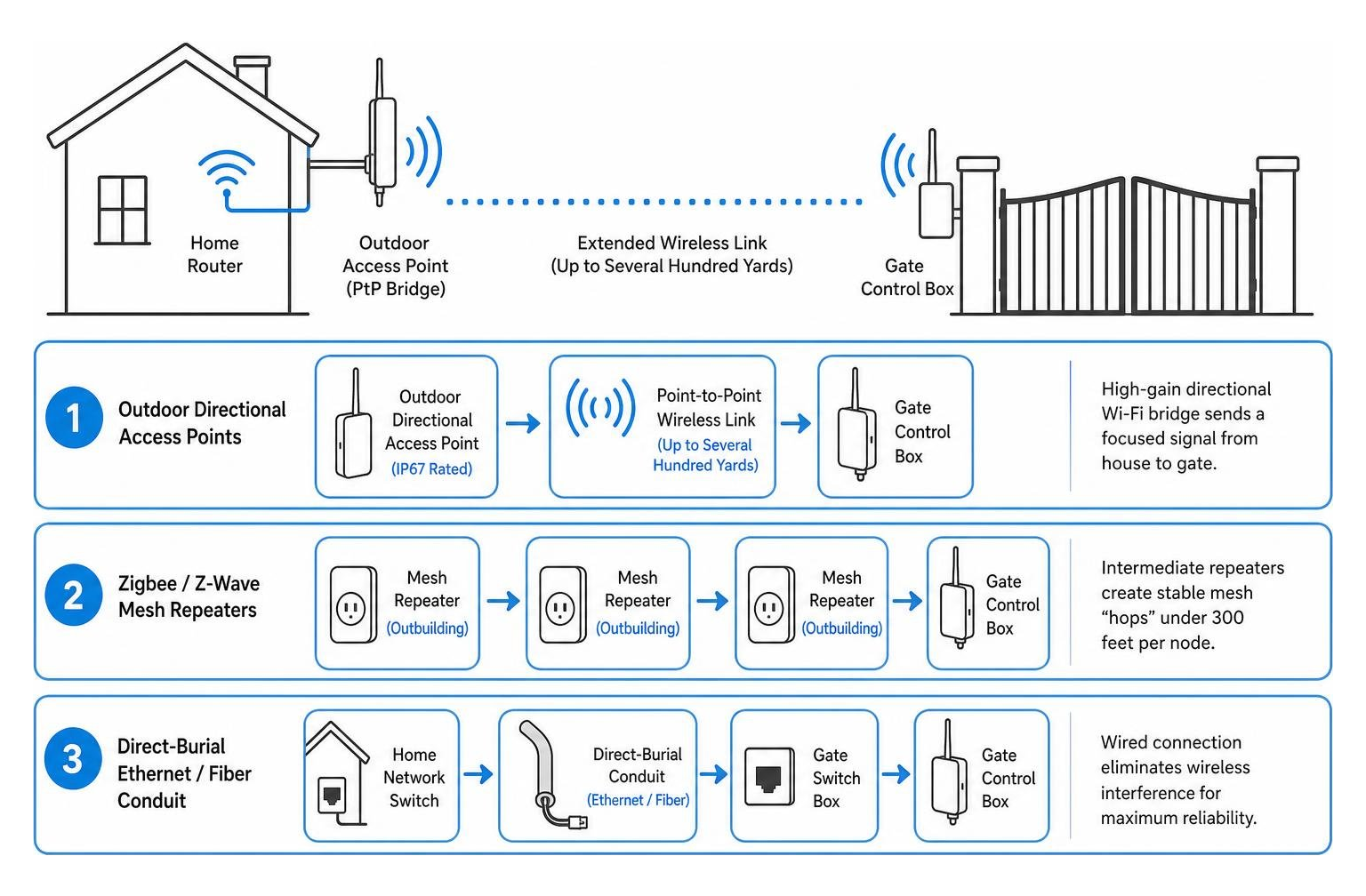
- Outdoor Directional Access Points: Installing an IP67-rated point-to-point (PtP) bridge or high-gain directional Wi-Fi access point on the exterior house eave broadcasts a focused wireless beam directly at the gate’s control box up to several hundred yards away.
- Zigbee / Z-Wave Mesh Repeaters: For smart systems using mesh protocols, placing intermediate mains-powered smart plugs or dedicated outdoor repeaters inside outbuildings (such as a detached garage, barn, or guest house) creates stable intermediate “hops” that bridge gaps under 300 feet per node.
- Direct-Burial Ethernet / Fiber Conduit: For total reliability across estate-scale distances, pulling shielded direct-burial Cat6 or fiber-optic cable through PVC conduit to an exterior gate switch box eliminates wireless interference entirely.
DIY Installation Steps for a Smart Electric Gate Opener
Most dual and single swing gate systems can be installed over a weekend with standard tools (drill, level, socket wrench, wire strippers, and measuring tape).
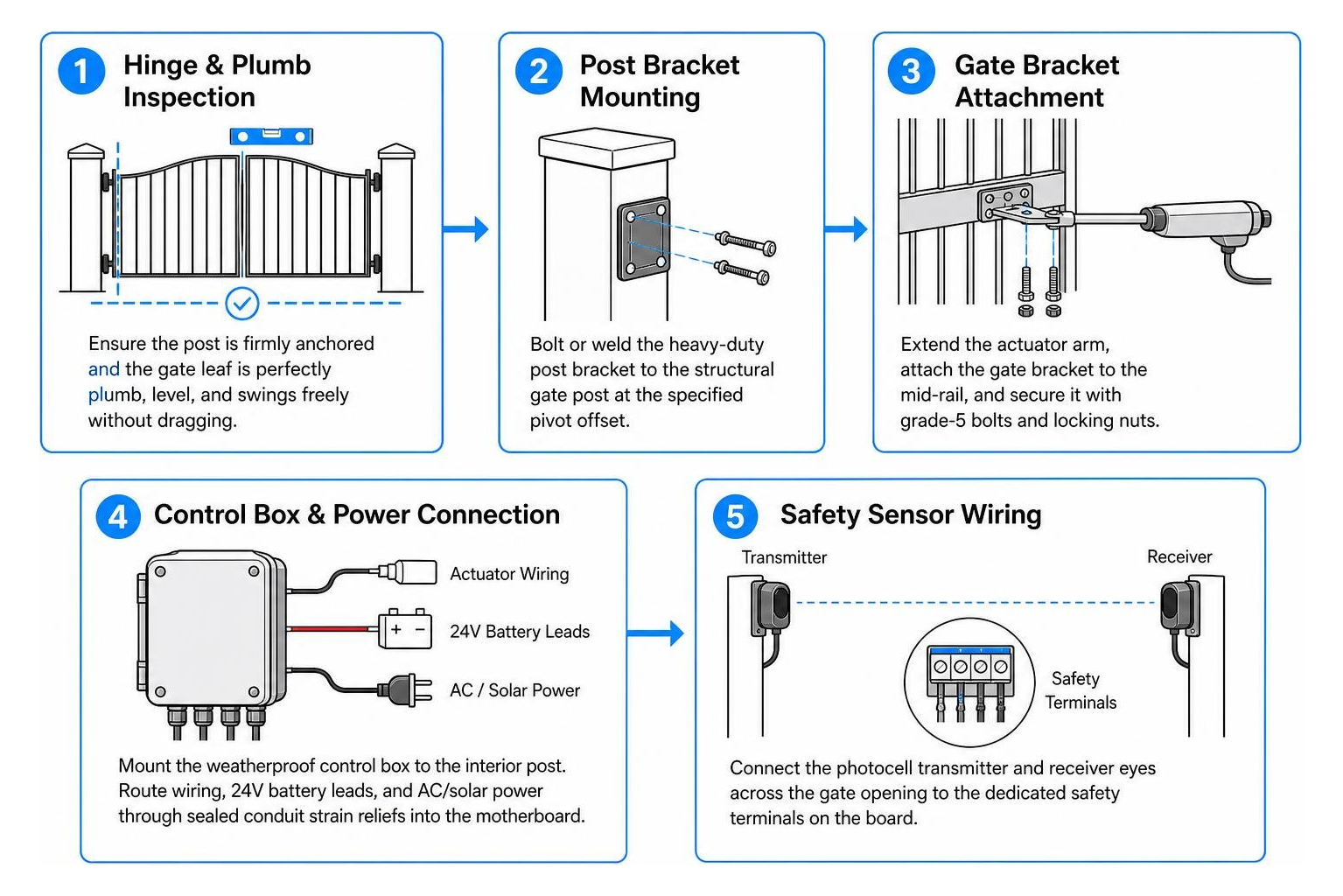
- Hinge & Plumb Inspection: Inspect your existing gate. The post must be firmly anchored in concrete, and the gate leaf must be perfectly plumb, level, and swing freely by hand without dragging along the ground. Never install a gate opener to compensate for a sagging or binding gate hinge.
- Post Bracket Mounting: Bolt or weld the heavy-duty post bracket to the structural gate post at the manufacturer’s specified pivot offset geometry.
- Gate Bracket Attachment: Extend the actuator arm fully, attach the gate bracket to the mid-rail of the gate leaf, and secure it with grade-5 mounting bolts and locking nuts.
- Control Box & Power Connection: Mount the weatherproof control box (minimum IP44 rated) to the interior post. Route low-voltage actuator arm wiring, 24V battery leads, and AC/solar power inputs through sealed conduit strain reliefs into the primary motherboard.
- Safety Sensor Wiring: Connect the photocell transmitter and receiver eyes across the gate opening to the dedicated safety terminals on the board.
- Limit Calibration & Obstruction Testing: Power up the system, set the electronic travel limits, and perform the UL 325 contact test: place an object (such as a 2×4 wooden block) in the gate path to verify the motor stops and reverses immediately upon contact.
Maintaining and Troubleshooting Your Smart Electric Gate Opener
Routine maintenance ensures dependable, quiet operation through all seasons:
- Semi-Annual Lubrication: Apply white lithium grease or silicone-based spray to gate hinges, actuator pivot pins, and internal sliding gears. Avoid heavy petroleum oils that attract dust and grit.
- Terminal & Battery Inspections: Open the control box twice a year to check for insect infiltration, clean any corrosion off 12V/24V battery terminals with a wire brush, and confirm solar charge controllers are reading proper float voltages.
- Cold Weather Sensitivity Adjustments: Extreme cold thickens hinge grease and stiffens mechanical tolerances. In sub-zero winter temperatures, slightly increase the board’s obstruction sensitivity to prevent false reversals while maintaining safe stop parameters.
- Firmware & Security Updates: Periodically open your smart gateway mobile app to apply over-the-air (OTA) firmware patches that improve rolling-code security and wireless stability.
Frequently Asked Questions About Smart Gate Systems
Can I automate an existing manual driveway gate?
Yes. As long as your existing manual gate swings or slides smoothly without binding, sagging, or dragging on the driveway, you can bolt on linear actuators or slide-drive hardware without having to replace your structural gate posts.
How far can a smart gate opener connect to home Wi-Fi?
Standard internal smart modules typically reach 50–100 feet in direct line-of-sight conditions. For gates positioned 150 to 500+ feet from the main house, an exterior-mounted directional Wi-Fi access point or hardwired outdoor repeater is required to maintain a stable app connection.
Will my smart gate opener still work during a power outage?
Yes, provided your system is equipped with a functional 12V or 24V deep-cycle battery backup or solar charging array. If the battery backup is completely depleted, all quality systems include a keyed mechanical emergency release mechanism to allow manual entry.
Conclusion
A modern smart electric gate opener provides an exceptional blend of perimeter security, daily convenience, and smart property automation. By carefully matching motor power to your gate’s physical dimensions, implementing essential safety photo-eyes, selecting the ideal power setup, and extending your network coverage, you can build a seamless entry system that serves your property reliably for years.
While DIY kits are accessible for handy homeowners, complex driveway layouts, high-voltage trenching, and estate-wide network integrations often benefit from professional design and ongoing support. At Smartmait, we provide homeowners and property managers with professional tech deployment combined with preventative maintenance solutions. Explore how our team can transform your property’s security and connectivity by learning more about the Smartmait smart home franchise and automation services.